

 1 hour ago
4
1 hour ago
4
ARTICLE AD BOX
The US-led campaign against Iran is evolving into a critical contest of industrial capacity and "magazine depth." While President Trump projects confidence, officials highlight concerns over the rapid depletion of US interceptor missiles versus Iran's cheaper drone and missile production. The war's sustainability hinges on who exhausts their weapon supplies first, with Iran potentially pivoting to drones to sustain pressure.
TL;DR: Driving the newsPresident Donald Trump is projecting confidence as the US-led campaign against Iran enters its sixth day, but officials and analysts increasingly describe the conflict as a contest of industrial capacity and “magazine depth” - the supply of missiles, bombs and interceptors that each side can keep firing before the war’s tempo becomes unsustainable.“We’re doing very well on the war front,” Trump said at the White House, arguing that Iran’s leaders had long threatened Americans and regional allies. Trump also said, "Their missiles are being wiped out rapidly. Their launchers are being wiped out.” The White House has gone further. Press secretary Karoline Leavitt said Iran’s regime had been “absolutely crushed” and that US forces had struck more than 2,000 targets while moving toward “complete and total control of Iranian airspace,” Bloomberg reported.Yet the war’s trajectory may turn not only on what gets destroyed from the air, but on what runs out first on both sides - Iranian missile launchers and stockpiles, or US and allied interceptor missiles and precision weapons. As one senior fellow put it in Bloomberg, the concern is that “we are using these interceptors faster than we can make them,” a warning that points to the most consequential resource constraint in a high-tempo air-and-missile fight.
The United States Munitions Stockpiles have, at the medium and upper medium grade, never been higher or better - As was stated to me today, we have a virtually unlimited supply of these weapons. Wars can be fought “forever,” and very successfully, using just these supplies (which are better than other countries finest arms!). At the highest end, we have a good supply, but are not where we want to be. Much additional high grade weaponry is stored for us in outlying countries. Sleepy Joe Biden spent all of his time, and our Country’s money, GIVING everything to P.T. Barnum (Zelenskyy!) of Ukraine - Hundreds of Billions of Dollars worth - And, while he gave so much of the super high end away (FREE!), he didn’t bother to replace it. Fortunately, I rebuilt the military in my first term, and continue to do so. The United States is stocked, and ready to WIN, BIG!!!
Donald Trump on Truth Social
Why it mattersThe war’s battlefield math is brutally simple: Iran can often build offensive drones and some missiles faster and cheaper than the US, Israel and Gulf partners can replace the defensive interceptors used to stop them. That cost and production asymmetry is why air defense stockpiles - not just aircraft, ships, and troops - can become decisive.Kelly Grieco of the Stimson Center said the math adds up quickly.
“Missile interceptors are a big concern,” she told Bloomberg. “We are using these interceptors faster than we can make them.”If that approach holds at scale, even a “moderate” barrage can burn through defensive inventories quickly. Bloomberg reported that a person familiar with the matter warned interceptor stocks “could be in danger of running low within days if the intensity of current Iranian attacks persists.”Iran’s basic strategy is to force those trades: Spend a relatively cheap missile or drone to trigger an expensive defensive response, then repeat until gaps appear. The BBC described the war’s tempo as high from the outset, noting that both sides are expending weapons faster than they can be produced and that sustainability becomes harder the longer the conflict drags on.At the same time, the US and Israel are trying to flip the equation by destroying launchers and production capacity so Iran cannot keep generating salvos.
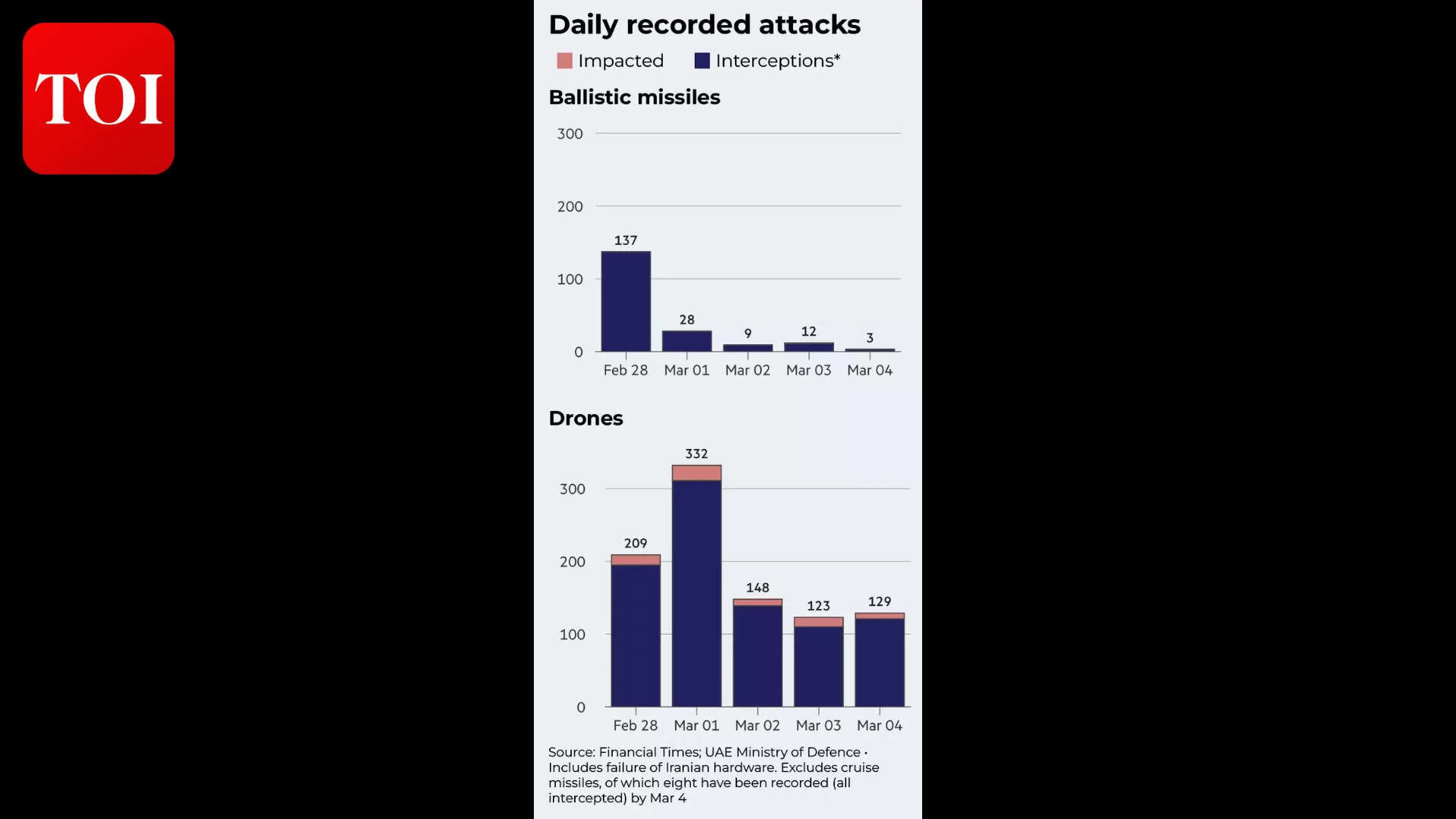
This is the essence of the “ammo race”: if Tehran loses the ability to launch, its theoretical missile stockpile matters less; if Washington and allies exhaust interceptors, Iran’s remaining missiles matter more.Zoom in: Iran’s launch rate drops - depletion, damage, or strategy?A striking data point is the reported decline in Iranian ballistic missile launches since the war began. The Financial Times said western officials view the “sharp drop-off” as evidence the US-Israeli air campaign is working, with aircraft hunting and destroying launchers and weapons stockpiles on the ground.The UAE - which the FT described as publishing the most complete data on launches and interceptions among countries drawn into the conflict - reported that 137 ballistic missiles were launched toward its territory on Saturday, the first day of the war, but only three had been fired on Wednesday as of noon local time. The UAE defense ministry said one of those missiles landed in UAE territory, the FT reported.Gen Dan Caine, chair of the US Joint Chiefs of Staff, said the rate at which Iran was firing ballistic missiles had declined 86% since the start of the war, and had dropped 23% in the past 24 hours, the FT reported.
The BBC echoed those figures, reporting that Caine said Iran’s ballistic missile launches were down 86% from the first day and that drone launches were down 73% since the opening day.
Iranian missiles and drones attack across the Middle East
But the “why” is contested - and that distinction matters for forecasting who runs out first.One western official told the FT: “We are starting to see a decline in Iranian missile strikes. That is . . . down to the work that the US and Israel are doing to destroy those launch sites and to attack those systems.”
The same official added, "We assess that Iran has several more days of capability to continue their activity,” the FT reported.Lynette Nusbacher, a former UK government intelligence adviser, told the FT that the decline could reflect the growing difficulty of executing launches under relentless pressure: “The [Iranian] missile commanders are firing, moving, setting up, fuelling and launching as fast as they can.
Their problem is ‘as fast as they can’ is getting slower.” She added that US and Israeli strikes have been destroying launchers, missiles and fuels - “It’s all depleted,” she told the FT.Others argue Iran may be conserving. The FT said the slowdown could also be a deliberate choice to preserve weapons for a longer war, noting Israeli officials had dubbed the initial approach a “drizzle” strategy designed to use up interceptors.
The FT also cited analysts who observed in last June’s 12-day Israel-Iran war that Tehran saved better missiles for later stages after interceptors had run down.Fabian Hoffman, a research fellow at the University of Oslo, told the FT the launch drop was likely too drastic to be purely tactical. “I tend to agree that very likely the launch capacity of Iran has been heavily degraded,” he said, adding that Iran might not be running out of missiles so much as “running out of launchers,” according to the FT.Decker Eveleth of the Centre for Naval Analyses argued the attrition pattern is less a clever choice than a constraint. The FT reported that Eveleth wrote on X: “It should be noted that this is not a strategy of choice. It is the only strategy available under likely launcher shortages and a failure to police their own airspace.”“If Iran has more missiles than its targets have interceptors, more attacks will start getting through,” Grieco warned in comments to Bloomberg.Former Israeli military spokesman Jonathan Conricus framed the war in similarly stark terms: “Eventually it boils down to numbers,” he said. “How many interceptors will we have versus how much launchers will they be able to field and fire.”The bottom line from these assessments: Iran’s capacity to keep firing may be shrinking, but it is not yet clear if that reflects irreversible depletion or a pause before another surge.Zoom in: Iran pivots to cheaper dronesEven as ballistic launches fall, the FT reported Iran appears to be leaning more heavily on cheap Shahed one-way attack drones, which can be hidden and launched from many locations, making them less vulnerable to air strikes than ballistic missile launchers.The FT said UAE defense ministry data showed 941 one-way attack drones launched against the UAE so far, including 129 on Wednesday, with 121 intercepted.
The FT also reported these drones - carrying 30-50kg warheads - have struck targets including a US Navy base in Manama, Bahrain, a US radar installation in Qatar and the US consulate in Riyadh.The BBC similarly framed drones as an area where Iran may be able to sustain output longer, noting Iran was believed to have mass-produced tens of thousands of Shahed drones before the war and that the US has even copied the design.
The implication is that Iran may struggle to maintain high-tempo ballistic missile operations under air attack, but could still keep pressure on defenses with large numbers of cheaper systems.That matters for the “who runs out first” question because drones can still force defenders to fire interceptors or use other limited defensive systems - and they can be launched from dispersed locations that are difficult to eradicate completely.The US side: Deep arsenals, but thin spots in interceptorsOn paper, the US has the deepest conventional stockpiles in the world. But the war is stressing the categories that are hardest to replenish quickly: air-defense interceptors and certain long-range precision weapons.The BBC reported that while the US can sustain air-to-ground strikes for a long time, the “air defence war” is “more iffy,” citing Mark Cancian, a former US Marine colonel now at CSIS.
Cancian estimated the US may have around 1,600 Patriot missiles in stockpiles and warned that the pace of interceptions could rapidly eat into that number. He also cited the high demand for Patriots from Ukraine and Arab allies and said each interceptor costs more than $4 million, with US production believed to be around 700 a year, according to the BBC.Defense secretary Pete Hegseth acknowledged the limits of even robust air defense, telling reporters, "This does not mean we can stop everything,” while insisting the US has “sufficient precision munitions for the task at hand” and that stockpiles remain “extremely strong.”The Wall Street Journal framed the dilemma as a race: the US is trying to destroy Iran’s missile and drone forces before it runs short of interceptors to fend off retaliation. Kelly Grieco told the WSJ: “One of the challenges is you can deplete these really quickly,” adding: “We’re using them faster than we can replace them.”The WSJ also reported that the Pentagon is working to replenish Patriot and Standard Missile interceptors and maintain sufficient stocks of THAAD interceptors, noting THAAD deployments to Israel and Jordan and the need to retain inventory for other theaters such as South Korea and Guam.Even editorial voices have acknowledged the constraint. A WSJ opinion piece argued that while the US has enough for the Iran fight, it remains true that “the free world needs more air defense rounds,” and urged expanded production of advanced Patriots and THAAD interceptors.Between the lines: Shifting to cheaper bombs is a signal - and a tacticOne reason the US may be able to keep striking even if some high-end munitions become scarce is the tactical shift enabled by air superiority.The BBC reported Gen Caine said the US was moving from expensive “stand-off weapons” such as Tomahawk cruise missiles to less costly “stand-in” weapons like JDAM bombs now that US aircraft can operate closer to targets. Hegseth told the AP that the US had used more advanced weapons early but was switching to gravity bombs as it gained control of the Iranian sky.This shift matters because it protects the most finite inventories by substituting cheaper and more abundant munitions.
It also indicates confidence that US aircraft can operate with less risk - a major advantage that Iran, whose air defenses have been battered, is struggling to counter.But the move doesn’t solve the toughest bottleneck: defending bases, embassies and partners across a wide region against missiles and drones.What’s next: A war of attrition - and procurement decisionsThe next phase of the war will revolve around two parallel campaigns:1. The offensive race to destroy Iranian launchers, stockpiles and production sites before Tehran can regenerate salvos; and2. The defensive race to maintain enough interceptors and air-defense capacity to keep bases and cities protected while that offensive work continues.The BBC described US Central Command’s stated focus on hunting missile and drone launchers, weapons stockpiles and factories. But it also emphasized limits: Iran is vast, weapons can be hidden, and recent history shows airpower alone often cannot destroy all militant arsenals - citing Israel’s long bombing campaign in Gaza and the US campaign against the Houthis in Yemen.Strategically, the longer the war lasts, the more painful the trade-offs become: keep burning high-end interceptors in the Middle East, or preserve those stocks for deterrence in the Pacific and elsewhere.That’s the core stockpile question hanging over the conflict: Iran may be losing launchers faster than it can replace them - but the US and allies may be spending interceptors faster than factories can replenish them.In that sense, depleted weapons stockpiles may not decide everything - but they could decide when and how the war ends.(with inputs from agencies)







 English (US) ·