

 1 week ago
10
1 week ago
10
ARTICLE AD BOX
As Iran signals possible fees on submarine internet cables near Hormuz, India could face indirect implications, with several key undersea networks carrying telecom and digital traffic passing through the Gulf region.
New Delhi,UPDATED: May 18, 2026 20:17 IST
It seems the Iran conflict is beginning to challenge nearly every pillar of modern life. What started with military objectives that remain far from fully achieved has steadily expanded into a confrontation with consequences extending far beyond the battlefield.
From oil and shipping to supply chains and financial markets, the fallout is increasingly global. Now, amid a fragile ceasefire and continued US pressure, Tehran appears to be signalling leverage over something even less visible but deeply critical: the internet itself. 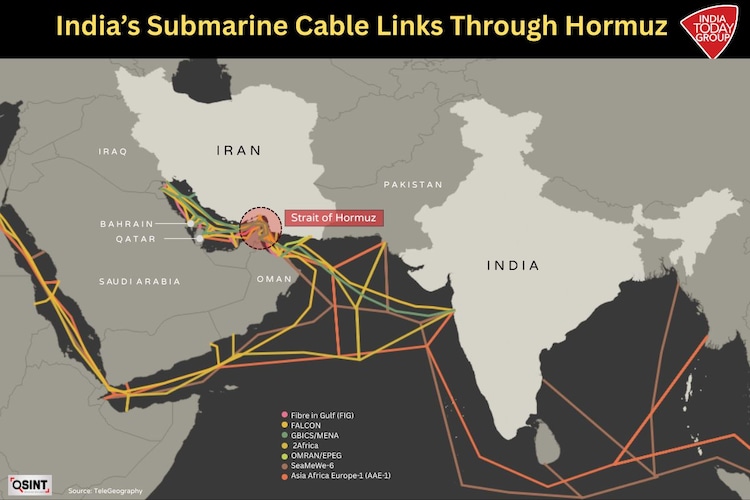
“We will impose fees on internet cables,” Iranian military spokesperson Ebrahim Zolfaghari declared on X last week. Iran’s reported plan to charge submarine cable operators crossing Hormuz could affect global tech giants and directly impact Indian telecom operators and millions of consumers reliant on digital services.
To understand the scale of the threat, India Today’s Open Source Intelligence (OSINT), using data from TeleGeography, a Washington-based telecommunications market research and consulting firm, mapped the undersea cable systems running through the Strait of Hormuz and adjoining Gulf waters.
The findings reveal that beneath this narrow maritime chokepoint lies a dense web of fibre optic systems carrying internet traffic across Asia, Africa, and parts of Europe, making Hormuz not just an energy corridor but also a critical digital artery of the global economy. 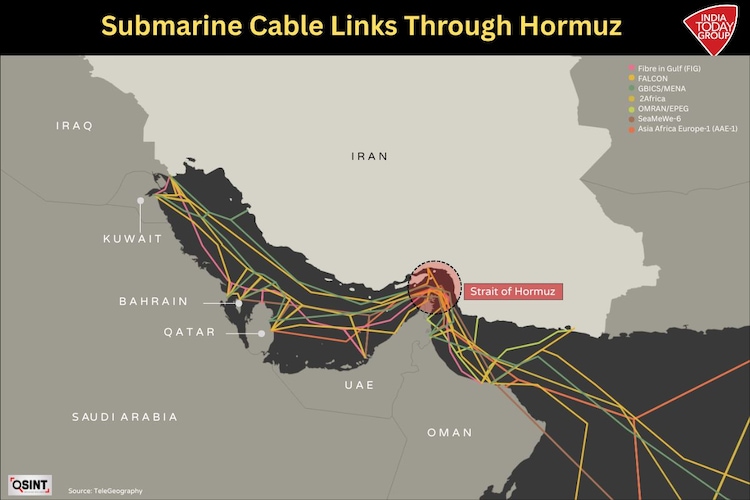
The analysis of submarine cable routes and ownership records identified at least seven major systems passing through or around the Strait, including FALCON, GBICS/MENA, 2Africa, OMRAN/EPEG, Fibre in Gulf (FIG), SeaMeWe 6, and Asia Africa Europe 1 (AAE 1), carrying vast volumes of global data traffic.
For India, the implications are direct. At least four submarine cable systems linked to the Strait of Hormuz directly land in India through Mumbai and Chennai: FALCON, GBICS/MENA, SeaMeWe 6, and Asia Africa Europe 1 (AAE 1). These networks route critical internet traffic connecting India with the Gulf, Europe, and Africa. 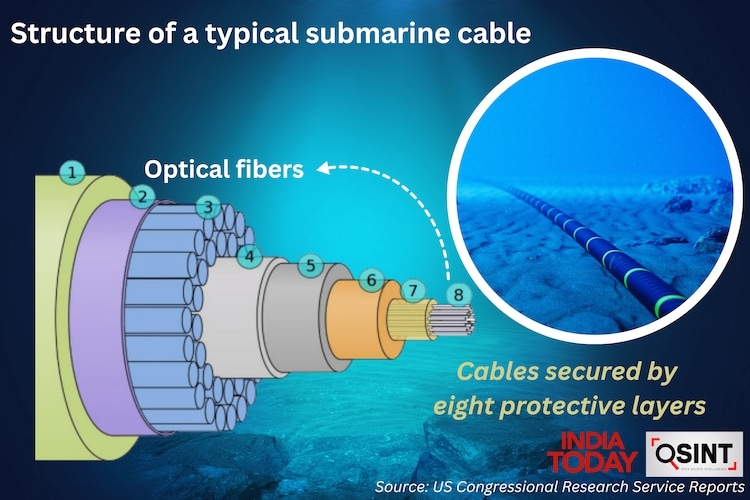
Additionally, Indian telecom operators, including Bharti Airtel and Reliance Jio, also have stakes or operational interests in some of these systems, with Airtel participating in SeaMeWe 6 and Reliance Jio linked to AAE 1. Several cables pass through regional hubs in Oman and the UAE before routing traffic to India, making the country heavily dependent on the corridor for cloud infrastructure, banking, digital payments, streaming services, and enterprise data movement. Any disruption, licensing fee, or repair bottleneck could eventually affect not just telecom operators, but also millions of Indian consumers reliant on everyday internet services.
- Ends
Published By:
bidisha saha
Published On:
May 18, 2026 20:17 IST






 English (US) ·