

 1 hour ago
4
1 hour ago
4
ARTICLE AD BOX
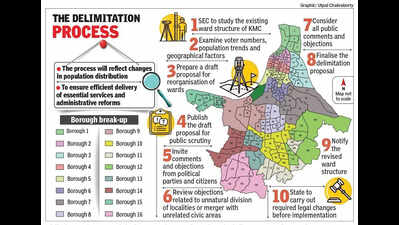
Kolkata: The delimitation exercise proposed in Kolkata Municipal Corporation (KMC) wards by chief minister Suvendu Adhikari before the Dec civic elections may lead to a reduction in the number of wards in north Kolkata and a rise in the ward count in areas along the Eastern Metropolitan Bypass.Civic officials pointed to the uneven demographic shift in Kolkata. Population growth in north Kolkata has been negative or low in many areas, while south Kolkata, particularly the belt around EM Bypass that has witnessed rapid expansion because of new residential complexes, commercial development and urbanisation has seen a significant growth. A KMC official pointed out small wards in and around Burrabazar area may get merged for the purpose of efficient delivery of essential services and administrative reforms.“As a result, the number of wards in the north may reduce, while the number of wards in the south may increase, even if the overall number of wards remains unchanged,” said an official.Similarly, parts of ward 66 and 67 that include Park Circus-Palm Avenue, Picnic Garden, Topsia-Tiljala belt may get merged with ward 68 that includes some Ballygunge-Golpark neighbourhoods and have barely 20,000 voters. Wards 108 and 109 whose jurisdiction extends up to the border of Sonarpur panchayat areas may be reduced, said a KMC official.
The delimitation exercise in the KMC area will attempt to redraw and reorganise the boundaries of existing municipal wards in a scientific and rational manner without increasing the total number of wards. “The purpose is to ensure that wards are more evenly balanced in terms of voters and population, while also keeping each ward geographically contiguous,” the official explained.Such an exercise was last carried out during the Left Front period.
The principle behind delimitation is that representation in KMC should reflect changes in population distribution. Over time, some areas grow rapidly while others lose population or remain stagnant. If ward boundaries are not revised, some councillors end up representing far more people than others, creating an imbalance in civic representation.The State Election Commission (SEC), which has to carry out the delimitation process, will have to study the total number of voters, the population distribution, geographical continuity and administrative convenience.
A key requirement is that every ward must be contiguous, meaning its areas must be physically connected and not scattered in separate pockets.“The SEC will have to first carry out a study of the existing ward structure. Based on voter numbers, population trends and geography, it will then prepare a draft proposal for the reorganisation of wards. This draft will then be published for public scrutiny. After publication of the draft, comments and objections will be invited from political parties as well as ordinary citizens.
This stage is important because ward delimitation affects electoral prospects, local representation and civic administration.
Residents may raise objections if they feel their locality has been divided unnaturally or merged with an area with which it has little civic connection,” explained a former official of SEC .After considering the public comments and objections, the SEC will take a final decision on the delimitation proposal.
Once the revised ward structure is finalised, legal changes will be required.However, there are concerns over how the complex exercise will be completed within six months and could be as challenging as the Special Intensive Revision that was conducted ahead of the assembly elections.For the new delimitation to take effect, a bill will have to be introduced in the state Assembly to amend the KMC Act. This is necessary because the structure and number of wards are governed by law.






 English (US) ·