

 19 hours ago
3
19 hours ago
3
ARTICLE AD BOX
At Ayodhya Bypass, one of Bhopal's busiest arterial roads, large-scale tree cutting has begun for a major road expansion project. Under the plan, the existing four-lane road will be widened to six lanes, along with two service lanes on each side, effectively turning it into a 10-lane corridor.
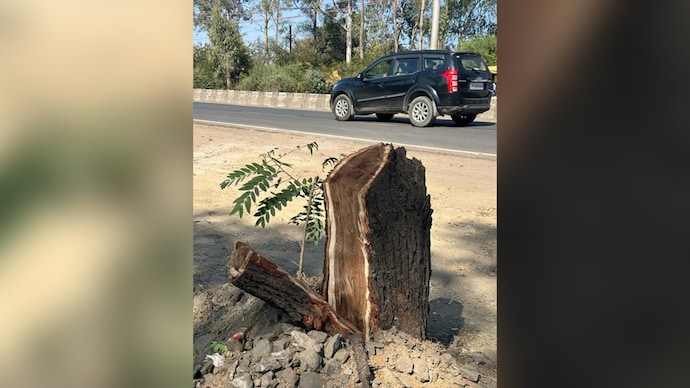
At Ayodhya Bypass, one of Bhopal’s busiest arterial roads, where large-scale tree cutting has begun for a major road expansion project.

Bhopal,UPDATED: Dec 24, 2025 08:52 IST
The debate over development versus environmental protection has once again intensified in India. Even as the controversy surrounding the Aravalli hills continues, a fresh flashpoint has emerged in Madhya Pradesh’s capital, Bhopal, a city long known for its lakes and green cover.
At the centre of the dispute is the Ayodhya Bypass, one of Bhopal’s busiest arterial roads, where large-scale tree cutting has begun for a major road expansion project. Under the plan, the existing four-lane road will be widened to six lanes, along with two service lanes on each side, effectively turning it into a 10-lane corridor.
The project, implemented by the National Highways Authority of India (NHAI), involves the felling of thousands of trees. As soon as details became public, environmentalists, nature lovers and civil society groups raised objections, questioning whether road widening is the only solution to traffic congestion and whether development must always come at the cost of green cover.
The matter reached the National Green Tribunal (NGT), which constituted a special committee to assess the project. Following its review, the committee granted conditional approval for the felling of 7,871 trees, reduced from an earlier estimate of 10,000. The approval requires the planting of 10 saplings for every tree cut, amounting to nearly 80,000 saplings.
NHAI has maintained that the plantation drive will not remain limited to paperwork, claiming there will be monitoring mechanisms and accountability to ensure sapling survival.
However, environmental experts remain sceptical. They argue that mature, decades-old trees cannot be replaced by newly planted saplings, as it takes years for a tree to provide comparable ecological benefits. Local resident Nitin Saxena had also approached the NGT against the tree felling, but failed to secure a stay on the project.
While wider roads may ease traffic congestion today, critics warn that the long-term cost could be borne by the city’s environment. With old trees falling and promises of plantation yet to be tested on the ground, Bhopal stands at a critical juncture where the decision is not just about infrastructure, but about the air future generations will breathe.
- Ends
Published By:
Zafar Zaidi
Published On:
Dec 24, 2025





 English (US) ·