

 1 hour ago
2
1 hour ago
2
ARTICLE AD BOX
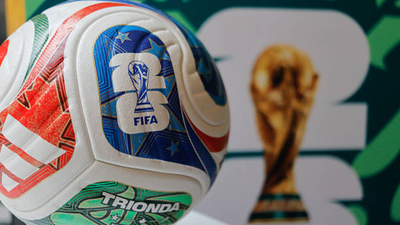
FIFA World Cup 2026 (via Getty Images)
The 2026 World Cup, already shaking things up with its expansion to 48 teams, is about to bring some changes to how players are disciplined on the field too. FIFA’s rolling out two new red card rules after a series of recent incidents have raised concerns about player behavior.With the tournament being hosted across the US, Canada, and Mexico, it’s already set to be a major departure from past World Cups, and now these new rules are adding another twist to the mix.
Mouth-covering confrontations to be punishable by red card
One of the central changes will allow referees to send off players who cover their mouths while confronting an opponent, a gesture that has become increasingly common in modern football and has drawn scrutiny in the context of abuse allegations. The push for this rule gathered pace after an incident involving Vinícius Júnior of Real Madrid and Gianluca Prestianni of Benfica during a Champions League knockout playoff match in February. During that game, Vinícius accused Prestianni of racially abusing him, with the Benfica player seen speaking while covering his mouth with his shirt, after which Vinícius immediately alerted referee François Letexier and the match was halted for 10 minutes under UEFA protocols.
Prestianni denied the allegation and later stated that he had used an anti-gay slur in Spanish rather than a racist term, with UEFA confirming that both forms of discriminatory language fall under the same disciplinary framework. UEFA subsequently issued Prestianni a six-match ban for discriminatory conduct, with three matches suspended for two years and one already served provisionally, while the sanction remains subject to appeal.

FILE - Benfica's Gianluca Prestianni watches the ball during a Champions League opening phase soccer match between Juventus and Benfica in Turin, Italy, Wednesday, January.21, 2026. (AP Photo/Luca Bruno)
Following that incident, FIFA formally proposed tightening sanctions, and the matter was taken to the International Football Association Board (IFAB), which is responsible for determining the Laws of the Game At a meeting in Vancouver, British Columbia, IFAB approved the change by unanimous agreement, introducing a provision that allows competition organisers to impose red cards in such situations.
An IFAB statement said: “At the discretion of the competition organiser, any player covering their mouth in a confrontational situation with an opponent may be sanctioned with a red card.” FIFA president Gianni Infantino had earlier indicated his support for the measure, telling Sky News after IFAB’s February meeting in Wales that he believed players should be dismissed if they confront opponents while covering their mouths.Also read: New 2026 World Cup yellow card rule will impact every nation.
Walking off in protest will now trigger instant dismissal
The second major change addresses situations where players leave the pitch in protest at refereeing decisions, with FIFA moving to impose immediate red cards for such actions during the World Cup. The rule will also extend to officials who encourage or incite players to leave the field, broadening the scope beyond individual misconduct to include collective behaviour. Under the updated approach, any team responsible for causing a match to be abandoned would, in principle, forfeit the game, reinforcing the consequences of such actions within the tournament structure. This decision is directly linked to events at the 2025 Africa Cup of Nations final, played on January 18, 2026, involving Senegal national football team and Morocco national football team. During that match, Morocco were awarded a penalty deep into stoppage time following a foul on Achraf Hakimi, prompting Senegal players to walk off the pitch in protest. The interruption lasted approximately 17 minutes before the players returned, and although Brahim Díaz missed the penalty, the game continued into extra time where Pape Gueye scored to give Senegal a 1-0 win on the field.
However, the Confederation of African Football (CAF) later ruled that Senegal’s walk-off constituted a breach of competition regulations, overturning the result and awarding Morocco a 3-0 technical victory. Senegal have since challenged that decision at the Court of Arbitration for Sport, with the case still ongoing.
Limited application for now, wider adoption requires IFAB approval
Although both rule changes will be enforced at the 2026 World Cup, they are not yet permanent additions to the global Laws of the Game. For either measure to be adopted universally across domestic leagues and international competitions, they would need to be formally integrated into IFAB’s rulebook beyond the current tournament-specific application. FIFA has indicated that these measures are being introduced in response to recent incidents and evolving concerns around player behaviour, with the World Cup serving as a controlled environment to implement and assess their impact.
Tournament context: expansion and hosting structure
The disciplinary changes come as part of a bigger shift for the 2026 World Cup, which will expand to 48 teams and introduce a new group-stage format before heading into a 32-team knockout round. The United States will host 78 of the 104 matches, including all fixtures from the quarter-finals onwards, while Canada and Mexico will each stage 13 matches. Alongside this, FIFA will introduce two yellow card reset points to reflect the longer format, with bookings wiped after the group stage and again after the quarter-finals, ensuring players are less likely to miss decisive matches due to accumulated cautions earlier in the tournament. With multiple layers of change already built into the competition, the introduction of stricter red card rules reflects an effort to shape behaviour on the pitch in line with those wider adjustments.








 English (US) ·