

 1 hour ago
2
1 hour ago
2
ARTICLE AD BOX
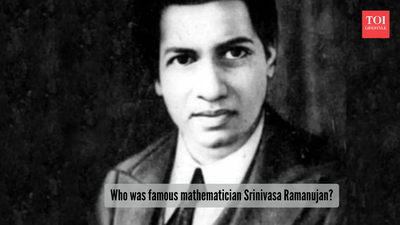
National Mathematics Day honors Srinivasa Ramanujan, a self-taught genius born in 1887. His groundbreaking work on series and partitions, despite lacking formal proofs, captivated mathematicians like G.H. Hardy. Ramanujan viewed mathematics as divine, with his insights still influencing fields like black hole physics, proving his enduring legacy.
Every year December 22, is celebrated in regard to numbers, intuition, and sheer brilliance as we mark National Mathematics Day in honour of Srinivasa Ramanujan, the great Indian mathematician.He was born in 1887 in a poor Brahmin family, living in a simple town in Southern India. This self-taught prodigy turned the world of math upside down with his uncanny command over the subject. He was one those young boys, barely into his teens, devouring an outdated math book and churning out theorems.In 2012, the Indian government declared this as the National Mathematics Day to coincide with 125th birth anniversary of Ramanujan - this day isn't just about formulas; it's a recognition about how a man's spark ignited global math revolutions.
Early life and self-taught genius
Born in colonial India, in Erode, Tamil Nadu, Srinivasa Ramanujan ignored everything but math from age 10, ignoring other subjects. At 16, George Shoobridge Carr's Synopsis of Elementary Results ignited his interest in the subject, thousands of theorems, old proofs, but he verified them all and invented more. He got a scholarship to the University of Madras in 1903, but it didn't last, he was too hooked on math to care about other stuff.
Broke and scraping by in Kumbakonam, he jotted down his big ideas on slate boards. That's where his genius really took off, all alone.
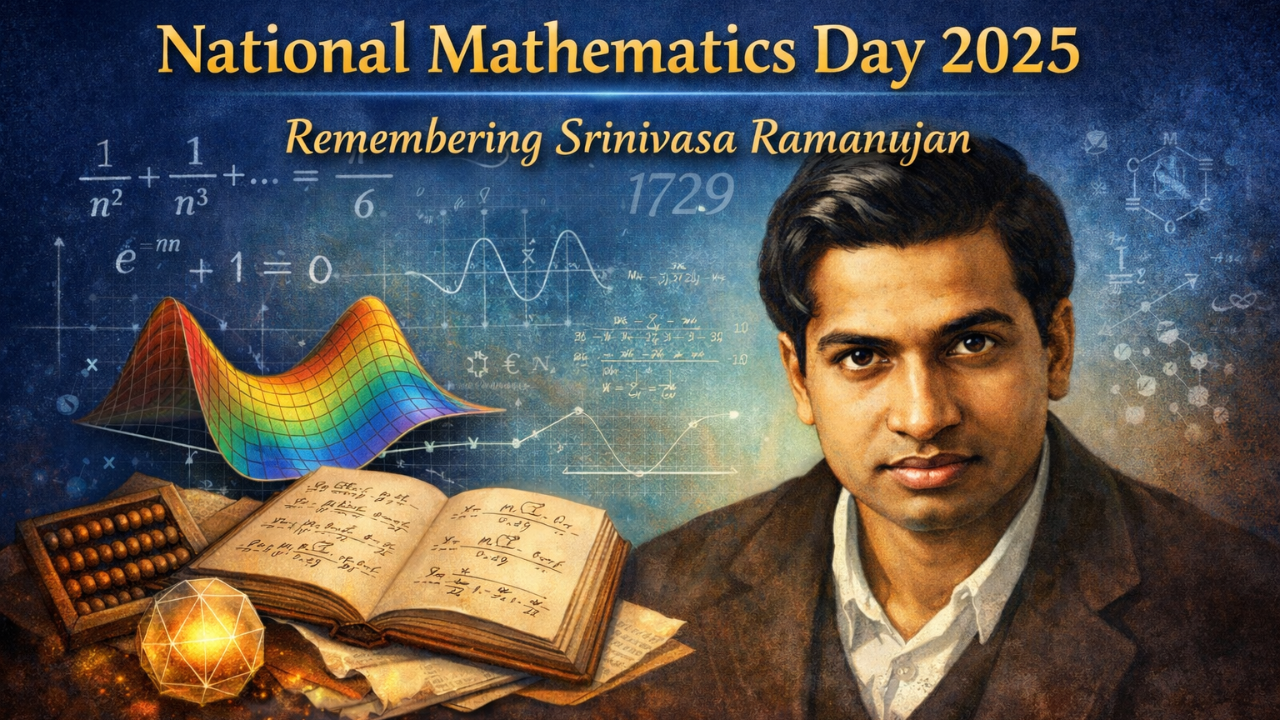
National Mathematics Day is marked on December 22, the birthday of Srinivasa Ramanujan
Breakthroughs in pure mathematics
In his 20s, Ramanujan wowed everyone with cool ideas on continued fractions, endless series, and partitions - like ways to make 4 (4 or 2+1+1). His 1911 paper, published in the Indian Math Society shocked experts. He mastered Riemann series, zeta functions, and invented summation for tricky series.
His self-discovered mastery stunned pros. He invented Ramanujan summation for divergent series. Gaps existed but his partition work and prime ideas stood out, even if some theorems missed proofs.
Partnership with Hardy
In 1913, Ramanujan wrote to British math whiz G.H. Hardy. The man was doubtful at first about the unproven ideas, but as soon as he spotted pure genius, he got Ramanujan scholarships and brought him to Cambridge in 1914. Despite cold weather and poor health, they worked together on modular forms and primes.
Philosophical side of numbers
Ramanujan thought math was God's own language. He is famously known to say, "An equation means nothing unless it expresses a thought of God,". Zero was absolute reality; infinity, its endless shapes. Theorems were not made up, according to him they were divine hints about the universe. His notebooks mixed math and spirit, linking numbers to the infinite. Visions from goddess Namagiri guided him, even in England. For him, equations were prayers bridging earth and eternity, fueling his amazing partitions and series.Ramanujan died at 32 in 1920 from TB, but his notebooks kept surprising mathematicians for decades. His "mock theta" ideas are still connected in a last letter to Hardy that still amazes scientists even today, and these theories are now linked to black holes! Like Euler, his work is also useful in physics. The movie 'The Man Who Knew Infinity' still inspires kids and National Mathematics Day keeps his spark and spirit alive!









 English (US) ·