

 1 hour ago
2
1 hour ago
2
ARTICLE AD BOX
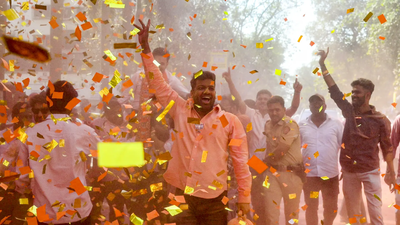
As BJP won the Municipal Corporation elections 2026, the party was leading in the Navi Mumbai Municipal Corporation (NMMC) elections, winning 66 of the 111 seats, according to early trends shared by officials.
Shiv Sena (Shinde faction) was next with 24 seats.The civic polls were held on January 15 across Maharashtra, covering 29 municipal corporations, including Navi Mumbai. In the city, nearly 9.50 lakh voters cast their votes to elect 111 corporators across 28 wards. Navi Mumbai has 9,48,460 eligible voters, including 5,16,267 men and 4,32,040 women. A total of 1,148 polling stations were set up at 185 locations, with 499 candidates in the fray.
The elections were held after a gap of more than 10 years, as the polls due in 2020 were delayed because of the Covid-19 pandemic. The main contest was between the ruling Mahayuti alliance and the Maha Vikas Aghadi (MVA).The Mahayuti comprises the BJP, Shiv Sena led by Eknath Shinde, and the NCP led by Ajit Pawar, while the MVA includes the Shiv Sena led by Uddhav Balasaheb Thackeray, the NCP led by Sharadchandra Pawar, and the Congress.
Despite being allies at the state level, BJP and Shiv Sena failed to reach a seat-sharing agreement in Navi Mumbai, leading to a direct contest between Ganesh Naik and Eknath Shinde. Shiv Sena had sought 57 seats, which Naik denied, while Shinde challenged Naik’s long-standing dominance over the city.Naik has held sway over Navi Mumbai since its inception and has retained influence despite switching parties over the years.
In the 2015 elections, the undivided Shiv Sena won 38 seats, finishing second behind the Naik-led NCP, which secured 52 seats, while BJP won six seats. In 2019, Naik and his corporators joined the BJP from Sharad Pawar’s NCP.In the current polls, BJP contested all 111 seats, while Shiv Sena fielded candidates in 105 seats. The elections also saw dynastic politics, with several leaders fielding relatives. Observers flagged key contests in Digha and Vashi and said money could play a role, particularly in slum pockets and villages.For the first time, the polls were held under a multi-member panel system. Voters in wards 1 to 27 voted once to elect four corporators each, while voters in ward 28 voted once to elect three corporators.






 English (US) ·