

 1 hour ago
3
1 hour ago
3
ARTICLE AD BOX
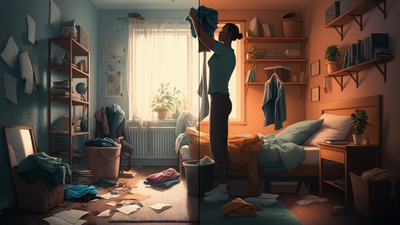
Woman actively tidying cluttered bedroom. Image Credit: TIL Creatives
We've all met someone who straightens cushions before sitting down, reorganises a drawer when stressed, or cannot fully relax until the kitchen is spotless. They are often labelled as control freaks.
But psychologists suggest the behaviour can sometimes reflect the brain's response to uncertainty rather than perfectionism alone.More and more research points to the idea that tidying and organising actually act as coping mechanisms, helping people regain a perceived sense of order and predictability.Why does anxiety prompt repetitive behaviour?When people feel anxious, they look for stability.A study by Martin Lang, Jan Krtk, and Dimitris Xygalatas, published in Scientific Reports, suggested that highly structured and repetitive behaviours can act as coping mechanisms for anxiety.
The researchers proposed that the purpose of the ritual and predictable activities is to return the brain to a more manageable state.The theory is that humans instinctively favour structured routines in moments of uncertainty, as consistent actions can create a feeling of being in control. A re-arranged wardrobe or tidied bedroom may seem unrelated to the original cause of anxiety, but the cleaning or tidying process has a start, middle, and end-things anxiety can strip away.
Cleaning can genuinely help reduce stress levelsThis calming effect is not purely psychological.Researchers found that cleaning activities appeared to reduce participants' stress responses and improve feelings of control. Additionally, according to a study available through PubMed, actual cleaning behaviour reduces the body's physiological response to stress.The researchers found that the act of cleaning can act as a coping mechanism for stress, even when the source of that stress has nothing to do with the immediate surroundings.
So, while arranging your cupboard is not going to solve any work-related problems, it may provide a temporary sense of relief from stress.

A woman calmly tidies, creating a serene and organized space. Image Credit: TIL Creatives
Childhood experiences can reinforce the behaviourChildhood experiences are said to play an integral part in how individuals respond to stress as adults.The National Child Traumatic Stress Network states that children raised in unreliable or unstable environments can become hyper-aware of their surroundings and can develop coping mechanisms to create security and control.
The organisation says that children raised in inconsistent environments can become highly attentive to change and uncertainty.For some children, maintaining order in their immediate environment may become a way of creating predictability amid uncertainty. Toys can be arranged, books can be aligned, and bedrooms can be tidy and organised.Over the years, these coping strategies may persist into adulthood, and they remain the preferred methods for dealing with stress even when the underlying issues have long passed.It is important to acknowledge that not everyone who is meticulous and tidy must have been exposed to traumatic childhood experiences, but for some individuals, this kind of behaviour is rooted in a need for certainty after childhood experiences.How does mess increase our stress levelsIt's also been suggested that the way we see our living space could have an impact on how stressed we are.A study led by the University of California, Los Angeles, and published in the Personality and Social Psychology Bulletin found that the more cluttered and disorganised people considered their homes to be, the more unbalanced their daily cortisol rhythms were.
Cortisol is a hormone often called the body's stress hormone. Those who considered their homes to be more restorative and tidy were found to have more regulated moods and lower levels of stress during the day.The findings suggest that physical surroundings can have a measurable impact on emotional well-being, which may explain why some people feel an urgent need to restore order when they feel overwhelmed.It’s not always about neatnessOften, the "control freak" stereotype simply misses the bigger picture.
For some, tidying is less about having a perfectly pristine home and more about managing emotions.For some people, an organised desk, neatly made bed, or tidy kitchen may represent a desire for control and order rather than housekeeping alone. That said, compulsive cleaning is not always a healthy outlet, and using tidying to cope can prevent people from addressing the underlying source of anxiety.Self-help experts advise approaching these habits without judgment and trying to pinpoint the emotions behind them, but the evidence suggests that for some people, a need for tidiness may come from years of trying to stay calm in an unpredictable world.









 English (US) ·