

 1 hour ago
5
1 hour ago
5
ARTICLE AD BOX

Tagore reimagined the philharmonic way. Read about Bickram Ghosh and Kamalini Mukherji’s collab that’s making it happen
Singer Kamalini Mukherji and percussionist-composer Bickram Ghosh have come together for a distinctive musical project that places Rabindranath Tagore’s songs within a Western orchestral framework.
Kamalini’s emotive interpretation of Rabindra Sangeet blends seamlessly with Ghosh’s expansive musical arrangements, creating a soundscape that bridges Indian musical sensibilities with Western symphonic traditions.
Together, they are opening a new chapter in the global journey of Tagore’s music. CT spent an afternoon with the duo at Jorasanko Thakur Bari, where they spoke about the collaboration, Tagore’s legacy, and the resonance of the historic venue.A historic first for Tagore’s music“For the first time, six Tagore songs, sung by me, are being brought together as a large-scale song cycle for a Western European orchestra, composed by Bickram da,” says Kamalini, who also curated the project. Commissioned by the Duisburg Philharmonic Orchestra, the work blends Western orchestral music with select Indian instruments and sound textures—marking a significant milestone in the international journey of Tagore’s music.
“Until now, the only Tagore song cycle of this scale was Lyric Symphony, composed in 1923 by Austrian composer Alexander von Zemlinsky, a contemporary of Tagore,” she adds. “I’ve been working in Germany for a long time, exploring meaningful cultural exchanges through music. The soundscape Bickram da has created brings Western symphonic traditions and Indian musical elements together in a way that feels natural and deeply engaging.”
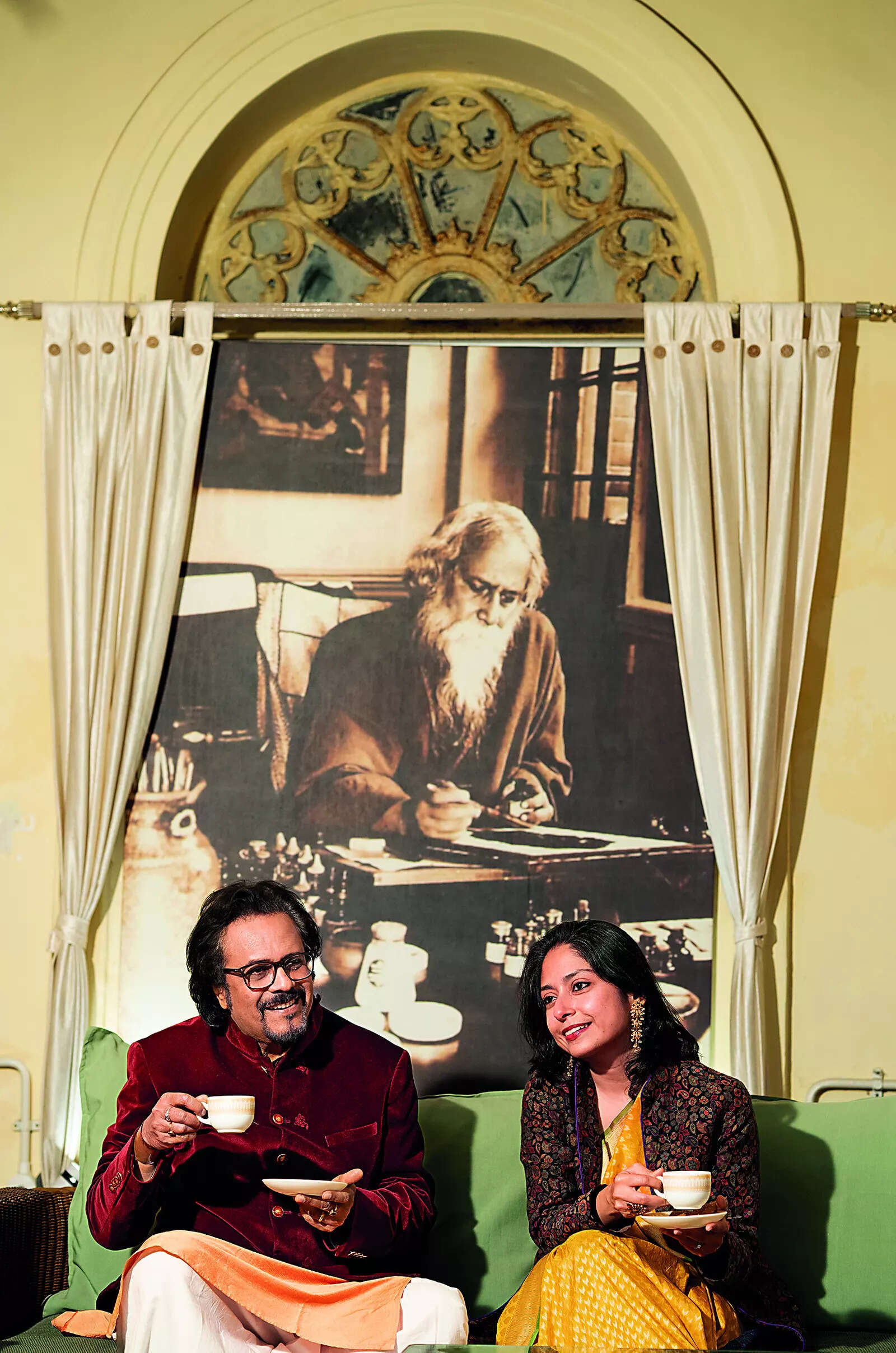
Bickram Ghosh and Kamalini Mukherji at Jorasanko Thakur Bari
Premiere in Europe, journey aheadThe Tagore Song Cycle will premiere in Duisburg on July 3, 2026, followed by guest performances across Europe. “The aim is to introduce Tagore’s poetry and music to new audiences worldwide,” says Kamalini. “Plans are also in place for a future pan-India tour, bringing the work back to the country where these songs were born.” Adding to the momentum, Bickram Ghosh will perform at Eigenzeit Festival 2026: Music Beyond Borders, inspired by Tagore’s vision of cultural unity and featuring leading artists from India and Europe.An email, a vision, and a larger canvasFor Ghosh, the collaboration began with an email from Nils Szczepanski, director of the Duisburg Philharmonic Orchestra, who approached Kamalini with the proposal. “Kamalini invited me to compose the orchestral parts for a new song cycle,” he recalls. “With a philharmonic orchestra I already admired, plus our own brilliant Indian musicians, the possibility of creating something special was immediate.”
“At this stage of my career, I want to work on a larger canvas,” Ghosh adds.
“Indian classical music is traditionally intimate, shaped by instruments like the sitar, tabla, veena and mridangam. Orchestral composition had long been an ambition—and this project offered the right moment, and the right philharmonic.”
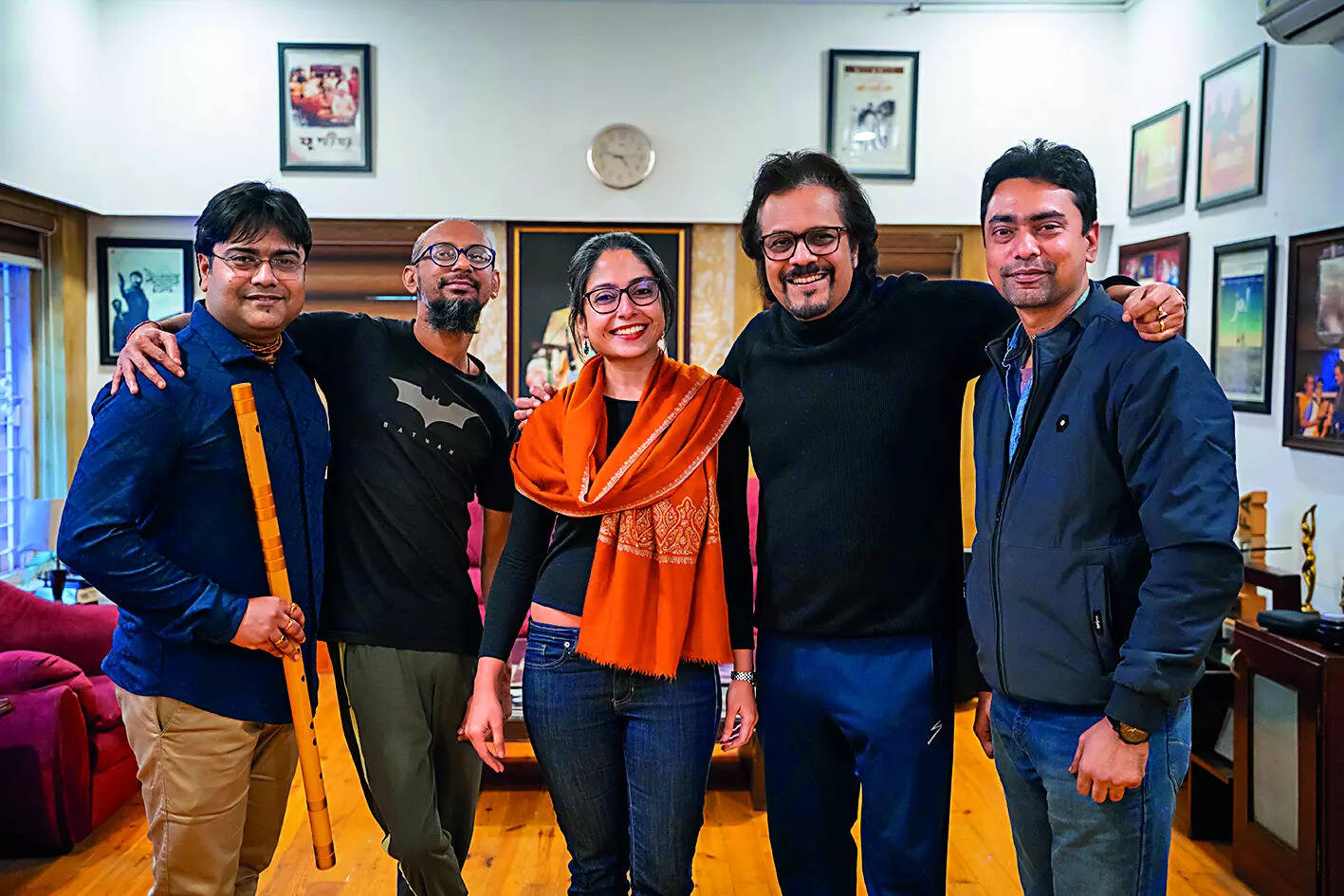
Kamalini Mukherji & Bickram Ghosh with the team of musicians who worked with them on the collab
What matters most to me is that I can talk to Bickram da about Tagore: Kamilini Mukherji“It’s wonderful to be working with Bickram da for the first time,” says Kamalini.
“I trust him musically, but what matters most is that we can talk about Rabindranath.” Their shared background in English literature allows for deeper exchanges — her reading of Tagore’s songs meeting his musical vision. “That dialogue is vital,” she adds, “because each song is poetry, carrying Rabindranath’s own spirit.”Rooted in Tagore, realised at JorasankoDescribing the shoot at Jorasanko Thakur Bari, Kamalini calls it “surreal,” saying the space carries an emotion akin to Santiniketan.
“Tagore walked, thought, wrote, and felt here—shooting here gave me goosebumps.” For Bickram Ghosh, the project’s pull lay in its Tagore connect. “Though my foundation is classical music, I grew up with Tagore. Presenting his work internationally, blending Indian musicians with a Western orchestra, felt like a once-in-a-lifetime opportunity.
”I’m extremely excited to revisit Rabindranath with Kamalini – this time on a much larger scale: BickramReflecting on the process, Bickram Ghosh says the past month and a half was spent completing the compositions in close studio sessions, with Kamalini singing as he built the arrangements around her voice.
The music now moves to Grammy-winner Barry Phillips for the full orchestral score, ahead of rehearsals in Germany in May. Calling Kamalini “a highly accomplished singer,” Ghosh adds that her openness, intellect and international vision made the collaboration seamless—and revisiting Tagore with her at this scale especially exciting. One of my all-time favourite Tagore’s songs is Akash Bhora Surjo Tara, and this is the first song I chose for the song cycle. The use of the word bishoye in the lyrics has always deeply moved me - Kamilini MukherjiOver the past 25 years, my work in fusion and film music has involved extensive use of orchestral sounds such as violins and cellos, making this project feel like a natural step forward”- Bickram GhoshPics: Anindya Saha; Location: Jorasanko Thakur Bari









 English (US) ·