

 1 hour ago
4
1 hour ago
4
ARTICLE AD BOX
WHAT ARE MICROPLASTICS.indd
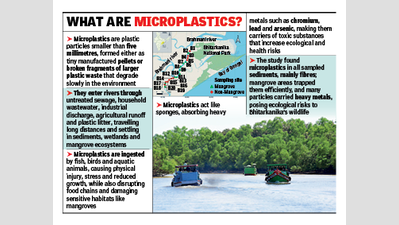
Bhubaneswar: Tiny plastic pieces have been found in the sediments of the Brahmani river flowing through Odisha’s Bhitarkanika wildlife sanctuary, raising concerns over pollution in one of the state’s most sensitive ecosystems.A study published in the journal Water, Air, and Soil Pollution (Springer Nature) on April 14 found microplastics at all sampling locations along the river within the sanctuary. Scientists warned that even small amounts of microplastic, particles that cannot be seen without a stereomicroscope, could pose long-term risks to mangroves, fish and wildlife that depend on the river.The highest concentration of microplastics was recorded near areas exposed to human activity.
Most of the particles were fibres, fragments and thin films, which are commonly linked to household wastewater, fishing gear, packaging material and degraded plastic waste carried downstream.While the overall levels of microplastics were lower than those reported from many heavily polluted rivers in India, researchers cautioned that Bhitarkanika’s fragile ecosystem makes it highly vulnerable. Mangrove sediments were found to trap these tiny particles, increasing exposure for plants and animals living in the mud and shallow waters.
“All sediment samples contained microplastics, indicating their widespread presence even in protected areas,” the researchers noted, adding that such contamination could affect aquatic wildlife and the ecological functioning of the sanctuary.The study was conducted by scientists from Nalanda University, Manipal Institute of Technology, Auburn University (USA), TERI and Nagaland University.Apart from plastic particles, the study found that microplastics carried toxic heavy metals such as arsenic, lead, cadmium, chromium and zinc on their surface, increasing risks for fish, crocodiles, turtles and birds.“The ecological stakes are high,” said Rakesh Kumar of Auburn University, one of the authors. “Buffer zones around Bhitarkanika should be strengthened for solid-waste management, with stricter controls on riverbank settlements, tourism operators and agricultural practices.”Bhitarkanika is known for its mangroves, saltwater crocodiles, Olive Ridley turtles, migratory birds and a resident elephant population. Researchers said the findings should serve as a warning and a baseline for policymakers to strengthen waste management and river protection measures to safeguard the sanctuary’s biodiversity. Kumar said citizen science and public awareness are the most pragmatic solution.







 English (US) ·