

 1 week ago
13
1 week ago
13
ARTICLE AD BOX
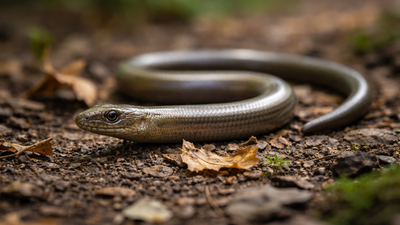
Have you ever seen a long, slithering creature in your backyard and wondered whether it is a snake? In India, which is home to a variety of wild creatures living in the midst of busy villages and rural areas, seeing a slithering creature may evoke a sense of curiosity and unwarranted fear.
While snakes are not found in Europe, slow worms are. They are found in the British Isles. It is a legless lizard that is often mistaken for snakes all over the world, much like how Indians often mix up snakes with glass snakes and other legless lizards found in the Western Ghats. It is interesting to learn about the difference between snakes and slow worms.
Key differences between snakes and slow worms
| Feature | Slow Worms | Snakes |
| Scientific group | Legless lizards (Anguis fragilis) | True snakes (suborder Serpentes) |
| Eyes | Have eyelids and can blink | No eyelids; cannot blink |
| Ear openings | Visible external ear openings | No external ear openings |
| Tongue | Short, thick, slightly notched | Long, slender and deeply forked |
| Body shape | Uniform body width with Little Neck definition | Distinct head and neck |
| Skin shedding | Shed skin in patches | Shed skin in one continuous layer |
| Jaw flexibility | Rigid lizard-like jaws | Highly flexible jaws for large prey |
| Tail behaviour | Can detach tail to escape predators | Cannot detach tail |
| Diet | Mainly slugs, worms, insects | Often rodents, birds, frogs and other vertebrates |
| Typical length | Usually up to about 50 cm | Many species exceed 1 metre |
What makes slow worms different from snakes
As described by Discover Wildlife, slow worms, which are scientifically known as Anguis fragilis, are similar to snakes but are legless lizards that belong to the Anguidae family.
While snakes are part of the suborder Serpentes under the Squamata class, slow worms are part of the Anguimorpha class. They are thus only distant cousins at best. "Slow worms have evolved without legs, yet retain lizard characteristics," Studying Wildlife, a wildlife observer, explains. One of the most obvious distinctions is that slow worms blink while snakes do not. While slow worms have flexible eyelids that allow them to blink and thus protect their eyes from dust, snakes have spectacle-like scales over their eyes that prevent them from blinking or from sleeping with their eyes open.
According to Wild Ideas Org, slow worms are also different from snakes in that their bodies are smooth and evenly built. Slow worms are thus able to dig into the ground by shedding their skin in patches instead of in one piece like snakes.
Snakes vs slow worms: Physical traits that make them easy to spot
Tongues tell another tale. Snakes flick long, forked tongues to sense air chemicals; slow worms have short, thick, notched ones that barely protrude. "Snakes have much longer, slimmer forks and the tongue reaches out much further," explains Discover Wildlife. Ears set them apart; slow worms feature external ear openings, but snakes do not. Jaws vary: snakes' hyper-flexible ones swallow large prey; slow worms' rigid lizard jaws limit them to slugs, worms, and insects. Wildlife expert Wild Ideas states, "Slow worms’ tongues are rounded, in contrast to snakes, who have unmistakable forked tongues." Tail autonomy is lizard magic. Slow worms detach tails to escape predators, regrowing them imperfectly; snakes cannot.
In Britain, gardeners welcome slow worms for pest control, much like Indians value garden lizards. Shiny, smooth slow worm scales contrast with snakes' often duller ones.
Behaviour and habitat: Lifestyle similarities between snakes and slow worms
Slow worms move deliberately, living up to their name, basking openly in gardens or woodlands. Snakes slither swiftly, often hunting actively. Both brumate in winter, reptile hibernation, but slow worms burrow underground, and snakes seek crevices. In Europe, slow worms thrive in compost heaps, favouring moist spots; snakes prefer drier hides. Though absent in India, parallels exist with legless lizards like India's Ophisaurus species in the northeast, sharing blinkable eyes and tail-dropping. Researchers at Thames Basin Heaths Org, reptile biologists highlight slow worms' smaller size, up to 50cm, versus many snakes exceeding a metre. They eat soft prey: slow worms devour invertebrates; snakes tackle vertebrates, too. Females give live birth to young (ovoviviparous), like some snakes, but this lizard trait underscores their non-snake status. Conservation insights: Why spotting the difference mattersMisidentifying slow worms as snakes leads to needless kills, harming biodiversity. In Britain, they're protected; populations decline from habitat loss.









 English (US) ·