

 1 hour ago
3
1 hour ago
3
ARTICLE AD BOX
“Land Ahoy” – cheered the crew as they sighted land. On Wednesday, the ‘stitched ship’ Indian Navy Sailing Vessel (INSV) Kaundinya sailed into Muscat’s Port Sultan Qaboos and into the history books – completing its maiden voyage and retracing ancient maritime routes.
From being ‘tailed’ by a flotilla of Indian fishing vessels near Sir Creek, spotting mahi-mahi dolphins, reading ‘spy’ thrillers and maritime history books, witnessing bioluminescence on a dark night, eating thepla with mango pickle for breakfast, when fresh rations ran out; to battling heavy ‘rolling’ at 40-degree angles and periods of lull when the winds died – the crew completed the arduous voyage in 17 days and scripted history.
The ‘stitched’ ship – modelled on a fifth-century vessel depicted in a painting in the Ajanta caves – set sail from Porbandar on December 29, embarking on a historic voyage to Muscat in the Sultanate of Oman. The vessel has been constructed using ancient Indian shipbuilding techniques, including stitched-plank construction without the use of modern nails or metal fastenings. It has been constructed by artisans and traditional shipwrights from Kerala using coconut fibre stitching, traditional wooden joinery, coir rope and natural resins, and powered by cotton sails.
Unlike modern sailing ships, it has square sails, no engine or propulsion and is aided by trailing oars and the wind. The ship is named after a legendary Indian mariner ‘Kaundinya’, who is believed to have sailed across the Indian Ocean to Southeast Asia.
Historian Sanjeev Sanyal, a member of the Prime Minister’s Economic Advisory Council who first pitched the idea of a stitched ship and was part of the crew, said: “We now have a good idea of how the ancient mariners felt when they made these great voyages”.
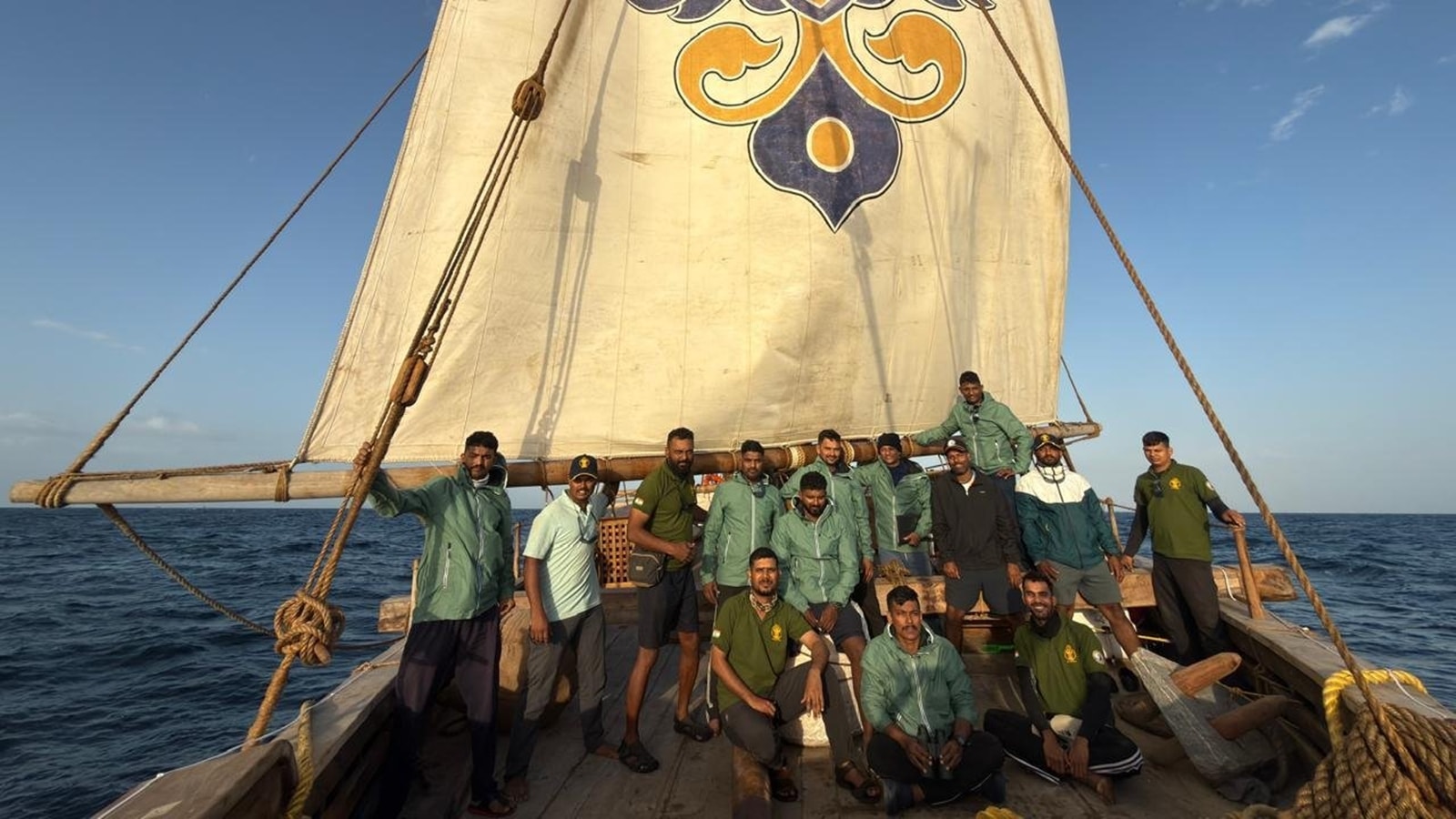 Crew aboard INSV Kaundinya. (Image source: Indian Navy)
“There was a colonial narrative that Indians somehow feared the seas and that we didn’t like to cross the oceans. We have proved that this is not true. We have proved the validity of the ‘stitched ship’ design. We have understood the strengths and drawbacks of using this technology,” he said.
He said: “For instance, when you have square sails, you can only sail at a limited angle to the wind. When we built the ship, most people assumed that the plan was to simply build it…maybe sail it a little bit and put it in a museum. But where is the fun in that? So, we decided that we were going to attempt to sail it, along some of the traditional routes”.
Story continues below this ad
“We thought maybe in good conditions it could do 2-3 knots speed, but we discovered that this boat is easily able to do 4 knots in good conditions. It came with a downside too – it rolls a lot,” he said.
Sanyal said during the initial days of the voyage, the winds were completely from the west and the vessel can’t sail at too much of an angle to the wind, so it could not break westward. “So, we were forced to go north and we went past the Gulf of Kutch and began to head towards Sir Creek,” he said.
When the Indian fishing vessels noticed a “strange apparition” of a ship approaching, with its “sails up” at night, they reported the suspicious vessel. “It was at night and that whole area is full of fishing vessels. It’s a close-knit community. When they noticed an unfamiliar ship, they dialled an emergency line channel 16 and reported it to the Coast Guard to apprehend our vessel,” recalled Sanyal.
For Cdr Y Hemanth Kumar, officer-in-charge of the expedition and a naval architect, the journey has been like “watching a child growing up”. Kumar has been involved in the project since 2021 from conceptualisation to the design and construction of the vessel.
Story continues below this ad
“The ship rolls a lot,” he said, describing the voyage. “Unlike a modern ship, it does not have a deep keel. We consistently had high sea states of 3-4 at the start. Operations such as raising sail are a very manual exercise and difficult to carry out, especially during extensive rolling.”
The other extreme, he said, was periods of no winds and glassy seas.
“So, whatever distance is gained, is sort of lost, as the vessel keeps drifting. It tests the patience of the sailors,” said Kumar. “Watching the bioluminescence created by phytoplanktons at night was mesmerising,” he said.
India, Kumar said, has been a shipbuilding nation for centuries.
Story continues below this ad
“It is not just an industry, but it’s a legacy of our country. We hope this voyage inspires the next generation of shipbuilders and seafarers. We want to send a message to the youth to celebrate our legacy and develop a spirit of adventure and to be fearless,” said Kumar.
Cdr Vikas Sheoran, the skipper of the ship, described it as “a surreal feeling”.
“The biggest challenge was keeping the morale high during such a long voyage,” he said. “After a few days, fresh rations run out. And eating the same food can often take a toll. And, then there is rolling. This is not a normal sailing boat with a deep keel. It is very challenging compared to conventional sail boats.”
During periods of lull, the crew brushed up on their history knowledge and read ‘The Ocean of Churn’, a book authored by Sanyal. “It helped having a historian on board,” added Sheoran.
Story continues below this ad
Said Sanyal: “For me, the creaking sound of the wood, the fluttering sail, sleeping on the deck during the full moon night and the sheer physical effort of handling this ship in rolling seas, has been quite the experience.”
He went on to say: “People do not realise that for sailors, it is not the rolling windy days that are truly difficult, but the absolutely flat glassy seas, when you are just drifting because there is nothing you can do. So, that is when we did chores on board, conducted repairs, cleaning…and wrote our personal diaries.”
In a press statement, the Embassy of India in Muscat, Oman, said: “The voyage of this traditionally built stitched sail vessel stands as a powerful symbol of the deep-rooted maritime, cultural, and civilisational ties spanning over 5,000 years between India and Oman”.
It also highlights the fact that oceans are connective corridors rather than barriers, enabling sustained interaction between the two nations, the statement said.
Story continues below this ad
“The expedition assumes special significance as the two nations celebrate 70 years of establishment of diplomatic relations,” it said.
According to an official, the vessel will undergo necessary underwater checks and sail back to Karwar in a few weeks.







 English (US) ·