

 1 hour ago
5
1 hour ago
5
ARTICLE AD BOX

Tamil Nadu is the graveyard of national political parties. It buried the Congress at its peak then in 1967. The BJP, also at its peak now, has been pregnant with possibilities but has failed to deliver. Never a serious player in the state before the dawn of the Modi-era, the BJP has been humbled in every election since his arrival in 2014 (2019, 2021 and 2024).
Pundits and laypersons, Tamil Nadu confounds everybody alike. What makes it the strongest citadel of regionalism in contemporary politics that is now soaked in nationalism? Why is it a unique entity even among its culturally similar southern states? All these states are also fiercely proud of their cultural moorings, but none practices antagonism to national parties as a principle of state policy, so to say. What makes it stand out and stand apart? Is it true that a monolithic national narrative suppresses or seeks to suppress the state's distinct Tamilakam (Tamil Nadu of yore) identity and ancient glory? Or, do the state's Dravidian parties deliberately stoke the sense of cultivated alienation and grievance to perpetuate their careers? What has Dravidian politics delivered that the state does not want a taste of any other model? What is the collective angst of the Tamils? Is it justified? Why can't the rest of India fathom it? As another grand electoral spectacle looms in 2026, these are some of the myriad questions that need to be addressed. Not to predict winners and losers, but just to understand why Tamil Nadu is the way it is.
In this new series, that is what Chennai-based senior journalist, TR Jawahar, will attempt to do. He will dig deep into history and heritage, arts and archaeology, language and literature, cinema and culture, kingdoms and conquests, castes and communities, religion and race and, of course, politics and pelf, to paint a picture of the state that might help you understand whatever happens when it happens.
Read More
This is the classic celluloid Cinderella story played out in real time for over five decades, like nowhere else in world and history: A tale that needs to be told.
In the flickering, high-stakes trade of the Tamil film industry, they originally labelled him Minimum Guarantee Ramachandran. It was a clinical term for a distributor’s safety net—a promise that an M.G. Ramachandran film would, at the very least, recover its costs and keep the theatres running. But as we survey the fifty-year arc of his life—a trajectory so surreal it seems fated by a master scriptwriter—one must correct the nomenclature. He was, in truth, Maximum Guarantee Ramachandran.
His guarantee was not merely a financial one for the box office; it was a psychological and spiritual contract with the masses. He offered a maximum guarantee of hope to the hopeless, a maximum guarantee of protection to the vulnerable, and eventually, a maximum guarantee of victory at the ballot box.
The Global Pioneer
While other stars flickered and faded, and while the legendary M.K. Thyagaraja Bhagavathar—the first true superstar of the Indian screen—saw his light extinguished in the shadows of the Lakshmikanthan murder case and subsequent prison time in 1944, MGR remained challenger-in-chief. He didn't just survive the greasepaint; he used it to camouflage a political revolution.
He was a global pioneer of the "actor-sovereign" model, predating Ronald Reagan’s ranch-to-White House journey and N.T. Rama Rao’s saffron-clad resurgence. MGR was the original screen-to-state phenomenon, a man who realized long before the rest of the world that in a land of myth and oral tradition, the shadow on the screen is often more real than the politician on the podium.
The Crucible of Poverty
MGR’s life was a song that began in a minor key of profound struggle. Born in Kandy, Sri Lanka, on January 17, 1917, he was the youngest son of Melakkath Gopalan Menon and Sathyabhama. The early death of his father plunged the family into the kind of abject poverty that would later become the emotional bedrock of his films. His mother, a woman of steel and sanctity, moved the family to Kumbakonam in Tamil Nadu, where she worked as a housemaid and performed gruelling manual labour to keep her sons from fatal starvation.
Alongside his elder brother M.G. Chakrapani, young Ramachandran entered the Madurai Original Boys Company, a theatre troupe that served as his true academy. This was the Madurai foundry where his skills were forged. Life in the troupe was monastic and brutal; routines lasted fourteen hours, and a missed cue or a forgotten line often meant a missed meal or a fine. It was here that he learned the Grammar of the Gritty—the realization that the audience, parched for justice, looks to the stage for a messiah. This period of hunger was the rehearsal. He wasn't just learning to act; he was learning to empathize.
His devotion to his mother, Sathyabhama, was the genesis of his lifelong bond with the Thaai Kulam (the community of mothers). He realized early on that if you win the heart of the mother, you own the loyalty of the home. Sathyabhama’s specific moral instructions—no smoking, no drinking, and never abusing women—became the MGR code of conduct that he never violated on screen, creating an unblemished image that felt real to the common man.
The Messiah’s Mentor
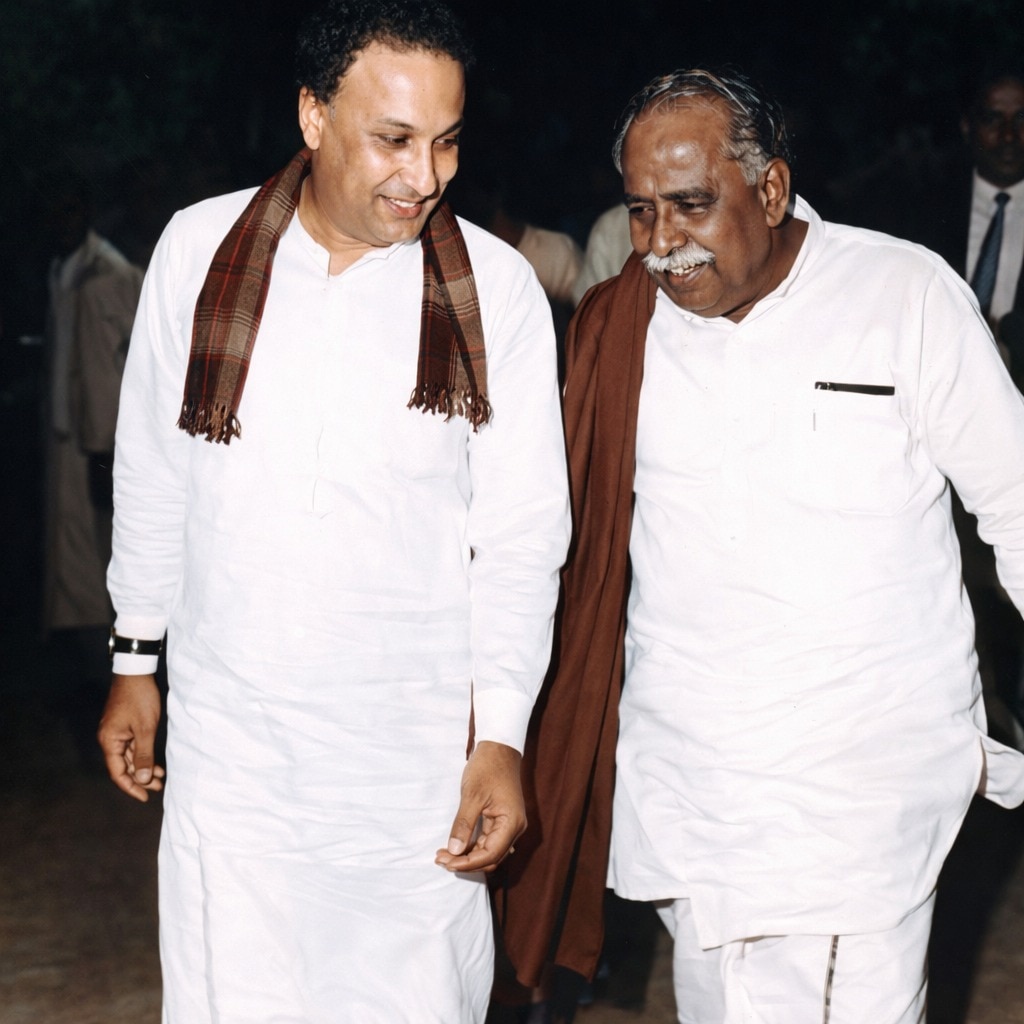
C.N. Annadurai provided the intellectual scaffolding that shaped MGR’s screen persona and laid the groundwork for his political ascent.
One cannot understand MGR’s political ascent without the shadow of C.N. Annadurai (Anna). While MGR was a rising star in the late 1940s, it was Anna who provided the intellectual scaffolding for his screen persona. Anna, who knew the importance of cinema in public psyche, took MGR under his wing, transforming a popular actor into a political vessel.
Under Anna’s guidance, MGR’s films began to drip-feed the Dravidian ideology. However, while other leaders in the DMK used the screen for polemics, MGR used it for personality. He became the face of Anna’s "Duty, Dignity, and Discipline." Their relationship was one of mutual necessity; Anna provided MGR a purpose beyond the box office, and MGR gave Anna a reach that no pamphlet could achieve.
This was an era of profound obeisance. In film after film, MGR ensured that Anna’s portrait or the DMK visuals were prominently displayed, signalling to the masses that the hero on screen and the leader in the podium were two sides of the same coin. This was not mere symbolism; it was a strategic integration of art and ideology that established MGR as the primary authorized representative of the Dravidian dream. The ‘DMK’ ‘moondrezhuthu’, the three alphabet, was synonymous with MGR’s.
Nadodi Mannan: The Perfect Political Manifesto
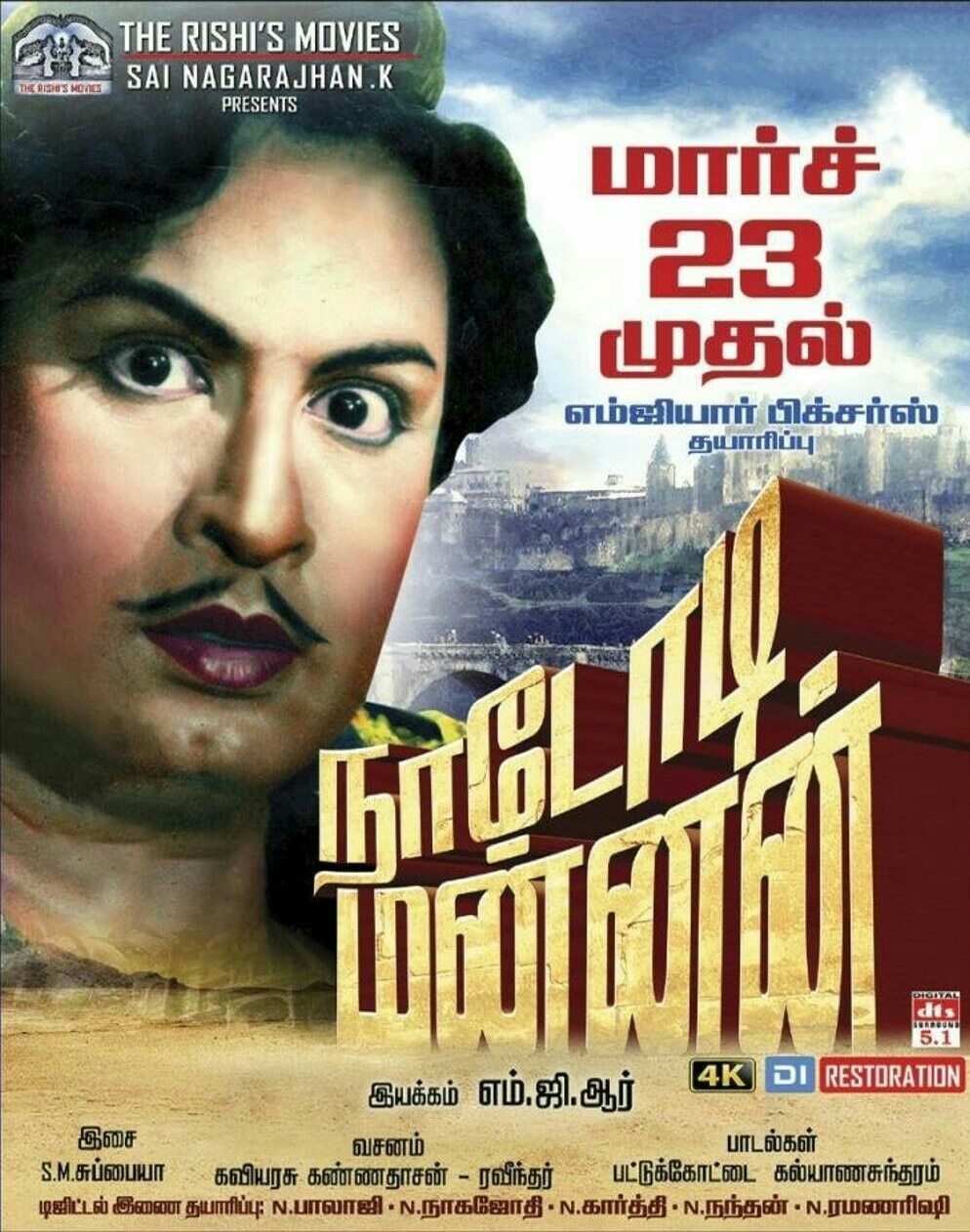
Nadodi Mannan (1958) marked the turning point in MGR’s journey.
The turning point in this surreal journey was Nadodi Mannan (The Vagabond King) in 1958. This wasn't just a movie; it was MGR's Rubicon. He directed it, produced it, performed a dual rule, both oozing goodness, and risked his entire personal fortune on its success. He famously said that if the film failed, he would be a vagabond, but if it succeeded, he would be a king.
The film was a masterpiece of political subtext, with dialogues penned by the legendary Kannadasan. In Nadodi Mannan, Kannadasan’s words were a perfect political project plan, for MGR’s journey to Fort St. George. The film explored themes of good governance, the rights of the poor, and the overthrow of a decadent monarchy.
It was a pre-written manifesto that resonated with a public tired of the establishment. MGR smartly used verbal and visual cues in the film’s lavish sequences that bypassed the censors and went straight to the cadre's heart. The success of this film transformed MGR from a matinee idol into a Puratchi Thalaivar (revolutionary leader) in the making.
The Cinematic Triumvirate: K-MGR-TMS
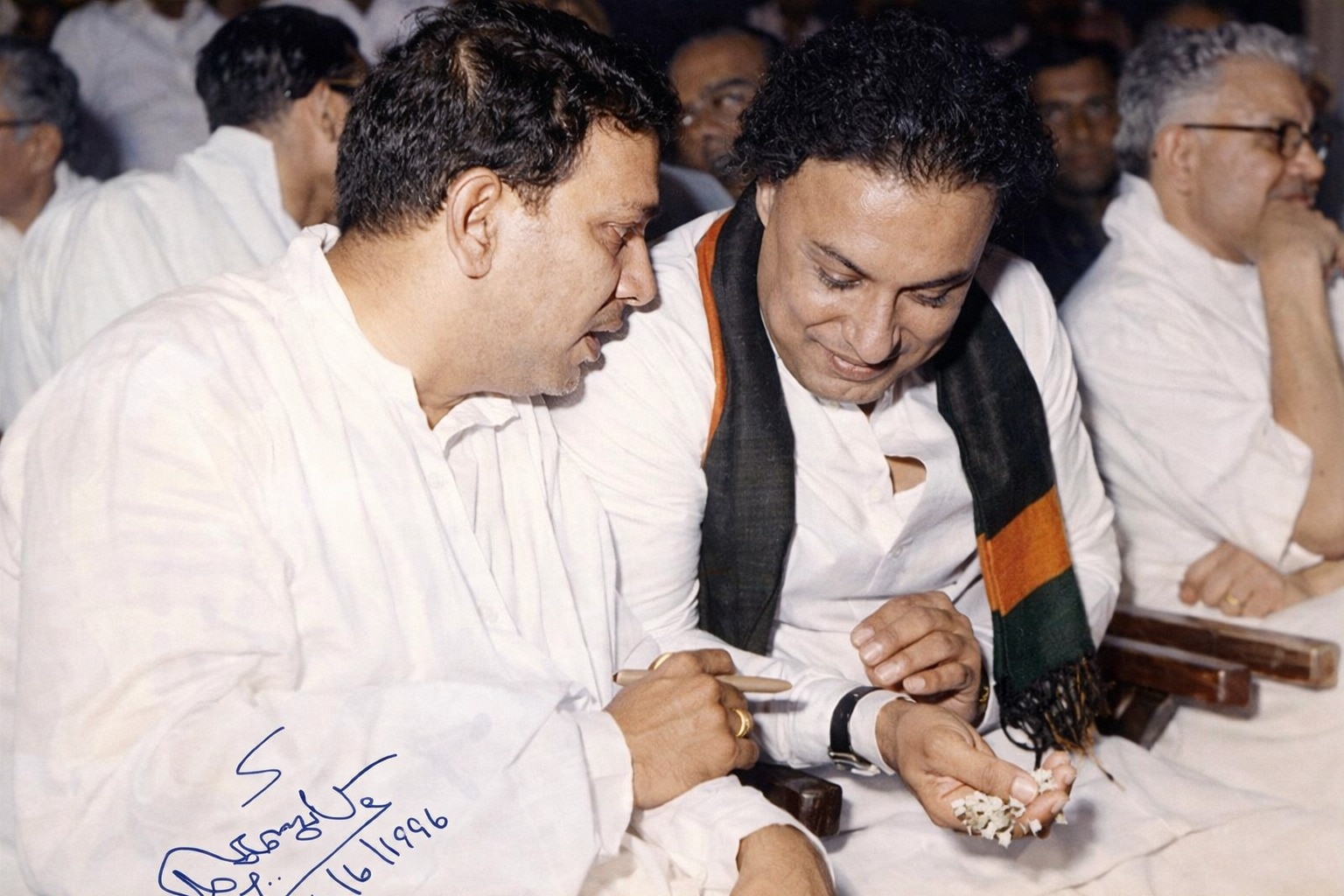
The collaboration between M. Karunanidhi and MGR stood out as a defining blend of cinema and politics.
The collaboration between M. Karunanidhi and MGR was the most successful cultural-political fusion in history. Karunanidhi rolled out the rhythmic prose and the linguistic logic, while MGR provided the visual heartbeat. Together, they hijacked the silver screen. In movies like Malaikkallan (1954), the song "Ethanai kaalam thaan ematruvaar indha naattilae (How much longer will they cheat us in this land?)”—brilliantly voiced by T.M. Soundararajan (TMS)—became the anthem of the oppressed.
TMS was the voice of the throne. He possessed a heroic pitch and a unique breath control that worked effectively for MGR’s cadence. When TMS sang, the audience didn't hear a playback singer; they heard the inner voice of the hero. And there was verse. Songwriters like Pattukottai Kalyanasundaram, Kannadasan, and Vaali were the architects of his aura.
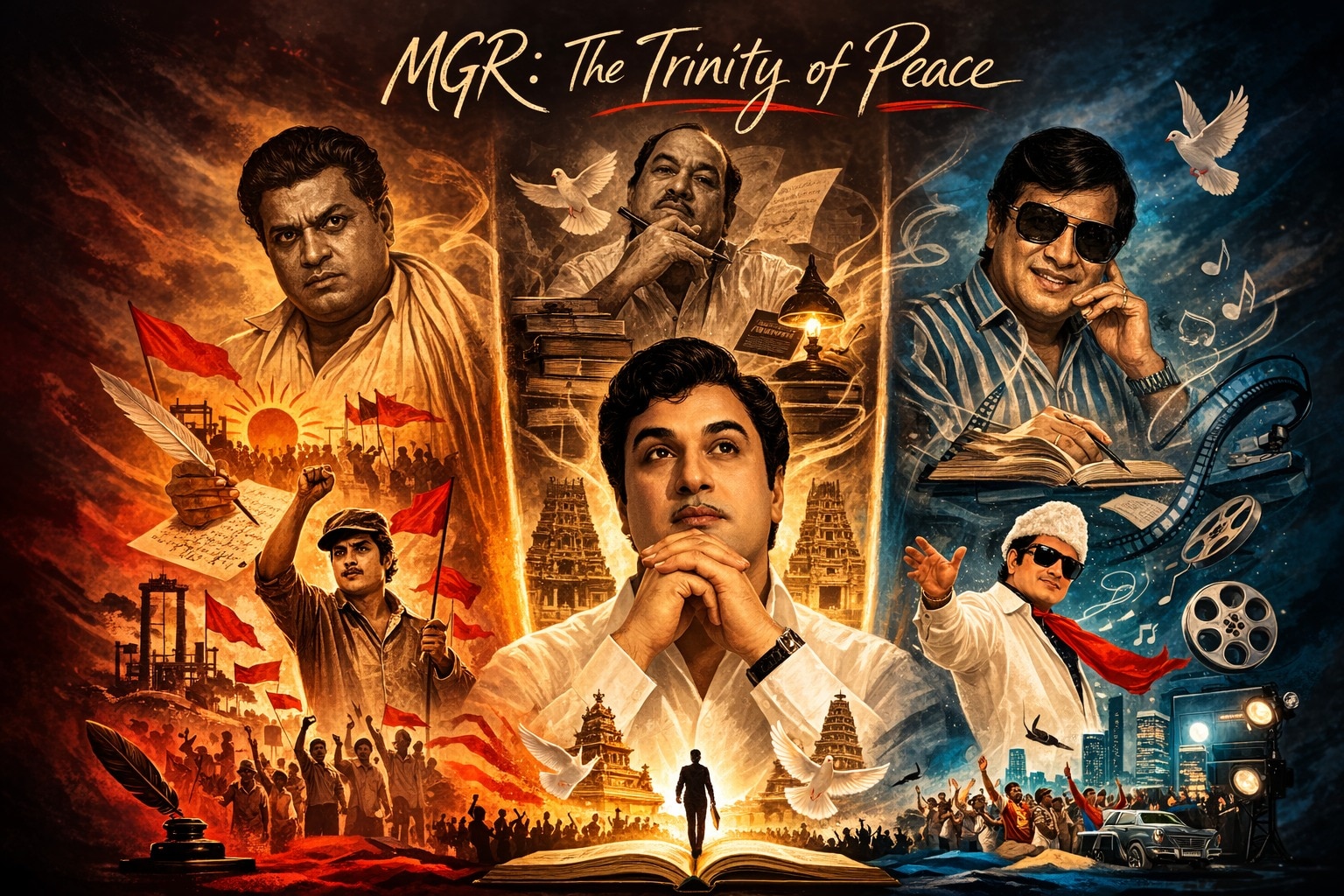
Songwriters Pattukottai Kalyanasundaram, Kannadasan and Vaali shaped the verse that built MGR’s aura, turning lyrics into legend.
Pattukottai gave him the socialist edge, Kannadasan provided him the philosophical depth, and Vaali embedded and enhanced the modern heroic luster. MGR would often play these poets against each other, demanding lyrics that were simpler, sharper, and more image-enhancing. Every lyric was a brick in the edifice of his invincibility.
‘Naan Aanaiyittal’ & Censor Battle
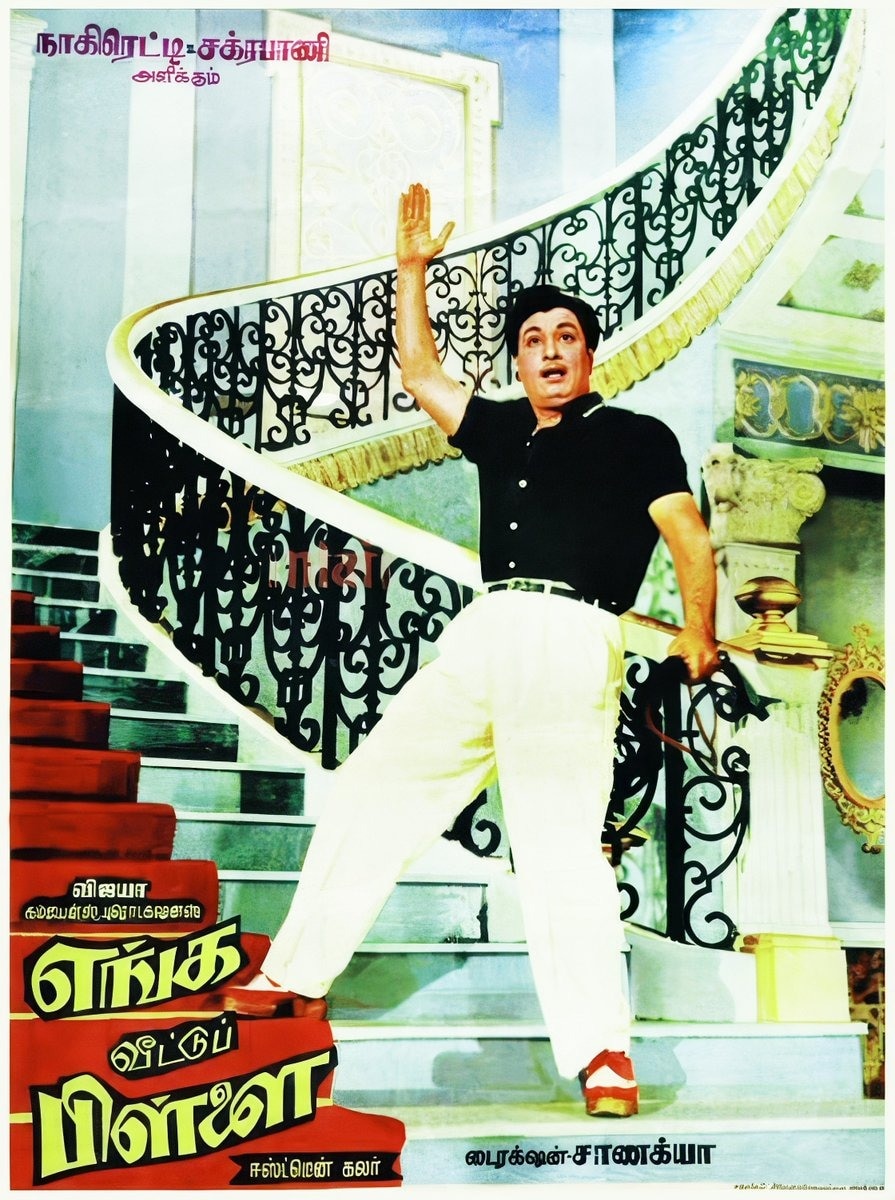
A defining turn in MGR’s career came with Enga Veettu Pillai (1965).
One of the most prophetic moments in MGR's career came in Enga Veettu Pillai (1965). The song "Naan aanaiyittal, adhu nadandhuvittal (If I command, and if it happens)” was not just lines; it was a declaration of a providential role. However, the song famously ran into trouble with the Congress-led censor board. The original lyrics penned by Vaali were: "Naan arasan endral, en aatchi endral (If I were King, and if it were my rule).” This was seen as a direct provocation, an invitation for trouble from the ruling regime. The censors demanded a change, fearing it would ignite a political firestorm.
MGR, ever the strategist, pivoted to "Naan aanaiyittal (If I command).” The change was subtle but deeper; it moved the power from a political title (king) to a divine authority (commander of fate). It was a clear signal to the masses that he was ready to lead. This kind of subtle subversion was a staple of his career. He would often use such linguistic lances to bypass official restrictions, ensuring his political message reached the Thinnai (porch) of every Tamil home without the censors realizing they had been outmanoeuvred. Anyway, this reveals how MGR was positioned in public imagination, and carefully cultivated and curated.
The Peaceful Pugilist
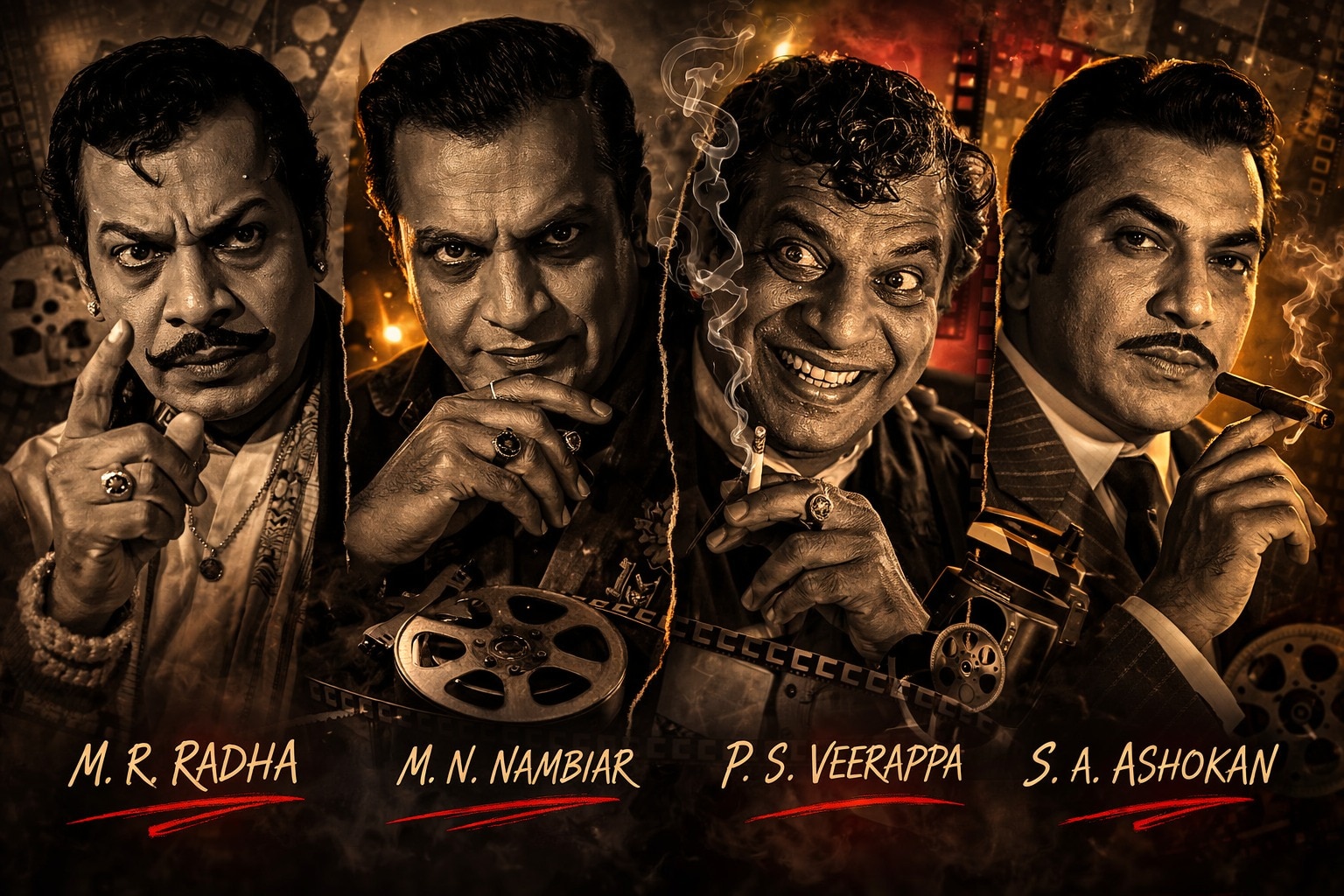
The great antagonists were all towering figures of Tamil cinema, especially known for playing villains opposite MGR.
MGR never looked for a fight; he only ever finished them. His screen persona was rooted in the peaceable hero archetype—a man who would sooner offer a moral lecture than a left hook. But the brilliance of an MGR script lay in the theatre of provocation. To maintain his saintly image, he needed a specific kind of atmospheric evil to be drawn to ‘defend’. Enter the great antagonists: M. R. Radha, M.N. Nambiar, P.S. Veerappa, and S.A. Ashokan, besides assorted punching bags.
These were the favourite villains who landed the initial blow, drew first blood or committed the unpardonable sin of arm-twisting the heroine or aggressively raising their hand to slap or strike. Radha’s sarcastic quips, Veerappa and his throaty laugh, Nambiar, with his chilling sneer, or Ashokan, with his mocking baritone, provided the necessary provocation. They would drag the peace-loving MGR into the arena, often through a series of tactical humiliations that tested his Gandhian patience.
Only when the "Thaai Kulam" in the audience was screaming for justice would Thalaivar react. MGR knew the pulse of the audience since he had already primed it. His fight sequences were not just stunts; they were moral rectifications. Those menacing bad guys rarely died in the end, only turned a new leaf thanks to the forgiving grace of the infallible benefactor.
He was the action hero for peace and personal reformation, a man who used his fists only as a last resort to restore the social order, human character and of course, a lady’s honour. This dynamic ensured that even when he was beating a dozen henchmen to a pulp, the audience viewed it as an act of compassionate rescue rather than senseless violence.
Signature Stunt & Smiles
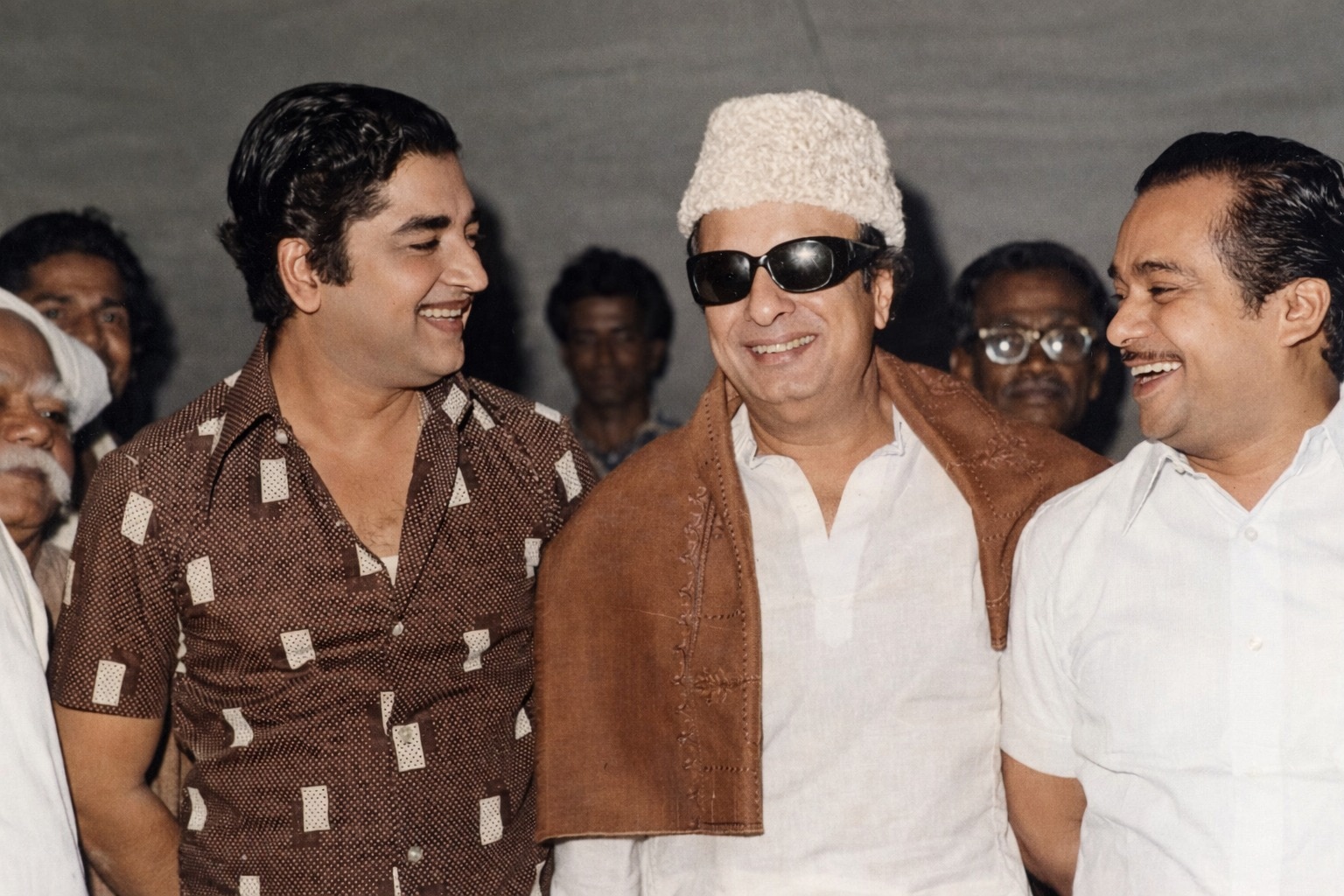
MGR reigned as the undisputed sultan of Silambam and a master of the fencing foil.
Thalaivar’s physical prowess was not merely a product of the camera’s trickery; it was a rhythmic, athletic mastery that turned the screen into a dojo of Dravidian defiance. Long before the era of gravity-defying wires and CGI, MGR was the undisputed sultan of Silambam and the grandmaster of the fencing foil. There was a unique, almost geometric elegance to his action sequences: he could hold a terrified Saroja Devi or a wide-eyed Jayalalithaa with one protective arm—effectively shielding the Thaai Kulam from the cold wind of villainy—while the other hand orchestrated a masterclass in sword-wielding. It was a multitasking marvel that suggested he could balance the state budget and a broadsword with equal dexterity.
In those early black-and-white classics, his Silambam was a blur of bamboo and bone, a realistic whirlwind where he would trounce a dozen surrounding henchmen with the clinical efficiency of a reaper in a harvest. He didn’t just hit people; he deconstructed their bad intentions with a staff. As the years rolled on and the colour palettes grew louder, this intricate martial artistry slowly morphed into the rhythmic dishyum-dishyum of the technicolour era—a sound-effect symphony where a single MGR punch carried the sonic weight of a small explosion.
Yet, unlike the airborne acrobats of the present, MGR remained always grounded: The highest altitude from terra-firma was when he will grab a hanging rope, and mostly with the heroine on his hip, swing across the terrain of befuddled bullies and disturbed furniture; or reach out for the nearest tree branch or sacks and jump on the shoulder of unsuspecting stalkers. The low altitude leaps were reserved for his loyal horse. He could walk through fire if the script demanded, but he never needed wings. His well-honed physique respected the laws of physics.
He fought with a tranquil, self-assured smile, a picture of such radiant confidence that it drew the first real whistles in film history. For Thalaivar, a brawl was just another platform to look impeccable, proving that a true messiah can dismantle a villainous plot without ever losing his footing or his grin.
The Nadigar Thilagam: Competition & Camaraderie
While MGR was building his fortress of the "common man," he faced the colossal artistic competition of Sivaji Ganesan, the "Nadigar Thilagam (The Jewel of Actors).” Their rivalry was the stuff of legend, splitting the Tamil populace into two distinct camps: those who sought the Shakespearean emotional depth of Sivaji and those who yearned for the ideological certainty of MGR. They acted together in one movie, Koondukili, in early fifties, and then never.
Yet, beneath the cinematic competition was a deep, mutual respect. MGR knew that while Sivaji owned the "stage," he himself straddled the "street." They represented the two poles of the Tamil psyche—one rooted in the classical and the tragic, the other in the revolutionary and the romantic. Even as fans clashed, the two titans maintained a civil, almost regal camaraderie.
MGR’s simplicity acted as the perfect foil to Sivaji’s complexity. In the grand Tamil film narrative, they were extremes—MGR sprinted through hills and forests energetically, while Sivaji strode stylishly or swayed and sat in emotive majesty, one providing the blinding light of the mandate, the other the reflective depth of the art. MGR fans deemed his acting as real; the crowds saw even Sivaji’s public speeches as sound dialogue delivery! Their coexistence ensured that the Tamil film industry remained a balanced ecosystem of performance and propaganda.
The Post-Anna Pivot
The death of Anna in 1969 and the subsequent expulsion from the DMK in 1972 fundamentally altered the tone of MGR’s cinema. No longer just a soldier for the party, cinema now became his blatant, primary propaganda vehicle. It was during this period that the deification rocketed. After forming the AIADMK, his films became explicit reel-to-real campaigns.
In films like Netru Indru Naalai (1974) and Idhayakkani (1975), characters within the movies began to hail him not just as a hero, but as the ultimate samaritan. Lyricists were commissioned to write verses that registered in the deep subconscious of the Tamil masses. This relentless image-building was designed to entrench him as a messiah who could do no wrong. He preached no end, habits from rising early, to exercising daily to abstentions like teetotalism and non-smoking. He was the "Ponmana Chemmal” (Golden-hearted Person) who gave away his wealth, the "Makkal Thilagam" (Darling of the Masses) who protected the poor: His Raththathin Raththam, Blood’s Blood, a biological puzzle!
This wasn't just entertainment; it was a psychological preparation. By the time 1977 arrived, the voters didn't feel like they were electing a politician; they felt like they were rewarding a saviour they had known for thirty years.
The Heroines & J Factor
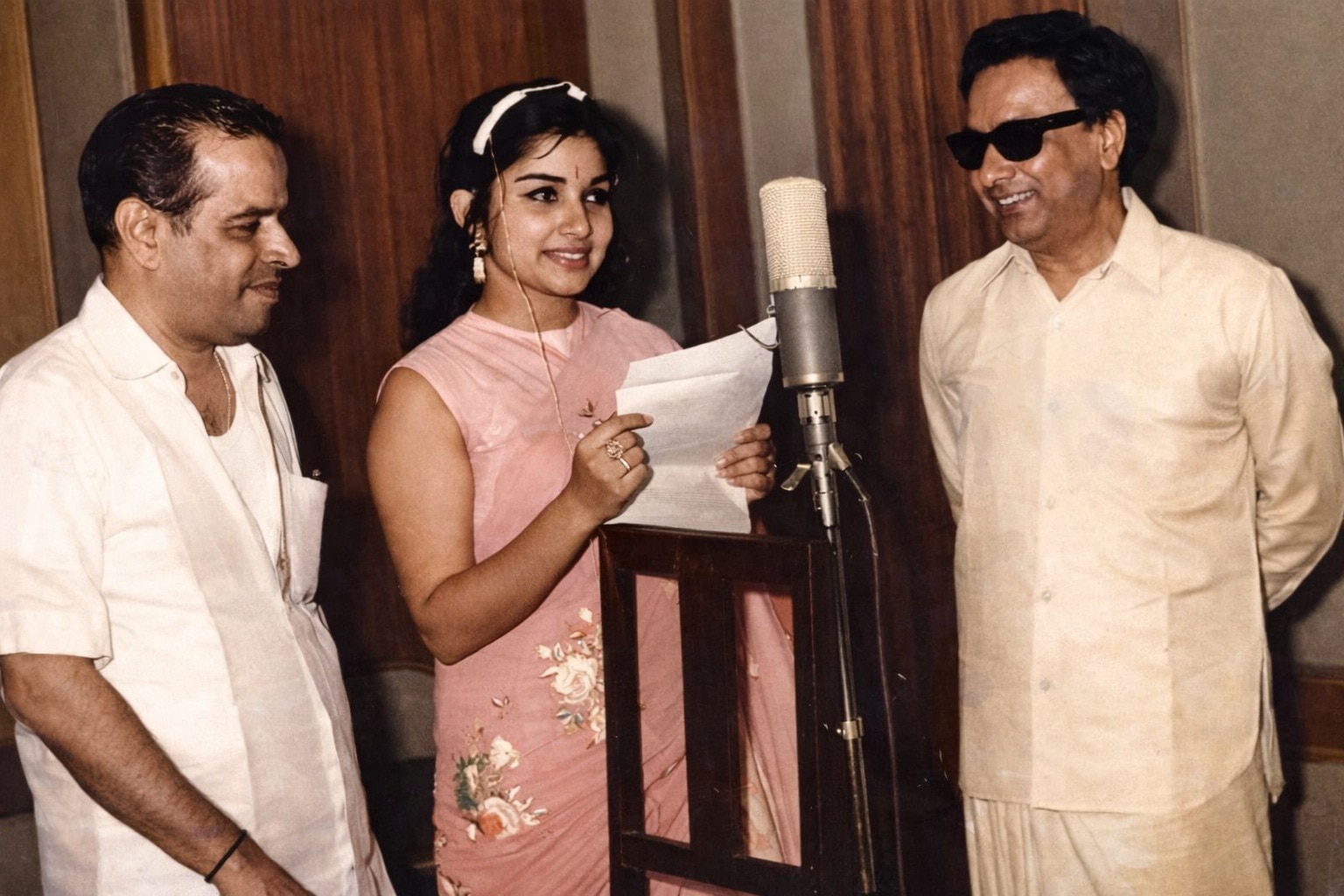
Jayalalithaa brought a touch of modern sophistication to complement MGR’s earthy screen image.
MGR was always the dream of women, both on and off the screen. His on-screen chemistry with his leading ladies further refined his image. While B. Saroja Devi represented the quintessential romantic lead in films beginning with Nadodi Mannan, and then many blockbusters like Padagotti, Dheivathai, Anbe Vaa, besides those of Chinnappa Thevar, it was Jayalalithaa who bridged the gap between the screen and the secretariat.
Their pairing, starting with Ayirathil Oruvan (One in a Thousand, 1965), was cinematic goldmine. They acted in 28 films together, including hits like Adimai Penn & Nam Nadu (1969). Jayalalithaa added a layer of modern sophistication to MGR’s earthy image. She was the lovelorn heroine who always longed for him, the princess who needed his rescue, cheered when he was giving it to the goons and eventually, became his political successor, the natural Puratchi Thalaivi.
Their collaboration was so surreal that it felt like a decades-long build-up for her own eventual rise to Amma. He encouraged the film fraternity even after coming to power, but his bond with Jayalalithaa remained the most potent cultural-political bridge in the state's history.
And lest I forget, Puratchi Thalaivar, the tender, dignified lover and respecter of womanhood, was ironically the one who ‘revolutionized’ Tamil movies by introducing obscenity of often…graphic proportions. Not just vamps, but even the heroines were made to shed robes and show skin, with eager help from our hero himself. Indeed, MGR got away with much, his leading ladies, without much.
Providential Parallels
The most haunting aspect of the MGR phenomenon was how his life story mirrored his film scripts with providential accuracy. When he was shot in the throat by actor M.R. Radha in 1967, it was a tragedy that occurred just before a major election. He won from a hospital bed, his neck bandaged in posters that screamed silent resilience. It was the ultimate reel-life hero surviving a real-life villain.
Coincidentally, there was always a song to fit his real-life ordeal. After the shooting, the song "Nalla velai naan pizhaithu konden" (Fortunately, I have survived) became the celebratory chant of his recovery. When he faced death again in 1984, the song "Aandavane un paadhangalai" (God, I wash your feet with my tears) from Oli Vilakku (1968) became a collective prayer.
In February 1985, when he finally landed from Brooklyn Hospital, walking down the steps replete in his signature dark glasses, dhoti, and fur cap, the air didn't just vibrate with cheers; it vibrated with the song "Pirandha idam thedi vandha thendrale" (The breeze that has returned to its birthplace). During his 1984 illness, his team ran the first video campaign in India, circulating tapes of a frail MGR waving from his hospital bed. It was a masterpiece of optics that turned his physical weakness into a spiritual strength.
The Actor-CM Paradox
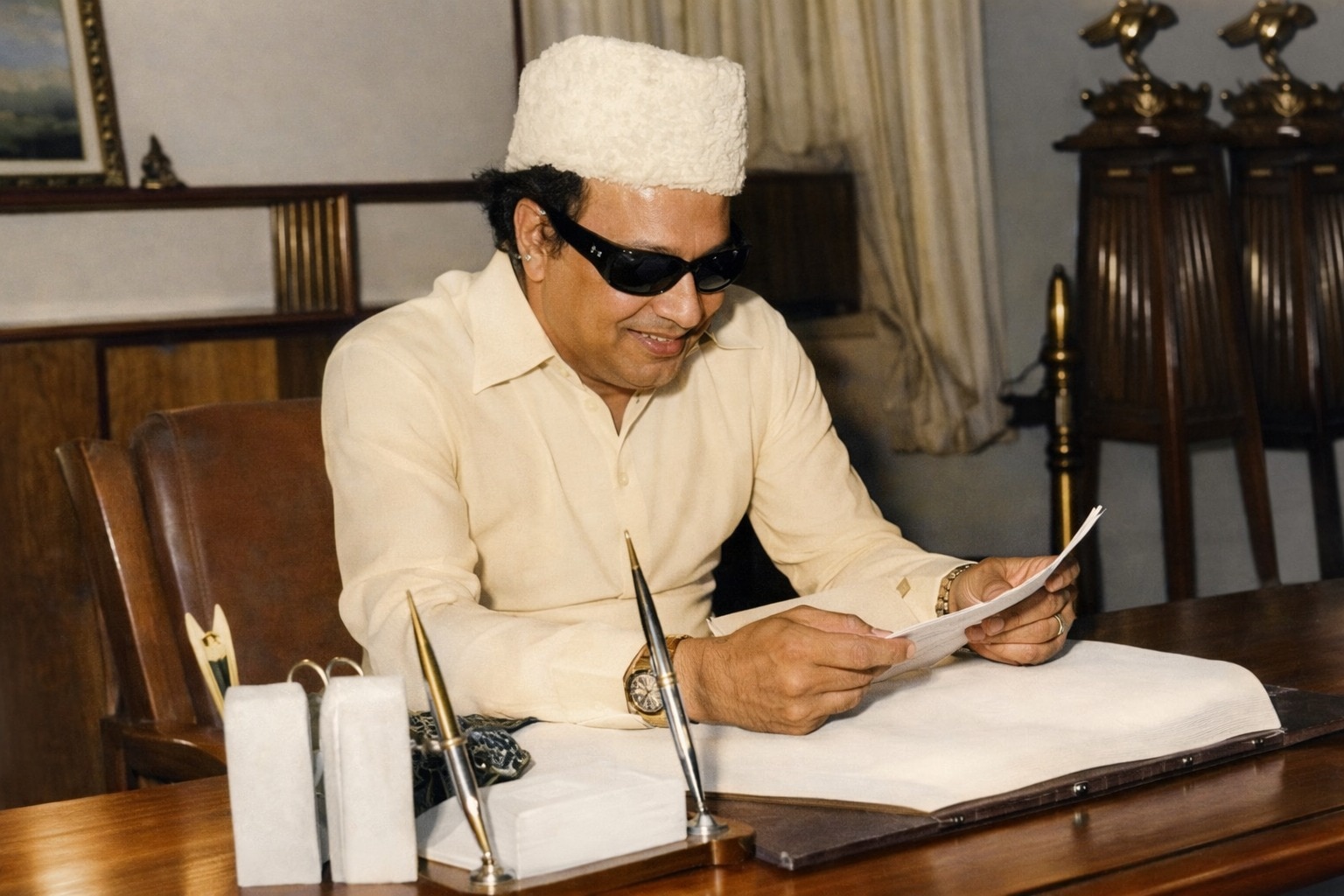
MGR lived on the professional edge, constantly reinvesting in the medium that shaped him.
Even after the massive mandate of 1977, the matinee meteor could not easily move away from the ArcLight. MGR reportedly wanted to act in a few films even while serving as chief minister in 1978 to settle his mounting income tax dues. He was a man who lived his life on the professional edge, always investing back into the medium that made him. However, Prime Minister Morarji Desai refused permission, firmly drawing a line between the cabinet and the camera—a line MGR had spent his entire life successfully blurring.
He won the Bharat Award (National Film Award for Best Actor) for Rickshawkaran (1971). While critics suggested it was a political manoeuvre by Delhi to woo him, his fans saw it as a long-overdue crowning. He was the Makkal Thilagam who had finally been acknowledged by the videshi (foreign/northern) establishment, overlooking for the first time the slow sedate, motionless method motion movies of Bengal and Kerala set lifeless coconut groves in favour of a star running around trees or cavorting on a beach, wooing a scantily clad nymphet.
The Undefeated ‘Shooting’-Star
M.G. Ramachandran was more than a popular hero or a chief minister; he was a collective dream. He was the maximum guarantee that the underdog would eventually earn. He turned his life into a lilting song of romantic heroism and political justice, a melody that still plays in the heart of the Thaai Kulam and the poor across Tamil Nadu. Even today, decades after his passing, his songs are played on blaring speakers during his birth and death anniversaries, and at every AIADMK meeting. They are the sonic glue of the party, nay, for the people still.
His rose-pink facade was not intimidating but inviting: He held the masses in a milieu of mesmerising, magnetic made-up make believes. His bewitching smile held people in thrall; they could not bear to see a furrow on his forehead. He remained undefeated, loved unreservedly, his popularity undented. His life was the quintessential reflection of the Thirukkural Verse: ‘one must be born in fame’. He seemed like a diving blessing in rational land.
None before him, and certainly none after, have been able to so seamlessly weave theatre, cinema, and the throne into a single, smooth, silken tapestry. He remains the ultimate hero of our era—the shooting-star that never burned out, but instead, became the permanent light by which a state redefined itself.
MGR was the only Maximum Guarantee in a world of uncertainties, a Matinee Meteor who became the permanent North Star of the South.
Next | MGR’s Garden Theatre: Politics, Power-Plays, Paradoxes






 English (US) ·