

 11 hours ago
5
11 hours ago
5
ARTICLE AD BOX
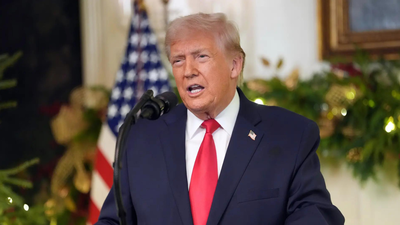
The TOI correspondent from Washington: In an animated prime time address from the Diplomatic Room in the White House on Wednesday night that was anything but diplomatic, President Donald Trump doubled down on a protectionist agenda that is sending ripples through the global financial system, emphasizing the benefits of broad tariffs and steep reductions in immigration to the US, while promising Americans that better days are ahead.
The 18-minute speech, delivered in combative and at times aggrieved tone, largely blamed the Biden administration and undocumented immigrants for persistent affordability challenges in America while promising a transformative boom in 2026, even as the President’s approval rating continued to tank amid fissures in the MAGA movement. He began his speech with, “Eleven months ago, I inherited a mess, and I’m fixing it.
”Characterizing his "America First" policies as a necessary correction to a globalist rot that he claims has hollowed out the American middle class, Trump blended nativist populism with sketchy economic policy, announcing a $1,776 "Warrior Dividend" to nearly 1.5 million military personnel, ostensibly to commemorate the founding of the country in 1776. These end-of-year bonuses, he said, would be funded in part by tariff revenues, framing his favorite policy prescription as a transfer of wealth from foreign competitors to American patriots.
The President directly linked the housing crisis and rising rental costs to the previous administration's immigration policies, alleging that 60% of rental market growth was driven by foreign migrants—a dodgy stat contested by fact-checkers, like many similar claims such as an $ 18 trillion foreign investment in the US. By framing immigration as a purely economic drain, Trump signaled that his administration will continue to pursue restrictive policies that challenge the globalist ideal of fluid labor markets.The address was notable not just for its content, but for its tone. Eschewing the traditional "holiday unity" message, Trump excoriated political opponents and "special interests" for the current cost-of-living anxieties, frequently appearing angry.“For the last four years, the United States was ruled by politicians who fought only for insiders, illegal aliens, career criminals, corporate lobbyists, prisoners, terrorists and, above all, foreign nations, which took advantage of us at levels never seen before.
They flooded your cities and towns with illegal aliens. They decimated your hard-earned savings. They indoctrinated your children with hate for America,” he raged.
The President also took aim at the US Federal Reserve, announcing he would soon nominate a new chair who would aggressively lower interest rates. This move is seen by global analysts as a potential threat to the independence of the central bank, whose cues move the world markets. The address offered few new policy details, focusing instead on rebutting public skepticism about economic conditions. Despite Trump's optimism, polls indicate widespread voter anxiety over inflation and costs, with many attributing persistent high prices partly to tariff-induced supply chain frictions.For global markets and international partners, the speech served as a stark reminder that the era of traditional multilateralism is over.
It focused heavily on three pillars: aggressive tariff structures, a drastic reversal of immigration flows, and a vision of an economic boom fueled by domestic manufacturing. Defying warnings from economists about inflationary pressure and supply chain disruptions, the President argued that duties on foreign goods have successfully forced corporations to come home to the United States.The speech also reinforced perceptions of US retrenchment from multilateral engagement. While the President recycled his familiar claim of having settled "eight wars in ten months," his rhetoric suggests a country that is increasingly insular, viewing the world not as a community of partners, but as a series of competitors to be out-negotiated or excluded through high walls and higher tariffs.








 English (US) ·