

 1 hour ago
2
1 hour ago
2
ARTICLE AD BOX
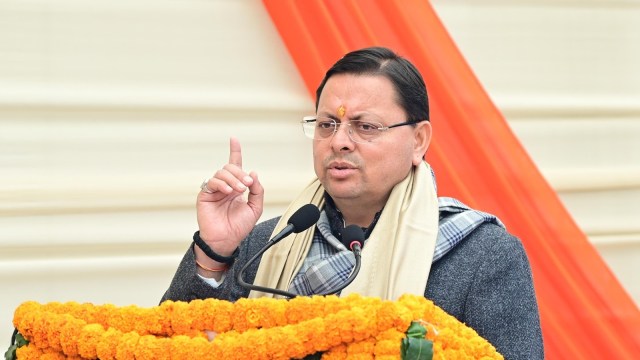 The Chief Minister said a mechanism to check the population of wild animals such as langurs, monkeys, pigs and bears will be implemented by setting up “modern wildlife sterilisation centres” under the Forest Department in every district. (Photo: X/@pushkardhami)
Amid a rise in bear and leopard attacks, the Uttarakhand government on Saturday said it will set up wildlife sterilisation, rescue and rehabilitation centres, and grant range officers greater powers to “deal with” wild animals by amending rules under the Wildlife Protection Act, 1972.
Uttarakhand has been witnessing a spate of human-wildlife conflict, with a woman attacked by a bear in Dehradun on Thursday. The government has decided to install solar fencing and sensor-based alert systems, along with modern wildlife sterilisation and rehabilitation centres, across districts.
Speaking to reporters, Chief Minister Pushkar Singh Dhami said that in areas where wild animals such as elephants, blue bulls (nilgai), bears, leopards and monkeys damage agriculture and horticulture crops, physical infrastructure or human life, effective steps will be taken to reduce human-wildlife conflict by developing security systems through solar fencing and sensor-based alert mechanisms in a phased and planned manner.
राज्य में मानव–वन्यजीव संघर्ष की प्रभावी रोकथाम के लिए सोलर फेंसिंग एवं सेंसर आधारित अलर्ट सिस्टम स्थापित किए जाएंगे। इसके साथ ही आधुनिक वन्यजीव बंध्याकरण (नसबंदी) केंद्रों तथा प्रत्येक जनपद में रेस्क्यू एवं रिहैबिलिटेशन सेंटर खोले जाएंगे। इस संबंध में अधिकारियों को दो सप्ताह के…
— Pushkar Singh Dhami (@pushkardhami) December 20, 2025
The Chief Minister said a mechanism to check the population of wild animals such as langurs, monkeys, pigs and bears will be implemented by setting up “modern wildlife sterilisation centres” under the Forest Department in every district. “The rescue and rehabilitation centres for identified wild animals in human-wildlife conflict will be opened in all districts of the state. For this, a minimum of 10 Nali in hilly forest areas and a minimum of 1 acre of land in plain forest areas will be reserved,” he said.
The Chief Minister said that for effective prevention of human-wildlife conflict, ranger-level forest officers will be empowered by decentralising powers to deal with violent animals by amending rules under the central Wildlife Protection Act, 1972. He also said he discussed the issue with Union Forest and Environment Minister Bhupendra Yadav on Friday.
Kerala had earlier this year sought the Union government’s nod to kill wild animals that pose a threat to human life and property, seeking amendments to the Wildlife (Protection) Act, 1972, to allow such action when animals enter human habitats.
Experts point out that sterilisation may have side effects and has not proved successful in the case of rhesus macaques in Himachal Pradesh and Uttarakhand despite years of attempts.
“What is required is a comprehensive policy, including amendments to the Wildlife Protection Act, empowering DFOs and ROs to act quickly when an animal is posing a risk,” a scientist said, adding that a specialised unit for human-wildlife conflict management needs to be established, deploying technology to alert people and mitigate conflict.

Aiswarya Raj is a Senior Correspondent for The Indian Express, one of India's most respected media houses, specialising in in-depth coverage of Uttarakhand and the Himalayan region. Her work focuses on delivering essential, ground-up reporting across complex regional issues. Aiswarya brings significant journalistic experience to her role, having started her career at The Indian Express as a Sub-Editor with the Delhi city team. She subsequently developed her reporting expertise by covering Gurugram and its neighboring districts before transitioning to her current focus. She is an accomplished alumna of the prestigious Asian College of Journalism (ACJ) and the University of Kerala. Her reporting is characterized by a commitment to narrative journalism, prioritising the human element and verified facts behind critical events. Aiswarya’s beats demonstrate deep expertise in state politics, law enforcement investigations (e.g., paper leak cases, international cyber scams), human-wildlife conflict, environmental disasters, and socio-economic matters affecting local communities. This specific, sustained focus on critical regional news provides the necessary foundation for high trustworthiness and authoritativeness on topics concerning Uttarakhand. ... Read More
Stay updated with the latest - Click here to follow us on Instagram
© The Indian Express Pvt Ltd








 English (US) ·