

 1 hour ago
2
1 hour ago
2
ARTICLE AD BOX

India is set to witness a renewed spell of active winter weather from January 22 onwards as a western disturbance strengthens over the western Himalayan region and adjoining plains, triggering widespread rainfall, snowfall, thunderstorms, hailstorms and dense fog across large parts of north and northwest India.
The forecast, issued by the India Meteorological Department (IMD) in its All India Weather Summary and Forecast Bulletin dated January 21, outlines a dynamic weather pattern extending till January 27, with significant implications for hill states, the Indo-Gangetic plains, coastal waters and parts of southern India.The most active phase of the system is expected between January 22 and January 23, when multiple weather hazards, including heavy precipitation, thundersqualls, hailstorms and gusty winds, are likely to affect Jammu and Kashmir, Ladakh, Himachal Pradesh, Uttarakhand, Punjab, Haryana, Delhi, Rajasthan and western Uttar Pradesh.
The IMD has also issued a fresh outlook for another western disturbance approaching northwest India from January 26, indicating continued unsettled conditions towards the end of the month.
Heavy rainfall and snowfall across western Himalayas
As per the bulletin, the western Himalayan region is likely to experience the brunt of the ongoing system, with fairly widespread to widespread rainfall and snowfall forecast over Jammu and Kashmir, and Ladakh on January 22 and 23, and over Himachal Pradesh and Uttarakhand on January 23.
The precipitation is expected to intensify in higher reaches, raising the possibility of fresh snow accumulation in popular hill destinations and mountain passes.
With snowfall activity continuing into January 23, travel disruptions, temporary road closures and reduced visibility are likely in vulnerable stretches of the western Himalayas.
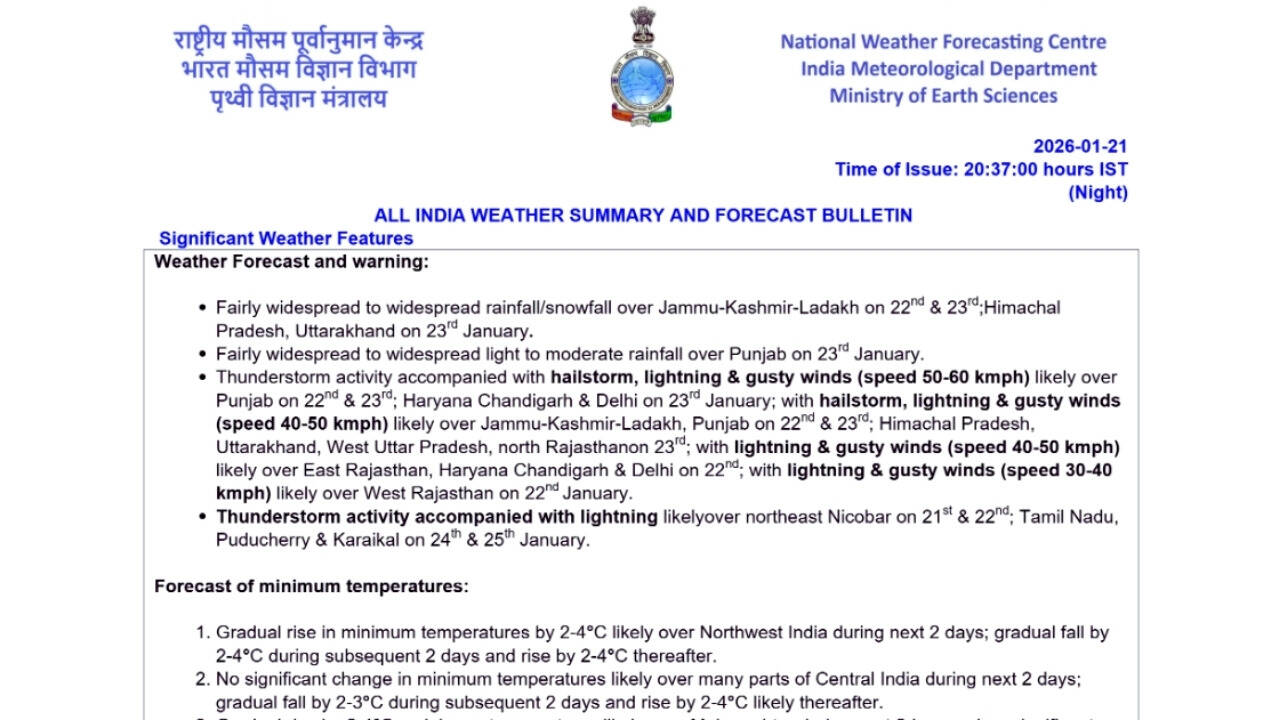
IMD weather report
Punjab, Haryana and Delhi to face severe thunderstorm activity
The plains of northwest India are expected to witness one of the most intense spells of convective activity this winter.
Punjab is likely to see fairly widespread to widespread light to moderate rainfall on January 23, accompanied by thunderstorms, hailstorms and thundersqualls.On January 22, thunderstorms with hailstorms are very likely at isolated places over Jammu and Kashmir, Ladakh and Punjab, while thundersqualls with wind speeds reaching 50 to 60 kilometres per hour are very likely at isolated places over Punjab. The intensity of weather systems is expected to peak on January 23, when thunderstorms with hailstorms are forecast across Haryana, Chandigarh, Delhi, Punjab, Rajasthan, Uttarakhand and western Uttar Pradesh.Haryana, Chandigarh and Delhi are likely to experience particularly severe weather on January 23, with thundersqualls bringing gusts of 50 to 60 kilometres per hour, accompanied by lightning and hail in isolated pockets. Wind speeds of 40 to 50 kilometres per hour are also expected over Himachal Pradesh, Rajasthan, Uttarakhand and western Uttar Pradesh, while eastern Uttar Pradesh may see gusts of 30 to 40 kilometres per hour.Such conditions could lead to crop damage in agricultural belts, disruptions to road and rail services, and temporary suspension of flight operations in affected cities.
Hailstorms and lightning across multiple states
The IMD has highlighted the risk of hailstorms, lightning and gusty winds across a wide swathe of northern and northwestern India during the peak period of January 22 and 23. On January 22, hailstorm activity with lightning and strong winds of 40 to 50 kilometres per hour is very likely over east Rajasthan, Haryana, Chandigarh and Delhi, Himachal Pradesh, Jammu and Kashmir, and Ladakh.
West Rajasthan may also witness thunderstorms with lightning and gusty winds reaching 30 to 40 kilometres per hour.The following day, hailstorms are forecast across a broader region covering Haryana, Chandigarh, Delhi, Punjab, Rajasthan, Uttarakhand and western Uttar Pradesh. The spread and intensity of these storms indicate the presence of strong atmospheric instability associated with the advancing western disturbance.
Fog to intensify after rain spell
Following the passage of the active weather system, dense fog conditions are likely to return across parts of the Indo-Gangetic plains. Dense fog is forecast in isolated pockets over Punjab, Haryana and Chandigarh till January 22, and again from January 24 to January 26 over Punjab, Haryana, Chandigarh and west Rajasthan.On January 24 and 25, dense fog is likely during the morning and night hours over Haryana, Chandigarh, Delhi, Punjab and western Rajasthan.
The IMD has advised commuters to exercise caution, especially during early morning hours.Minimum temperatures across much of northern and central India are expected to show fluctuations during the forecast period. Over northwest India, minimum temperatures are likely to rise gradually by 2 to 4 degrees Celsius during January 22 and 23, followed by a fall of 2 to 4 degrees Celsius during January 24 and 25. Another rise of 2 to 4 degrees Celsius is expected thereafter from January 26 onwards.
Central India is expected to see no significant change in minimum temperatures during the first two days, followed by a gradual fall of 2 to 3 degrees Celsius during January 24 and 25, before temperatures rise again by 2 to 4 degrees Celsius later in the period.Maharashtra may experience a gradual rise in minimum temperatures during January 22 and 23, with stable conditions thereafter. Gujarat is likely to see stable temperatures initially, followed by a slight fall and a subsequent rise towards the end of the forecast period.
The rest of the country is expected to witness no significant temperature variations.
Thunderstorms in southern and island regions
Apart from northern India, convective activity is also expected over parts of southern and island regions. Thunderstorms with lightning are very likely over the Andaman and Nicobar Islands on January 22, while Tamil Nadu, Puducherry and Karaikal may experience thunderstorms with lightning on January 24 and 25.These storms are likely to bring brief spells of rain, gusty winds and localised waterlogging in coastal and low-lying areas.
Strong winds and warnings for fishermen
The IMD has advised fishermen not to venture into the northwest Arabian Sea from January 22 to 24, along and off the Oman coast on January 23, parts of the southwest and adjoining west-central Arabian Sea from January 23 to 24, and along and off the Somalia coast from January 22 to 25. No warnings have been issued for the Bay of Bengal.









 English (US) ·