

 1 hour ago
4
1 hour ago
4
ARTICLE AD BOX
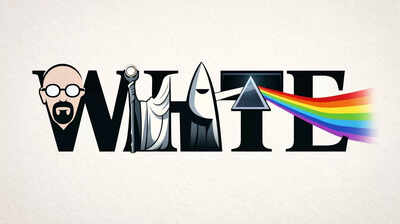
The Wordle word of the day is white, and quite frankly it is an awkward choice. In this day and age, white is no longer a neutral descriptor. It is a word carrying overt politics, cultural anxiety and historical residue.
It has long outgrown its original job of describing a colour and has instead become shorthand for power, grievance and identity. That is a lot to ask of a word that once existed simply to describe snow.Say white today and the images arrive instantly, uninvited. A drug kingpin demanding to be recognised by name. Ku Klux Klan members wrapped in pointed hoods, mistaking costume for legitimacy. Saruman the White, convinced that wisdom and authority are his by right.
For a colour, it conjures a remarkable cast of characters, none of them accidental. Somewhere along the way, a descriptor became a diagnosis.
Where the word comes from
The etymology of white is, at least initially, untroubled. Almost soothingly so.It comes from Old English hwīt, itself derived from Proto-Germanic hwītaz and earlier Indo-European roots meaning “bright,” “shining,” or “clear.” In its earliest uses, white described snow, ash, daylight and bone.
It was a sensory word, not a moral one. It told you what the eye could see, not what the world should be.There was no ideology embedded in it. Just light. No sermons. No hierarchies. Just visibility.That innocence makes what followed all the more revealing.
What white actually is
Scientifically speaking, white is not even a colour in the conventional sense. White light is the combination of all colours in the visible spectrum. When passed through a prism, it breaks obediently into violet, indigo, blue, green, yellow, orange and red.
VIBGYOR. A school mnemonic that quietly contains a rather radical idea. Not subtraction, but revelation. White, in physics, is inclusion. It is everything arriving at once.
No colour dominating the others. No hierarchy. Just coexistence. Which makes its cultural journey almost perverse.
From brightness to righteousness
Somewhere between religion, empire and the mundane needs of bookkeeping, white stopped describing light and started implying virtue.
Brightness slid into purity. Purity into goodness. Goodness into normality. And normality, as it so often does, quietly became superiority. White robes came to signify holiness. White space suggested order. White pages promised renewal. The metaphors stacked up until the word was no longer observational, but aspirational.
By the time modern racial categories were formalised, white had already been positioned as the default.
Not one colour among many, but the standard against which all others were measured. Everything else became marked. Qualified. Explained. The word did not just describe people. It ranked them.
When white turned into ideology
White supremacy was never really about colour. It was about anxiety. Anxiety about loss. About dilution. About no longer being the unexamined centre of the story. A descriptor became an identity. An identity hardened into a hierarchy.
And a hierarchy, in a familiar twist, eventually rebranded itself as victimhood. People began to police imagined borders, read history selectively, and treat demographics like destiny.
A word that once meant “everything together” was now being used to insist on separation. That is how people went mad over a colour.
Culture saw it coming
Popular culture, being less polite and often more honest, grasped the pathology before political language caught up.
Saruman the White does not fall because he embraces darkness. He falls because he believes clarity entitles him to control. His whiteness represents authority, certainty, the assumption that he knows best. When he abandons white for “many colours,” Tolkien practically underlines the point: purity was always the illusion.Walter White follows the same arc in modern dress. He is not driven by desperation so much as wounded entitlement.
A man convinced that his intelligence and effort should have guaranteed dominance. “Say my name,” he demands, long after the name itself has become a threat. The colour is incidental. The psychology is not.Even the Ku Klux Klan understood the visual grammar. White robes. White hoods. White as costume and camouflage. A colour repurposed into terror, sold as purity. If nothing else, it is proof that symbolism, once weaponised, does not need much imagination.
When style guides expose the strain
The confusion surrounding white is now so entrenched that even language authorities struggle.The AP Stylebook capitalises Black when referring to race, recognising shared history and identity, while keeping white lowercase. The result is wire copy that can read oddly, sometimes uncomfortably, when the accused is Black and the victim is white. The choice is deliberate, but the discomfort it produces is instructive.Language is trying to correct history without pretending history never happened. That is a delicate act. The strain shows.
How a colour became a burden
White did not fail as a word. We loaded it with theology, hierarchy, grievance and fear. We asked it to justify power, explain inequality and soothe insecurity. No word survives that kind of workload unchanged. In physics, white still breaks cleanly into VIBGYOR, revealing the full spectrum hidden inside. In culture, it no longer does. It arrives dense, politicised and heavy with implication. Some words age quietly.
White aged loudly, under pressure, until it stopped being just a colour at all. It began as everything at once. Somewhere along the way, we made it a problem.




 English (US) ·