

 2 days ago
8
2 days ago
8
ARTICLE AD BOX
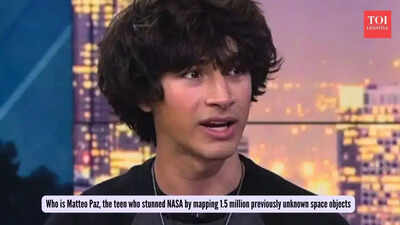
A Pasadena High School student, Matteo Paz, has astounded scientists by developing an AI pipeline to analyze NASA's vast NEOWISE data. His work, uncovering over 1.5 million variable celestial objects, has been published and is now aiding major observatories, proving a young mind's potential can truly reach for the stars.
A California high schooler recently went viral for turning dusty NASA data into an amazing discovery, setting an example of how a curious mind can shake up the stars. While space news often spotlights billion-dollar missions or astronauts on the ISS, this story is an inspiration for aspirational young minds.
Who is Matteo Paz?
Matteo Paz, a student at Pasadena High School, explored NASA's NEOWISE dataset during a 2022 summer program at Caltech's Planet Finder Academy. Under the guidance of scientist Davy Kirkpatrick at the Infrared Processing and Analysis Center (IPAC), he analysed the telescope's decade-spanning infrared archive, with nearly 200 billion data rows focused on near-Earth asteroids and more, according to a Futura Sciences report.
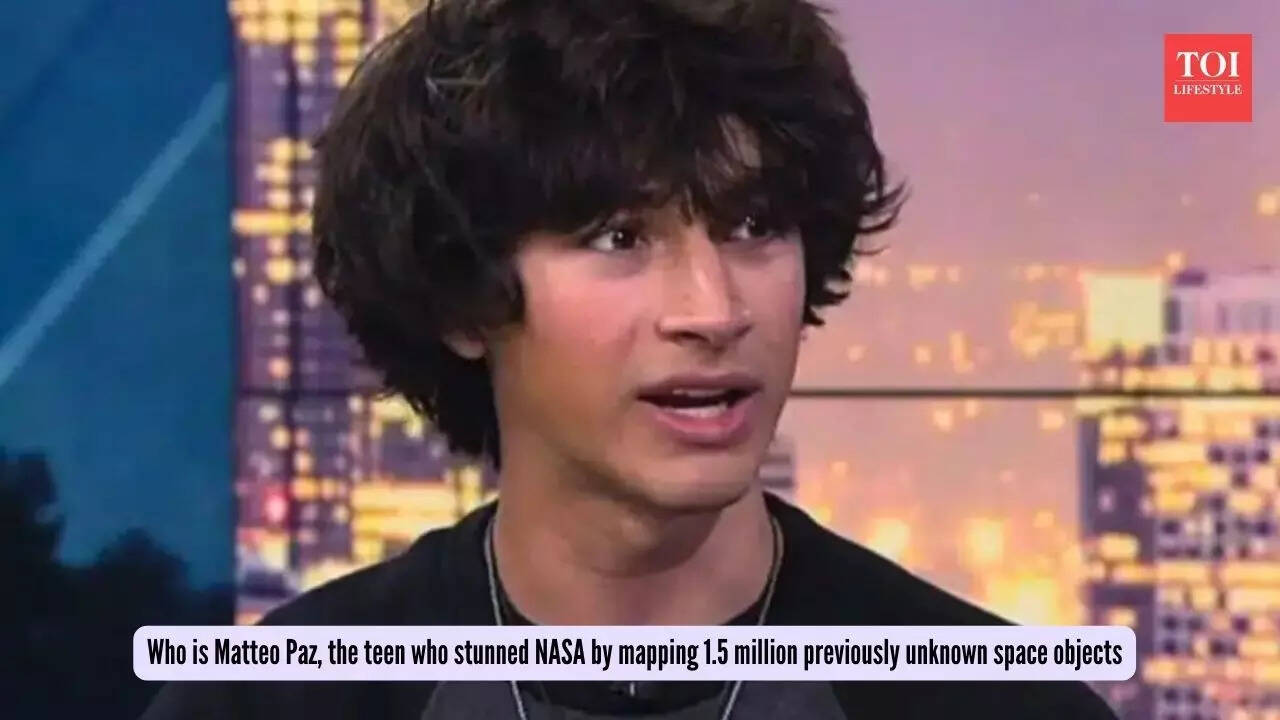
Matteo Paz (Photo credit : Fox 11 Los Angeles)
Rather than sorting through it by hand, Paz developed an AI pipeline in just six weeks. Drawing on his skills in coding, theoretical math, and time series analysis, the system detected subtle brightness changes in variable objects such as quasars, binary stars, and supernovae, which are changes that are hardly observable to the human eyes or standard software. "The model started showing promise almost right away," Kirkpatrick told Phys.org.
"As Paz fine tuned it, the results only got more exciting."
How AI managed huge data through NASA software
NEOWISE, launched in 2009, surveyed the entire sky but hid many faint signals in its data. Paz's system used Fourier transforms and wavelet analysis to detect slow or brief changes in brightness, producing a catalog of more than 1.5 million variable sources.Published in The Astronomical Journal in late 2025, this catalog now supports observations at facilities like the Vera C.
Rubin Observatory, offering new insights into stellar evolution and distant galaxies.Paz collaborated with Caltech experts, including Shoubaneh Hemmati, Daniel Masters, Ashish Mahabal, and Matthew Graham, to analyse the full dataset. In early 2026, NASA leaders praised his work, with Jared Isaacman highlighting how a teenager's AI matches major lab efforts—going so far as to offer him a job and a jet ride.
From classroom to cosmos
Honed in Pasadena Unified's Math Academy, Paz's tools suit grad-level work. Kirkpatrick said, "If I see their potential, I want to make sure they reach it. I'll do whatever I can to help them". The catalog hit public release in 2025, sparking James Webb follow-ups.





 English (US) ·