

 1 hour ago
5
1 hour ago
5
ARTICLE AD BOX
India Today tracked Amazon price histories and found a quiet rise in everyday products over the past 100 days of the Iran war.

Representative image generated with AI
It’s not just petrol, diesel, or your morning milk that has quietly burned a hole in your pocket. From the protein powder in your gym bag to the copper tumbler on your kitchen shelf, everyday items on Amazon have been getting costlier, and the receipts don't lie.
We tracked the price history of dozens of products across categories, and what emerged is a clear pattern: the West Asia conflict has sent shockwaves well beyond the fuel pump. 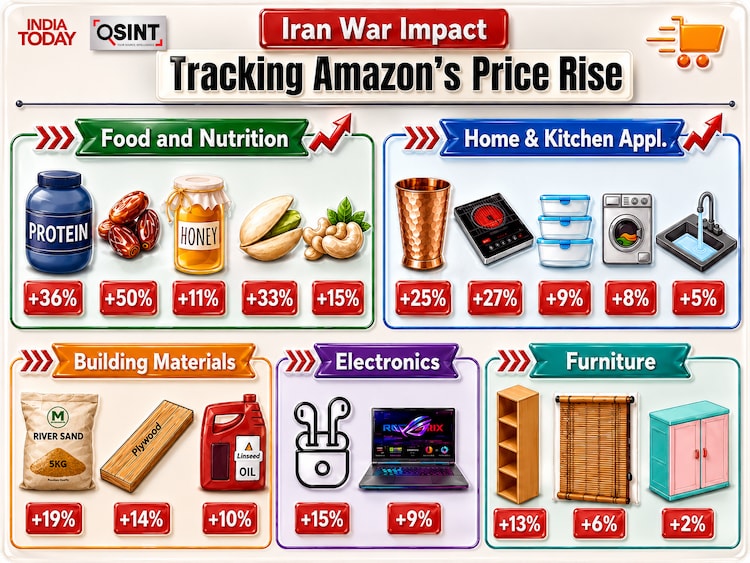
Amazon’s price history tool, a feature most shoppers scroll past, turned out to be the most honest ledger of a crisis unfolding in slow motion, one that is gradually reshaping what Indian households pay every day.
Over the past hundred days since India Today first reported on the Iran war's early economic tremors, prices have continued to climb, in some cases sharply.
The shift became clearer over the last 30 days, a period marked by heightened anticipation of fuel price increases as disruptions in West Asia deepened and oil markets turned volatile. Consider a few examples: Nutraj UAE Kalmi Dates Pack (500g) is up nearly 51%, Isopure Unflavoured Protein Powder has climbed 36%, while even a Milton copper tumbler, the kind found in many Indian kitchens, is now costlier by nearly 25%. The products may seem unrelated, but together they point to a broader pattern: the economic aftershocks of disruptions in West Asia may now be showing up far beyond the fuel pump.
Fuel prices in India have been inching upward since mid May as disruptions in oil supply routes and shipping networks linked to the Iran-Israel conflict unsettled global markets. But how much of that pressure is quietly spilling into everyday purchases?
To understand this, India Today tracked the price history of select products across food and nutrition, home appliances, electronics, furniture and construction materials over the last 30 days using Amazon’s publicly available price history feature. What emerged was a clear pattern: products linked to imports, logistics and global supply chains were seeing some of the sharpest price movements.
The trend also appears to be evolving rather than fading. In an earlier India Today analysis, we tracked the first signs of price pressure after the Iran conflict, when LPG-linked appliances, dry fruits and even airfares had begun reacting to disruptions in West Asia. The latest numbers suggest some of those early signals are not only persisting but, in some cases, deepening.
Take the Kent Sunstar Infrared Cooktop for instance. In the last 30 days alone, its price jumped from Rs 3,899 to Rs 4,950, a rise of nearly 27%, while over the broader 90-day window it climbed from Rs 2,900 to Rs 4,950, up more than 70%. The steady increase may not be incidental. During periods of fuel uncertainty and fears around LPG supply disruptions, appliances seen as alternatives to gas cooking often witness a rise in demand. India Today’s earlier analysis had already picked up a similar movement in LPG linked appliances as households and sellers reacted to expectations of tighter fuel supply and higher cooking costs.
We focused on products that showed either a consistent rise over the broader 90-day period or a sharp spike in the last 30 days, a phase marked by mounting anticipation around fuel price hikes in India as disruptions in West Asia intensified, expectations that eventually turned into an inevitable reality. The sharper movements discussed below, however, largely reflect the last 30 days.
During the period, the clearest pressure point is food and nutrition, especially products tied to imports or global commodity chains. The price of Nutraj UAE Kalmi Dates Pack (500g) has jumped from Rs 254 to Rs 383, an increase of nearly 51%. Happilo Premium California Roasted & Salted Pistachios have climbed from Rs 289 to Rs 385, while Isopure Unflavoured Protein Powder, a staple in many gym bags, rose from Rs 5,861 to Rs 6,959. Cashews and honey have also recorded steady increases. Higher freight costs, disrupted shipping routes and rising import bills could be among the factors driving these changes.
The rise is visible in Indian kitchens too. A Milton copper tumbler that earlier cost Rs 316 is now priced at Rs 395, while kitchen appliances such as induction and infrared cooktops continue to show upward pressure. Food storage containers are up around 9%, washing machines 8%, and sinks 5%. Many of these products rely on metals, petroleum derivatives, packaging and transportation, sectors that tend to feel pressure when oil prices rise.
Even home construction has not been spared. River sand prices have risen nearly 19%, while linseed oil is up around 10%. Plywood, another essential for home construction, has climbed from Rs 4,153 to Rs 4,370. Logistics disruptions and rising raw material costs appear to be quietly feeding into housing expenses too.
While consumers may not typically buy construction materials in bulk from Amazon, movements in the prices of products such as river sand, plywood and linseed oil still offer a useful glimpse into broader market trends, especially in sectors sensitive to logistics, fuel and raw material costs.
The ripple is visible in electronics too. Earbuds have become around 15% costlier and gaming laptops roughly 9%, likely reflecting pressure on imported components and supply chains. Furniture, however, has remained relatively insulated, though shelves, blinds and wardrobes have all registered modest increases.
Individually, these price jumps may look routine. Taken together, however, they tell a different story: the economic ripple effects of turmoil in West Asia may no longer be limited to fuel stations or shipping routes. They are beginning to show up in the quiet arithmetic of everyday spending.
- Ends
Published By:
bidisha saha
Published On:
Jun 5, 2026 17:45 IST









 English (US) ·