

 2 days ago
3
2 days ago
3
ARTICLE AD BOX
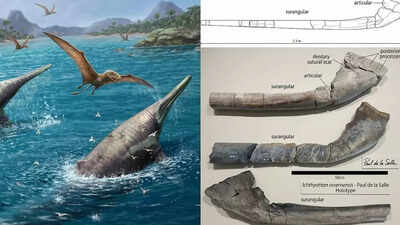
Ancient ocean giant discovered after young girl finds mysterious fossil on British coast / Image: file
In May 2020, while most of the world was in lockdown, 11-year-old Ruby Reynolds and her father, Justin, scanned the mudflats of Blue Anchor, Somerset, for fossils. What they found wasn't just a simple souvenir; it was a jawbone fragment so massive it belonged to a creature that challenges the blue whale for the title of "Largest Animal Ever."
Now officially named Ichthyotitan severnensis, this prehistoric "fish lizard" has swum out of the shadows of time thanks to a young girl's keen eye.
Discovery of Ichthyotitan severnensis
Paleontologists discovered the fossil fragments in May 2020 on the beach at Blue Anchor in Somerset, southwest England. Ruby Reynolds and her father Justin found them while exploring mudflats for fossils. Ruby noticed a large fragment of bone lying in the sediment, while her father had already spotted another smaller piece nearby.
Paleontologists later examined the unusual bones and realized they were parts of a gigantic jawbone from a prehistoric marine reptile. After detailed analysis and further excavations, scientists confirmed the fossils belonged to a newly identified species named Ichthyotitan severnensis.The name roughly translates to “giant fish-lizard of the Severn,” referencing the nearby Severn Estuary and the creature’s enormous size.
Prehistoric reptile as long as a blue whale
Scientists estimate that Ichthyotitan severnensis may have reached around 25 metres (about 82 feet) in length, making it comparable to a modern blue whale and potentially the largest marine reptile ever discovered.The fossil itself is a huge lower jawbone more than two metres long, indicating the animal must have been extraordinarily large.Ichthyosaurs were marine reptiles that lived during the age of dinosaurs and resembled a cross between dolphins and sharks, with long snouts, streamlined bodies and flippers adapted for powerful swimming.
They were among the dominant predators of ancient oceans.Researchers believe this giant species roamed the seas around 202 million years ago during the Late Triassic period, just before the Triassic-Jurassic extinction event.
Scientists confirmed the new species
The fossil Ruby found turned out to be the missing piece of a puzzle that scientists had been trying to solve for years.In 2016, researchers had already discovered a large ichthyosaur jaw fragment about 10 kilometres away at Lilstock in Somerset.
However, the fragment was incomplete and its true identity remained uncertain.When Ruby’s discovery was analysed alongside the earlier fossil, scientists realized both bones belonged to the same kind of gigantic ichthyosaur. The combined evidence finally allowed paleontologists to confirm the existence of a new species.The fossils came from the Westbury Mudstone Formation, a geological layer dating to the very end of the Triassic period.Researchers later returned to the site multiple times between 2020 and 2022 to recover additional fragments, gradually reconstructing a much larger portion of the jawbone.
Why the discovery of Ichthyotitan matters?
The discovery of Ichthyotitan severnensis is important because it shows that giant ichthyosaurs were still thriving near the end of the Triassic period. Previously, scientists believed such massive marine reptiles had disappeared earlier.The find also helps scientists better understand how prehistoric ocean ecosystems worked and why enormous animals evolved in ancient seas. With abundant food and little competition, ancient oceans could support gigantic predators comparable in size to today’s largest whales.Perhaps most remarkably, the discovery highlights how amateur fossil hunters, and even children, can contribute to major scientific breakthroughs. Ruby Reynolds later became a co-author on the scientific study describing the species, an extraordinary achievement for someone who simply set out for a day at the beach.









 English (US) ·