

 1 hour ago
5
1 hour ago
5
ARTICLE AD BOX
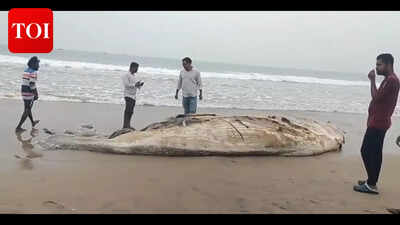
A massive 30-foot baleen whale carcass washed ashore at Paradip beach in Bhitarkanika National Park, sparking local curiosity. Forest officials and veterinary experts are investigating the highly decomposed remains, which show signs of entanglement or ship strike. Identified as a protected and endangered species, the exact cause of death awaits lab analysis.
Kendrapada: Carcass of a baleen whale, about 30-ft long, washed ashore on Paradip beach within Bhitarkanika National Park on Tuesday, triggering curiosity among locals and marine fishermen.A group of fishermen returning from the sea spotted the carcass and alerted others. Soon, several locals reached the spot, took photographs and videos and shared them on social media. “We saw a giant whale carcass on the beach on Tuesday morning,” said Krishna Rao, 40, of Paradip.Forest officials of Kujang range rushed to the spot after villagers informed them. The whale’s carcass was highly decomposed, with scars and signs of earlier entanglement.
“Entanglements are common among baleen whales because of their feeding habits. The animal may also have been hit by a ship or a fishing vessel in deep sea. After its death, the carcass washed ashore,” said Sanjay Kumar Pradhan, range officer of Kujang.A team of veterinary experts collected viscera samples and sent them to the Odisha University of Agriculture & Technology (OUAT), Bhubaneswar, for analysis. “Exact cause of death will be known after the lab report.
Our teams are guarding the carcass,” Pradhan added.Herpetologist and taxidermist Siba Prasad Parida said the carcass was identified to be that of a baleen whale. “Baleen whales, also known as toothless whales, use baleen plates to filter food from water. They are protected under Schedule I of the Wildlife Protection Act, 1972, and are also listed as ‘endangered’ by the International Union for Conservation of Nature (IUCN),” he said.








 English (US) ·