

 1 hour ago
4
1 hour ago
4
ARTICLE AD BOX
Last Updated:April 16, 2026, 17:57 IST
A central feature of this reform is the dramatic expansion of the Lok Sabha's maximum strength from 550 to 850 members


Furthermore, a larger Lok Sabha will naturally lead to an increase in the permissible size of the Council of Ministers, which could grow from 81 to 122 members, potentially reviving concerns about the administrative efficiency of oversized cabinets. (File photo: Lok Sabha/Sansad TV)
The introduction of the Delimitation Bills of 2026 marks a transformative shift in India’s legislative landscape, fundamentally altering the composition of the Lok Sabha and the procedural requirements for women’s reservation. According to a study by PRS Legislative Research, this legislative package—comprising the Constitution (131st Amendment) Bill, the Delimitation Bill, and the Union Territories Laws (Amendment) Bill—seeks to bypass the significant delays inherent in waiting for the 2027 Census results. Under previous statutes, women’s reservation was tethered to the first census conducted after 2023, a timeline that would have effectively excluded the 2029 general elections. This new reform decouples that requirement, enabling delimitation to proceed based on the 2011 Census and ensuring that the one-third quota for women can be operationalised in the immediate future.
A central feature of this reform is the dramatic expansion of the Lok Sabha’s maximum strength from 550 to 850 members. As highlighted by the PRS study, this increase is designed to restore the principle of proportional representation, where each state’s seat share reflects its actual population. However, this shift inevitably reopens the debate over the “population stabilisation" incentives that had frozen seat allocations since 1976. By shifting the baseline to the 2011 Census, the relative political weight of states will change significantly. High-growth states in the north, such as Uttar Pradesh and Bihar, are projected to see substantial increases in their tallies, while southern states like Tamil Nadu and Kerala, which successfully implemented population control measures, face a relative decline in their share of the House.
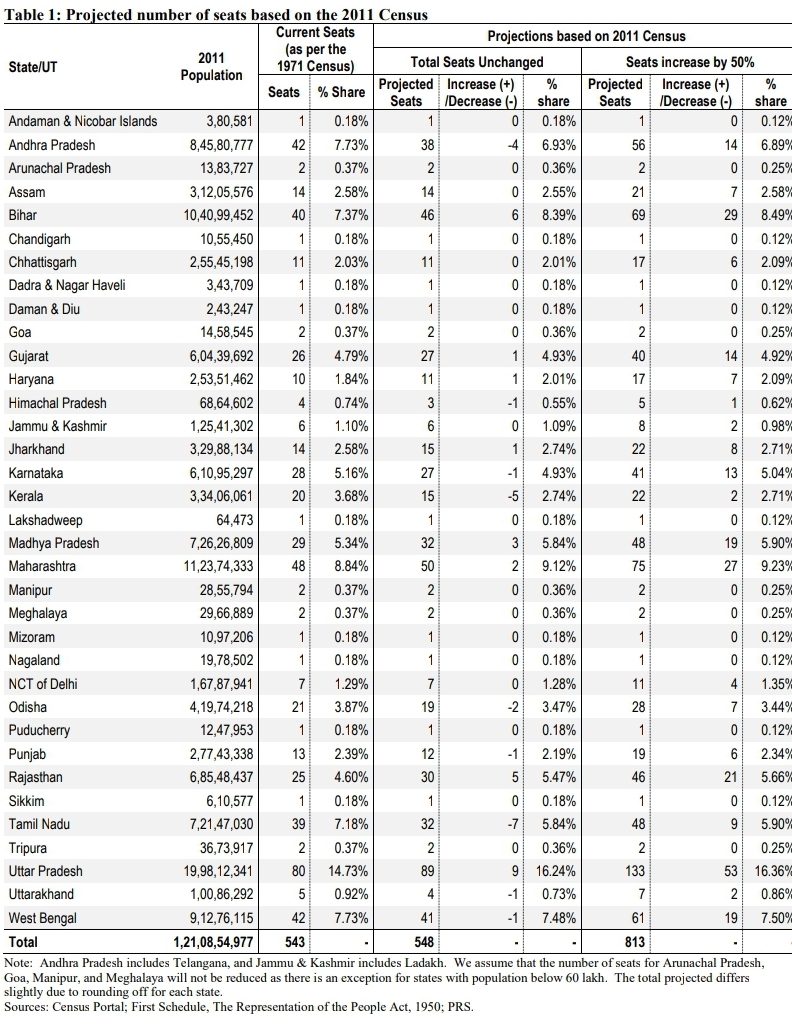
Beyond the geographic distribution of power, the expansion carries profound implications for the internal mechanics of Parliament and the balance between its two Houses. While the Lok Sabha grows by over 50 per cent, the Rajya Sabha’s strength remains frozen at 250 members. The PRS analysis points out that this widening disparity alters the constitutional ratio between the two bodies from 2.2:1 to roughly 3.3:1, effectively diluting the Rajya Sabha’s influence during joint sittings and in the election of the President and Vice-President. Furthermore, a larger Lok Sabha will naturally lead to an increase in the permissible size of the Council of Ministers, which could grow from 81 to 122 members, potentially reviving concerns about the administrative efficiency of oversized cabinets.
Finally, the Bills introduce a notable change in how delimitation is triggered and governed. By granting Parliament the power to determine both the timing of future delimitations and the specific census to be utilised via a simple majority, the amendment moves away from the rigid constitutional periodicity of the past. This provides the executive with greater flexibility but, as the PRS research notes, also removes certain constitutional certainties regarding the use of the latest data. As the new Delimitation Commission prepares to redraw the map of 850 constituencies, the focus will remain on how individual Members of Parliament manage their roles in a more crowded chamber, where the time available for debates, questions, and legislative scrutiny will be significantly more constrained.
Handpicked stories, in your inbox
A newsletter with the best of our journalism
First Published:
April 16, 2026, 17:57 IST
News politics 50% Delimitation Formula: Which States Will Get What Based On 2011 Census
Disclaimer: Comments reflect users’ views, not News18’s. Please keep discussions respectful and constructive. Abusive, defamatory, or illegal comments will be removed. News18 may disable any comment at its discretion. By posting, you agree to our Terms of Use and Privacy Policy.
Read More






 English (US) ·