

 1 hour ago
6
1 hour ago
6
ARTICLE AD BOX
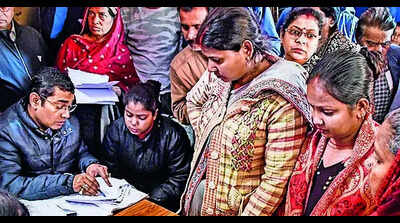
People undergo physical verification to correct errors in the electoral rolls under the Special Intensive Revision
Noida: Around 60,000 duplicate voter entries were removed from electoral rolls in Ghaziabad and Gautam Budh Nagar during the Special Intensive Revision (SIR), accounting for just about 1% of total deletions in the two districts, officials said.
Of these, nearly 30,000 duplicate voters were identified in Ghaziabad and about 34,000 in GB Nagar.According to the final voters’ list, deletions were largely driven by shifted, absent and unverified voters. The revision, carried out between Jan and March, involved large-scale field verification and database checks to reconcile entries with 2003 base electoral records.GB Nagar district magistrate Medha Roopam said the objective of the exercise was “to ensure the voter list was free from impurities”.
However, fresh enrolments would remain open through Form 6, with applicants now required to submit an additional declaration linking their details to the 2003 electoral roll. Officials said the revised process is aimed at ensuring that new entries are authenticated against a stable base dataset.Under the updated system, applicants must establish a link either through prior registration or through family records, a step intended to reduce the risk of duplication in future revisions.
Authorities said the move marks a shift from earlier processes where Form 6 alone was sufficient for inclusion.To further tighten scrutiny, the Election Commission introduced a “Duplicate Elector Verification” feature in the booth-level officer (BLO) app. The system uses demographic data and photo matching to flag suspected duplicate entries. Field officers are then alerted and conduct physical verification at listed addresses to confirm whether multiple voter IDs exist for a single individual.Officials said the layered approach was designed to prevent duplication at the entry stage itself, reducing the need for repeated intensive revisions.The SIR exercise had flagged a significant number of entries for discrepancies. In Ghaziabad, of the 20.1 lakh voters in the draft rolls published in Jan, about 1.5 lakh were marked as “unmapped”, meaning their details could not be linked to the 2003 rolls. Another 5.8 lakh entries were flagged for logical inconsistencies, such as improbable age gaps within families or multiple records linked to the same parentage.
The final roll has 22.6 lakh voters.In Gautam Budh Nagar, 6.2 lakh notices were issued among 14.2 lakh voters in the draft rolls, including 1.7 lakh unmapped entries and 4.5 lakh flagged for discrepancies. The final roll recorded 15.1 lakh voters across its three assembly constituencies.Most of these cases were resolved during verification, with only a small number remaining unverified — around 196 in Ghaziabad and 212 in GB Nagar.






 English (US) ·