

 1 hour ago
4
1 hour ago
4
ARTICLE AD BOX
Ten years is too short to be called an era, but Pep Guardiola’s decade with English football is an era unto its own. Ten years of stacking trophies, of varied sizes, shapes and values; ten years of building an identity and heritage for a club that had languished in the shadows of the more historic institution in the neighbourhood, and ten years of refashioning the ideals and values, methods and style of the English game.
He would be immortalised as the greatest Manchester City manager, as one of the greatest of the league, but his biggest legacy is that he changed the footballing mentality of a stubborn nation that claims to have discovered the game. He found the league in English and left it Guardiola-esque.
Precisely for this reason, his time in England can’t be fully quantified. To call him a supreme tactician would be to limit his aura to the numerous innovations and inventions he produced with various iterations of City; to belittle the supreme man-manager he was, in how he coaxed his men to buy his unusual theorems, in how he made them function like an orchestra; to disregard the revolutionary he was, in how he burst the physicality myth in England with his short, small and twinkle-toed footballers; to forget the romantic that resides in him, who till the last day didn’t instruct his men to tackle or resort to set-piece fixations; to ignore the rebel that rebelled his own ideas; to neglect a generation of managers he mentored.
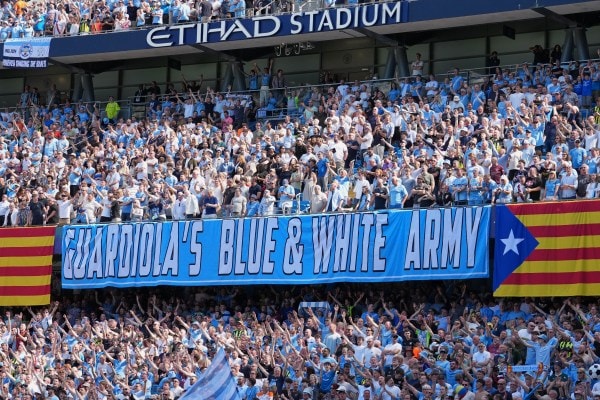 Manchester City fans holds a sign thanking the coach Pep Guardiola during his last match as a manager during a Premier League match against Aston Villa on Sunday. (AP Photo)
Guardiola is an unrepeatable footballing life, a blend of all the greatest managers that had strived and succeeded on English shores and made it arguably the most competitive in the world. If Alex Ferguson was the colossus team-builder, Arsene Wenger the aesthete, Jurgen Klopp the radical, Jose Mourinho the shape-shifter; Guardiola was all and more, perhaps outdoing them all. He was everything that English football had been in the last ten years; and he would be everything that English football would be in the next decade, from style and tactics to the very length of grass they play on these days.
To pinpoint a singular narrative thread that captures Guardiolismo is difficult. Arguably, it is how he tore up the prevailing concepts of English football and rewrote them. After City finished 15 points adrift of champions Leicester City in the first season under him; the lack of physicality in the midfield was debated and perceived as the biggest stumbling block between him and glory. Next year, he added even shorter players who became champions touching the century mark. He defended the crown next year, and in the next eight years built a dynasty that was as indomitable as Ferguson’s. Every team now plays from the back, everyone wants ball-playing defenders, craves for pass-metronomes, demands inverted full-backs, and once-upon-a-time false nines.
But when every other manager was busy learning from Guardiola, Guardiola was busy unlearning himself, challenging his core ideas, tweaking and tinkering his methods to suit the ever evolving game, driven by a quest to think ahead of the pack. The man that sculpted the greatest false nines of all time in Barcelona, Lionel Messi, chiselled the most destructive conventional nines of this milieu, Erling Haaland. The man that installed midfielders at the heart of the team once, then thrust the creativity keys to the men on the wings. He who made goalkeepers with ball control fashionable purchased a classic shot stopper in his end days. Where once he fixated over control and possession, he began to invest in individual quality. He adapted to the English game too, especially in realising the importance of the second ball after the first season.
Ten years that will live forever.
Thank you for everything, Pep 🩵 pic.twitter.com/eEFr8RPirx
— Manchester City (@ManCity) May 24, 2026
At the heart of Guardiola is perhaps not a tactician or a romantic, but a student of the game, aware of the game’s infinite possibilities, football as a game of chess in hurry. The conduit of ideas on the field, Xavi Hernandez once summed up Guardiola’s nature beautifully: “He’s a perfectionist. If Pep decided to be a musician, he would be a good musician. If he wanted to be a psychologist, he would be a good psychologist. He is obsessive; he would keep going until he got it right. He demands so much from himself. And that pressure that he puts on himself, those demands are contagious – it spreads to everyone.” Perhaps, in the end, the intensity was too much for him to sustain for a decade. It ate away into the pleasures of winning, week in and week out.
Perhaps, his departure is just a physical one. He will lurk invisibly in boardrooms and on the playing field through his ideas and methods, from the Premier League to Sunday Leagues. If Guardiola were to watch a game, any game in any tier of the country, he would be surprised at how he can see shades of himself in other managers, in their fundamentals and sensibilities, in how they conduct the play, in how they think about the game.
Story continues below this ad
English football would miss Guardiola, but what he embodied would live through a generation of managers he had influenced and groomed. His successor at City, Enzo Maresca, and the man that denied him a fairytale farewell, Mikel Arteta, were his assistants. He managed Bayern Munich’s Vincent Komany, Como’s Cesc Fabregas (rated highly), Xabi Alonso and Xavi. Guardiola, thus, is perhaps the closest English football had to Johan Cruyff. And all he required were ten years, an era unto itself, to stamp his greatness in English football, in a way that cannot and will not come again.



 English (US) ·