

ARTICLE AD BOX
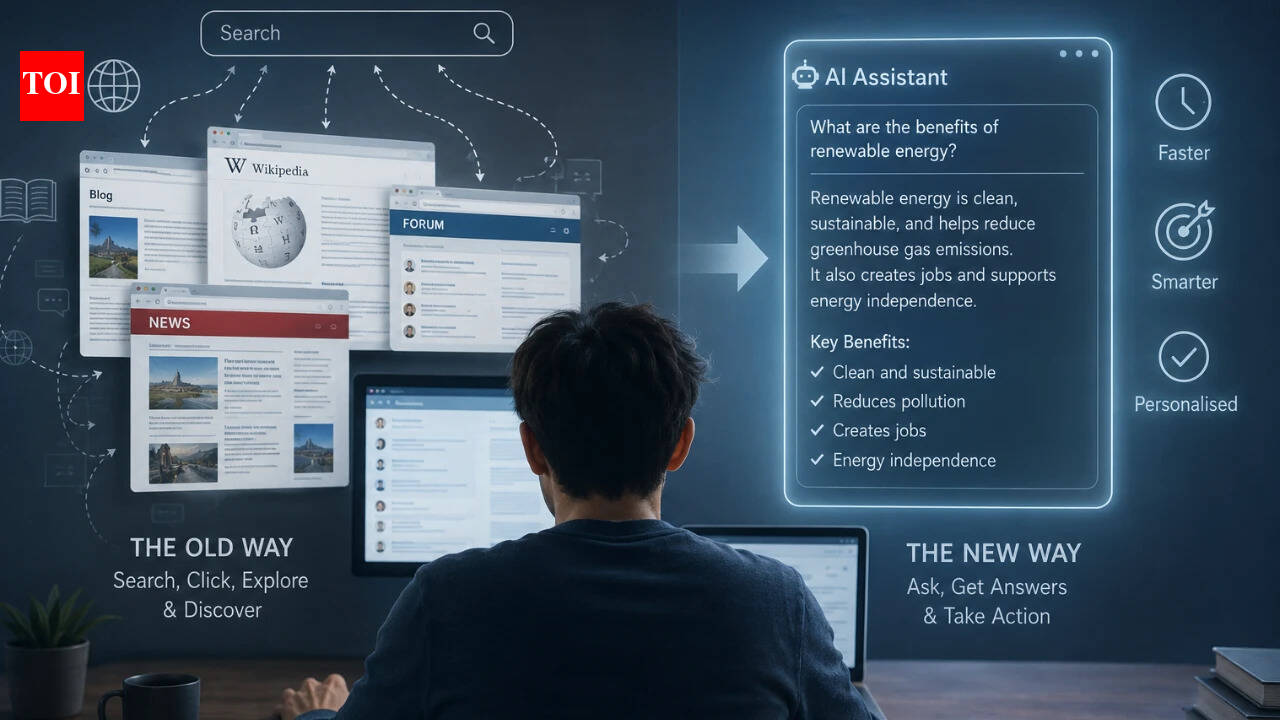
A new YouGov report shows that AI assistants are now a major part of India’s online search journey, ranking close behind traditional search engines.
NEW DELHI (India CSR): AI assistants are rapidly becoming a mainstream part of India’s online search behaviour, with a new YouGov report showing that Indian users are no longer depending only on traditional search engines for information. The report, titled Searching for Answers: How AI is Changing Online Discovery in 2026, highlights a major shift in how Indians search, verify, compare and consume information online.
According to the findings, online search in India has become highly frequent, mobile-first and task-specific. Two-thirds of Indians, or 66%, look for information online at least once every day. Of these, 43% search six or more times daily. The trend is even stronger among Gen Z and Millennials, with 45% searching online six or more times a day. Among higher-income earners, this figure rises sharply to 55%, indicating that frequent online discovery is closely linked with digital engagement, work patterns and access to devices.
Mobile Leads Search
Smartphones remain the dominant gateway to online information. The report finds that 76% of Indians most often use a smartphone to search for information online, compared with only 14% who rely mainly on a laptop or desktop computer. This confirms that India’s search economy is overwhelmingly mobile-first, cutting across generations.
Both younger and older users show strong smartphone dependence. This makes mobile accessibility, simple interfaces and fast-loading platforms central to the future of digital information services in India.
Search Engines Lead
Traditional search engines continue to lead the market, but their dominance is no longer absolute. In the past 30 days, 65% of Indian online searchers used search engines to look for information or answers. However, AI assistants and chatbots are already close behind at 57%.
AI assistants now rank ahead of social media platforms at 49%, video platforms at 48%, maps and navigation apps at 31%, news websites or apps at 30%, marketplaces at 26%, and online communities or forums at 24%.
AI Gains Ground
The report shows that Indians are choosing platforms based on the nature of the task. AI assistants are the preferred starting point for asking a specific question, with 41% of online searchers beginning there.
Search engines remain relevant for broader information needs, while maps lead for finding local places, marketplaces lead for buying products, and news websites or apps are preferred for current events. This suggests that online discovery in India is becoming less about one dominant platform and more about selecting the right tool for the right job.
Daily AI Usage
AI search is already a frequent habit for many Indians. Six in ten online searchers start at least one new query with an AI assistant every day, while another 23% do so several times a week.
The habit is stronger among Gen Z and Millennials, where 66% are frequent AI searchers, compared with 48% among Gen X and Baby Boomers+. India also ranks among the highest markets globally for AI search adoption, with 89% of respondents classified as AI searchers.
Global Adoption Ranking
India stands alongside Indonesia and the UAE at 89% AI search adoption. This places India far ahead of several developed markets. The US, for example, records 48% AI search adoption, while Great Britain stands at 54%.
The data indicates that Indian users are adopting AI-led search faster than many mature digital economies. This may be due to India’s mobile-first internet behaviour, younger digital population and growing comfort with conversational technology.
Answers And Verification
The rise of AI is not just about convenience. Users are turning to AI assistants for direct answers, verification and decision support. Among AI searchers, 49% use AI to directly answer questions, 44% use it to verify information from elsewhere, 43% use it to summarize information, and another 43% use it to compare options.
Other uses include deciding what to search for next, planning or recommendations, and troubleshooting. This shows that AI is working not only as a search tool but also as an information processor.
Search Companion Role
AI is not fully replacing traditional search. The report finds that only 27% of AI searchers describe AI as their starting point. A larger share, 36%, use AI after using other forms of search, while 26% use it alongside other sources.
This indicates that AI is functioning more as a search companion than as a complete replacement for search engines. Many users still cross-check, compare links and move between platforms before trusting an answer.
Trust Still Matters
Trust is emerging as a key factor in AI adoption. AI assistants rank third for trust among Indian online searchers, with 69% saying they trust information from AI assistants.
This places AI behind maps and navigation apps and search engines, both at 75%, but ahead of marketplaces, news websites, video platforms, online communities and social media. The finding is significant because AI assistants are relatively new in the search journey but have already built a strong trust position.
Proof Builds Confidence
The report makes clear that trust in AI depends on proof. The strongest trust signal is whether the answer comes from official sources, cited by 18% of online searchers.
Other important signals include seeing multiple sources side by side, a clear explanation of how the AI arrived at an answer, verified source labels, clearly dated information, separation between ads and other information, and clear links or citations.
Data Control Counts
Personalization is another area where users want balance. While 29% are comfortable with AI using their data to give tailored answers, 28% are comfortable only if they can easily control or turn it off.
Another 25% prefer less-tailored answers if that means using less of their data. This shows that users want relevance, but not at the cost of privacy and control.
Future Search Shift
The YouGov report concludes that India’s online discovery landscape is entering a new phase. Search engines remain important, but AI assistants are becoming powerful answer engines, summarizers, checkers and decision-support tools.
For AI platforms, the next challenge will be to combine speed and usefulness with transparency, official sourcing, visible citations and user control. In India’s fast-growing digital ecosystem, the future of search may not be a battle between links and AI answers. It may be a race to deliver both.

ADVERTISEMENT

ADVERTISEMENT

ADVERTISEMENT

ADVERTISEMENT










 English (US) ·