

 1 hour ago
2
1 hour ago
2
ARTICLE AD BOX
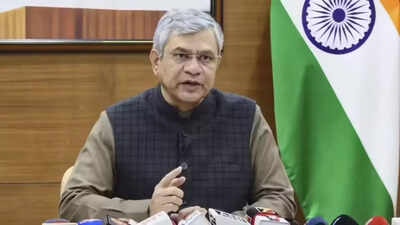
NEW DELHI: Ahead of next week’s AI Impact Summit, Union information technology minister Ashwini Vaishnaw on Saturday said that investments in the infrastructure layer of artificial intelligence may top $200 billion with commitments of around $90 billion already received.“We are working on all five layers of the AI stack. Conventionally, our strength has been providing IT services. Now, we have to convert this into providing AI-based services. The IT industry too has worked in recent years on this changing business model. It has invested in creating new tools and reskilling their workforce, so they can provide AI services,” Vaishnaw said, while addressing the ET NOW Global Business Summit.He added that after the UK, South Korea and France, India is set to host the biggest AI Impact summit next week, with more than 20 Heads of State and govts attending the event. “At the summit, we will be launching our bouquet of sovereign models. On so many parameters, the models are better than Open AI, Gemini Pro and Deep Seek, giving us confidence that India can develop models on very frugal resources,” said the minister, who is also in charge of railways and information and broadcasting ministries.
Highlighting the development in the third layer of AI stack, Vaishnaw stressed that progress in semiconductor development — the “chip layer” — had been significant, with startups and research teams developing cutting-edge solutions that are expected to bear fruit in the coming years.Vaishnaw also noted electronic goods will be among the top two exported goods soon. “One of the key things Europeans wanted from India was electronic goods in the FTA.
They wanted electronic items of all kinds for their industry and consumers, because we are a trusted country. India will become a trusted partner in the semiconductor and electronics value chain,” Vaishnaw said. The minister said AI is set to outpace all previous industrial revolutions and technological shifts, necessitating the need for industry and society to remain prepared for this swift transformation, as India’s coordinated push across talent, models, chips and applications will help position the country at the forefront of the global AI revolution. Sharing the progress on the first bullet train project, Vaishnaw said that the first section between Mumbai and Ahmedabad will open in 2027. He also said that the proposed Bengaluru–Chennai corridor could reduce travel time to just 73 minutes, thus bringing the two cities much closer and boosting economic activity. “Our engineers have really lived up to the challenge. Our industry too has gone through that learning curve and is practically self-sufficient in the entire high speed train technology.
That is why Prime Minister Modi has announced seven new bullet train corridors, which will connect large parts of the country and transform the entire transportation industry. We are also going to standardise the entire system so that anyone in the world can come and participate.
We will have a large role for the industry as well,” he added. On wider railway reforms, Vaishnaw said the ministry is working on “52 reforms in 52 weeks” in 2026, with two new reforms slated to be announced on the same day.
Seven reforms have already been implemented and the rest are in progress.“These changes aim to improve overall travel experience, especially for daily passengers belonging to the low- and middle-income families. They remain our most important customers in the railways. We have been able to reduce accidents by about 90%. We want to further reduce it,” he said.








 English (US) ·