

 51 minutes ago
2
51 minutes ago
2
ARTICLE AD BOX
Marco Rubio's cross-country itinerary suggests this visit is about far more than repairing recent strains in the relationship. It signals that Washington and New Delhi have absorbed the friction and are ready to take ties into their next phase: America First, but India Forward.
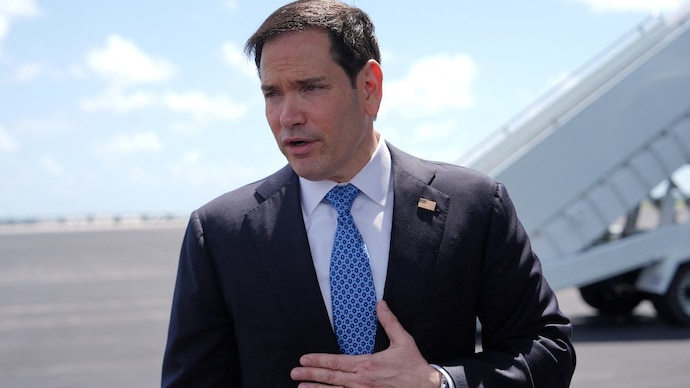
Rubio’s understanding of India’s strategic trajectory predates his swearing-in as Secretary of State in January 2025 and can be traced back to his years in the Senate. (Photo: Reuters)
New Delhi,UPDATED: May 22, 2026 19:43 IST
32,000 feet above the Atlantic
When US Secretary of State Marco Rubio touches down in India this week for his first official visit, covering Kolkata, Agra, Jaipur and New Delhi, the dominant narrative in Washington is that he is coming in “repair mode”. After a turbulent year marked by sharp rhetoric and a series of unforced missteps by sections within the administration, many observers believe the relationship now requires careful recalibration.
But to view Rubio’s visit merely as diplomatic damage control is to fundamentally misunderstand who is stepping off the plane.
For New Delhi, Rubio is not just the 72nd Secretary of State. He is arguably the most consistent, institutionally powerful and historically vocal champion of the US-India partnership in modern Washington.
Rubio’s understanding of India’s strategic trajectory predates his swearing-in as Secretary of State in January 2025 and can be traced back to his years in the Senate.
Long before the Indo-Pacific emerged as the defining geopolitical arena of the century, Rubio had consistently argued that Washington should view India not merely as an economic power, but as a critical pillar of American security.
From penning op-eds a decade ago demanding greater strategic convergence, to advocating for expanded H-1B visas for highly skilled Indian professionals during his time in the "Gang of Eight," Rubio has long recognised the immense value of the Indian democratic project.
That deep-seated appreciation translated into immediate action the moment he took the helm at Foggy Bottom.
It was no accident that on his very first day in office, Rubio hosted the Quad foreign ministers and held his first bilateral meeting with External Affairs Minister S Jaishankar. It was a calculated signal to the world: the Indo-Pacific, and India specifically, sits at the apex of American strategic priorities.
This steadfast commitment has proved crucial over the past year. Even as some sections within the administration occasionally resorted to abrasive rhetoric and protectionist threats, Marco Rubio remained a stabilising force and a consistent anchor in the relationship.
His influence is unparalleled, reinforced by a rare concentration of authority: Marco Rubio currently serves as both Secretary of State and acting National Security Advisor - a consolidation of foreign policy power not seen since Henry Kissinger in the 1970s.
As a result, when Rubio speaks about India, he does so with the full institutional weight of the American national security establishment behind him.
His approach is shaped by a clear-eyed strategic realism. Widely regarded as one of Washington’s leading China hawks, Rubio has long argued that the United States must adapt to an increasingly volatile and competitive global order.
Just before departing for India, Rubio articulated a fundamental truth: for the US to survive and maintain its edge in an increasingly volatile century, it needs capable allies and partners, and he views India as such.
He knows that checking authoritarian expansion in the Indo-Pacific cannot be done from Washington alone. It requires a robust, empowered and fully integrated Quad.
It requires a partner in New Delhi that is economically resilient, militarily capable and technologically advanced. Rubio does not merely acknowledge India’s rise, he sees it as a strategic necessity for maintaining balance and stability in the global order.
Looking ahead, Rubio’s influence in Washington appears only to be growing. In a deeply polarised political environment, he commands relatively rare bipartisan credibility and is increasingly being viewed as a serious contender in the conversation around 2028.
For New Delhi, cultivating this relationship is an investment in the long-term future of American leadership.
Ultimately, Rubio’s visit redefines the current administration's defining slogan. Under his foreign policy framework, "America First" does not mean America alone. It means an America that prioritises strategic partnerships with countries it sees as aligned with democratic values, economic resilience and regional stability.
Rubio’s cross-country itinerary suggests this visit is about far more than repairing recent strains in the relationship. His route, from Kolkata to the power corridors of New Delhi, sends a deliberate signal. Washington and New Delhi have absorbed the recent friction and are ready to take the relationship to the next phase: America First but India Forward.
- Ends
Published By:
Shipra Parashar
Published On:
May 22, 2026 19:43 IST



 English (US) ·