

 1 day ago
5
1 day ago
5
ARTICLE AD BOX
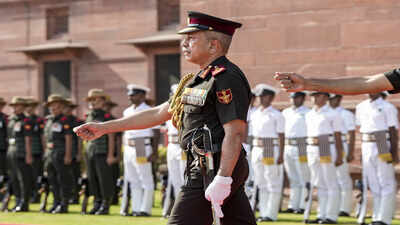
**PTI's Best Photos of the Week** New Delhi: Lt Gen NS Raja Subramani accorded a Tri-Services Guard of Honour during a ceremony marking his assumption of charge as the new Chief of Defence Staff (CDS), in New Delhi. (PTI Photo/Money Sharma)(PTI05_31_2026_000043A)(PTI06_07_2026_000352A)
The appointment of General Raja Subramani as India’s third Chief of Defense Staff (CDS) comes at pivotal moment in India’s rise in the comity of nations as also its consequent military evolution.
With a tenure expected to span about four years, the General gets a unique opportunity. He can transcend the initial experimental phase which the office of the CDS has weathered and institutionalize deep-rooted reforms. The "Agenda for the CDS" is not merely a to-do list; it is fundamental for transforming a fragmented military hierarchy into a cohesive, technology-driven, and operationally integrated force capable of meeting the challenges and requirements of a rising global power.
It needs to re-imagine India’s Military Outlook.
The Evolution of the Post
The CDS role is still evolving within the Indian military hierarchy. That is a given. However, the importance of General Raja Subramani’s appointment lies in the fact that he has served as the Vice Chief of Army Staff and as a Military Advisor National Security Council Secretariat (NSCS). This higher-level transition is vital. The interregnum as a Military Advisor would have broadened his vision at national level and enabled him to shed the "baggage" or "prejudices" of his Service.
His “higher view” and “political exposure” will be essential for the civil-military fusion that he will be expected to drive. The CDS must be a bridge between professional military leadership and political decision-makers, while possessing the mental balance to manage Service / Theatre commanders without service-specific bias.
The Operational Priority: Jointness and Theater Commands
The most significant item on the CDS agenda is the long pending transition to Theater Commands.
India’s current system, as evidenced during Op Sindhoor suffers from a lack of unified operational command. During Op Sindhoor, decisions were made through a "collective" process involving three service chiefs and executed through individual Service Commands. It is a considered opinion that such a process could have resulted in operational "bargains" rather than the most effective military choice(s).
A theater commander would have had the autonomy to match resources to tasks, offering higher military and political leadership clear options with enumerated consequences.
It would have given India’s military leadership some space to think rather than forcing them to manage day-to-day fighting. The outcomes might have been far better than what we did achieve (which were outstanding in any case). In this future structure, the CDS will become the operational commander-in-chief of all theater commands, while the service chiefs transition into the roles of "providers" and "sustainers" of force.
This shift is essential for India if it is to take its rightful position as a growing economic and global power. In it is also in line with international practices.
Strategic Communication
A glaring void in India’s military apparatus is the lack of a cogent Strategic Communication strategy. During past crises, senior leaders – military and political - have spent considerable time "firefighting" narratives rather than executing operations.
This is in explicable since India possesses massive institutional infrastructure to carry out effective strategic communication. India’s Ministry of Information and Broadcasting has a huge footprint but is largely underutilized.
This "sleeping elephant" currently lacks the synergy to run sophisticated information campaigns in the age of narrative warfare. The CDS must prioritize push for the creation of a national communication cell which can synergize India’s vast capabilities.
India’s narrative can be as slick and aggressive as political canvassing during elections or commercial marketing campaigns. This involves leveraging the resource and expertise of the Ministries concerned and synthesizing them with that of the Services and National Security Advisor (NSA). India needs to work in lockstep to communicate the nation's resolve.
Capability Development and Technology Ingestion
Capability development must move away from being a "sum of what the air force, army, and navy want” towards a realizing a joint perspective plan in an environment of technology denial.
The CDS must provide operational clarity to avoid inter-service competition which has been our bane. True capability is not just about buying new equipment; it is also about sustaining old capabilities while aggressively ingesting new technology.
Currently, the Indian armed forces lack a comprehensive plan for technology ingestion, particularly in how to repurpose cutting-edge technologies for military domain awareness.
The CDS must also drive a process-driven system that institutionalizes Military-Civil Fusion, ensuring that defense research, civil aviation, railways, external affairs and other ministries are synergized into a whole of the nation approach.
The Space Frontier
Space is no longer a civilian-only domain. Space is ubiquitous and is an indispensable factor in modern communication, navigation, and warfare. We use it in our day to day lives more often than we know.
While India has significant space capabilities through ISRO, it lacks a dedicated military space capability. The CDS must bridge the artificial divide between civilian and military space efforts. The faster it is done the better.
Military Diplomacy
Military Diplomacy must be reimagined in India’s power structure. It is increasing in scope as our comprehensive national power grows. It now being rested upon and being driven largely by the Ministry of External Affairs.
Military diplomacy must be the alternate channel to widen India’s global footprint. Military-to-military contacts should be the primary tool for increasing defense exports and expanding India’s global footprint.
The CDS must be the points man to ensure effective coordination between the top political, bureaucratic and military levels so that military diplomacy takes a new meaning.
The Human Element: Reforming the Agnipath Scheme
Perhaps the most immediate and probably contentious task for General Raja Subramani is addressing the flaws in the Agnipath (Agniveer) scheme. While the concept of a youthful profile is sound, the current execution pathway risks hollowing out military wisdom and expertise. This will affect the Indian Army the most. By 2030, nearly 60% of the force would be Agniveers if the scheme runs on as per current norms.
It will leave units/subunits with a dangerously low percentage of experienced personnel at the cutting-edge level. In an era of increasing high-tech in the military, experience is invaluable. A battery or squadron or company cannot effectively operate or maintain hi-tech costly weapon systems if 70 – 90 % of its personnel have only four years or less service.
These young men will neither be able to operate such complicated hi-tech equipment or maintain it.
In both cases the loss will be national. The CDS must advocate for increasing the retention rate (to at least 50%), ensuring that the "cutting edge" of the military remains technically competent and psychologically prepared for the future battlefield.
Conclusion
The agenda for the new CDS is formidable. It is indeed a vast spectrum, ranging from the creation of theater commands to the nuanced reform of personnel intake. His tenure represents a transition from the what the CDS is “expected” to do to what the CDS can “achieve” through institutionalization. By focusing on jointness, strategic communication, and technical capability, the CDS can ensure that the Indian military is not just a collection of three services, but a unified force ready to defend the interests of a third-largest global economy.
The success of the agenda of the CDS is a national imperative since warfare remains an unforgiving endeavor with "no runners-up".





 English (US) ·