

 36 minutes ago
4
36 minutes ago
4
ARTICLE AD BOX
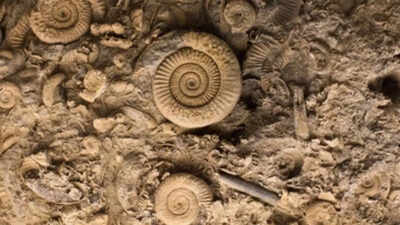
(Photo credit: Shutterstock)
Earth is home to millions of animal species today, from tiny insects and marine worms to giant whales. For many years, scientists have been trying to unravel the mystery of how animal life originated and diversified on our planet.
Now, thanks to a new study, researchers believe they may be one step closer to unlocking that mystery.This study, which was published in Science Advances, was conducted by paleontologists who studied fossil remains dating back to almost 567 million years ago. The fossils, discovered in Canada's distant Mackenzie Mountains, will provide insight into the Ediacaran Period, a period long predating the emergence of anything familiar such as dinosaurs, trees, or even fish.Early communities of animals on EarthAs per a report by Phys Org, Ediacaran period was a relatively recent era in geological time, existing between 635 and 538 million years ago. It featured some of the first complex creatures discovered by humanity, many of which had odd, soft bodies with bizarre shapes.While some of these early beings were flat and leaf-like, other species took on forms that appeared as tubes, coils, or quilted impressions embedded in ocean floors.
Due to the immense age of these organisms, scientists have yet to definitively decide their relation to modern species. Scientists typically classify Ediacaran fossils according to phases defined by age and location.
Why is the new finding significant?
The recently discovered Ediacaran fossils from Canada seem to represent animals believed to belong to the "White Sea" group, which had only been found previously in locations such as Russia and Australia.
This was particularly important because it demonstrated that these early animal populations existed not only in those areas but also in other parts of the ancient world.Moreover, the new findings appear to be older than the majority of the White Sea fossils scientists identified earlier. Researchers estimated the age of the rocks in which the fossils were found at approximately 567 to 566 million years ago.
Life in the deep ocean
Perhaps the most surprising result of the study is what kind of environment these creatures would have lived in.
Unlike their ancestors from the White Sea, which came from shallow waters, these creatures seem to hail from deeper parts of the sea. It seems that early animals could have lived in deeper waters long before moving into shallow waters.As far as experts are concerned, this means we must revise our views about early animal development. While earlier theories proposed a rapid succession of one group over another, this new discovery implies that both could co-exist for extended periods in the oceans.As far as evolution is concerned, this finding confirms that the process took place gradually. The early animals experimented with body types, food gathering techniques, and survival strategies.Such environmental factors might have played an important role in shaping features that aided the survival and evolution of certain animals over millions of years.This scientific discovery can also be considered in terms of convergent evolution, the phenomenon where organisms acquire the same features because they are exposed to similar conditions.
Some examples of convergent evolution can currently be observed in dolphins and sharks, which are distantly related yet share streamlined body shapes.This scientific discovery gives us more insight into one of the most intriguing scientific mysteries related to the origins of animal life on our planet. As more fossils from the deep-water regions become known, we are getting closer to understanding how single-celled organisms gave rise to so many different animals.









 English (US) ·