

 1 hour ago
7
1 hour ago
7
ARTICLE AD BOX
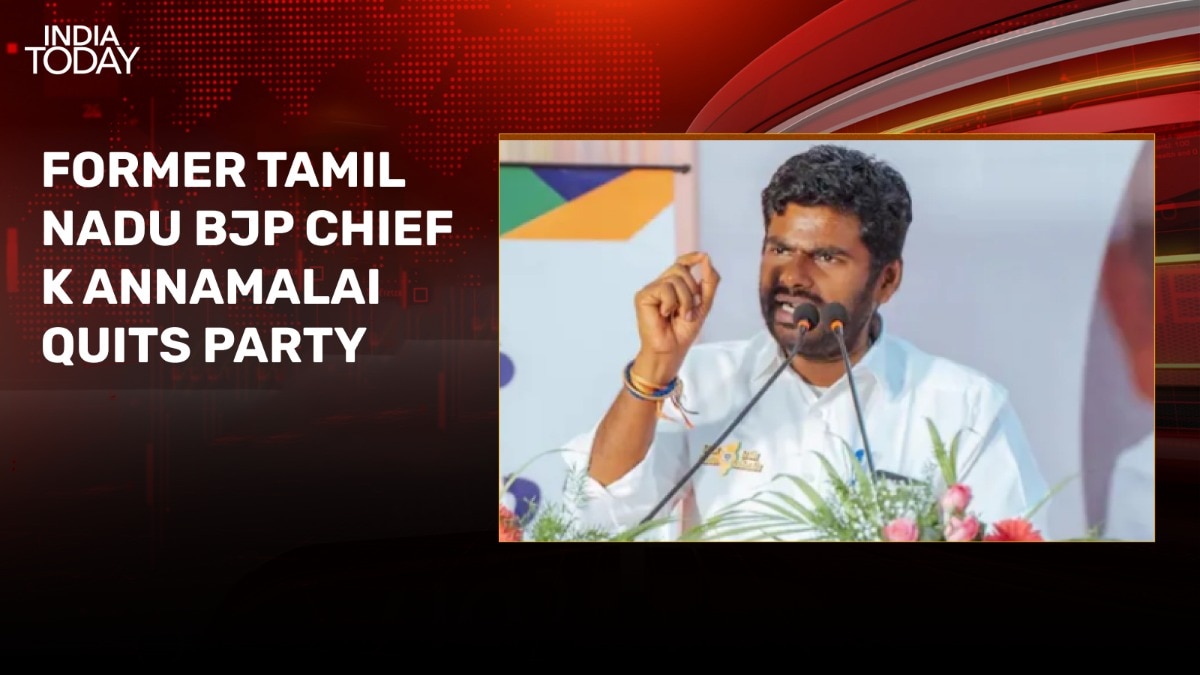
What began as the BJP's most ambitious political experiment in Tamil Nadu has ended with its most recognisable state leader walking away. The party's former state unit chief K Annamalai's resignation comes after intense speculation, internal differences and growing buzz about his political future.
His departure is significant not merely because a senior leader has left the party, but because he was widely seen as the face of the BJP's expansion project in a state where it has historically struggled for political relevance.
Annamalai had achieved what many once considered impossible in Tamil Nadu politics. Under his leadership, the BJP secured an 11 per cent vote share in the 2024 Lok Sabha elections, delivering a double-digit performance.
For a party that has long remained on the margins of Tamil Nadu's Dravidian-dominated politics, that performance was viewed as a breakthrough.
EXIT FOLLOWS GROWING IDEOLOGICAL DIFFERENCES
According to sources, Annamalai's resignation was preceded by months of disagreement with the party leadership on issues relating to Tamil Nadu's political and cultural sensitivities.
In his communication to the BJP leadership, Annamalai is understood to have argued that national parties often speak a political language that Tamil Nadu does not easily accept.
His reservations reportedly extended to the three-language policy proposed under the National Education Policy (NEP) 2020.
Sources said he had conveyed his concerns to the central leadership as early as December 4, 2025. However, he was reportedly asked to continue in his role until the electoral process was completed.
Even while announcing his departure, Annamalai maintained a respectful tone towards Prime Minister Narendra Modi, saying he continues to hold him in the highest regard.
At the same time, he indicated that he would engage politically with the BJP much like he would with other parties in Tamil Nadu, including the DMK, TVK, MDMK and DMDK.
The statement underscored both his admiration for the Prime Minister and his growing distance from the party organisation.
SEAT STRATEGY SPARKED INTERNAL DISCONTENT
Differences also emerged over electoral strategy.
According to party insiders, Annamalai was unhappy with the distribution of seats during the Tamil Nadu Assembly elections.
The BJP contested four seats in Pudukottai district, where it lacks significant organisational strength, while fielding candidates in only one constituency in Coimbatore, widely regarded as the party's strongest base in the state.
The results did little to ease those concerns. The BJP managed to win only one seat.
Ahead of the election, Annamalai had also stepped away from active campaign responsibilities, citing his father's ill health.
While the party publicly maintained unity, dissatisfaction over strategy and decision-making reportedly continued to simmer beneath the surface.
BJP FACES RELEVANCE CHALLENGE AHEAD
Annamalai's rise was unusually rapid by Tamil Nadu BJP standards.
A former IPS officer, he brought visibility, energy and media attention to a party that had often struggled to break through the state's entrenched political landscape.
His popularity among younger voters and social media audiences transformed him into arguably the BJP's most recognisable leader in Tamil Nadu.
That rise, however, also reportedly caused discomfort among some senior leaders who had spent decades building the organisation.
Now, with Annamalai gone, the BJP faces a larger challenge than simply filling a leadership position.
The real question is not whether the BJP can continue to grow in Tamil Nadu.
The question is whether it can remain politically relevant without the individual who became synonymous with its aspirations in the state.
YOUNG CADRE MAY FOLLOW ANNAMALAI
Perhaps the greatest risk for the BJP lies not among voters but within its cadre.
A significant number of first-generation BJP supporters and young workers entered politics during the Annamalai era. Many identified more strongly with his leadership style and political messaging than with the party's traditional organisational structure.
If even a section of these supporters chooses to follow Annamalai's future political journey, the BJP could lose some of its most energetic grassroots workers.
That possibility becomes even more significant amid speculation that Annamalai may launch a new political outfit, though he has not formally announced any such plans.
TAMIL NADU POLITICS ENTERS NEW ERA
Annamalai's departure comes at a time when Tamil Nadu politics is undergoing a broader generational shift.
The dominance of traditional Dravidian politics is increasingly being challenged by newer personalities and emerging political formations. The rise of TVK chief Vijay has already altered political calculations, while younger leaders are becoming more central to future electoral contests.
The uncertainty is not limited to the BJP. The AIADMK too faces questions about its long-term position in a rapidly changing political landscape.
As old political equations weaken, Tamil Nadu appears to be moving towards a new phase defined less by legacy parties and more by individual leaders capable of attracting new voters.
VIJAY-UDHAYANIDHI-ANNAMALAI RESHAPE FUTURE
Looking ahead, the next decade of Tamil Nadu politics could be shaped by three prominent faces: Vijay, Udhayanidhi Stalin and Annamalai.
Whether or not that scenario ultimately materialises, all three represent a new generation of political leadership competing for influence in a state undergoing transition.
If Annamalai succeeds in building an independent political platform, the BJP could find itself absent from a contest involving one of the leaders who helped it gain visibility in Tamil Nadu in the first place.
That is why his departure could prove more damaging than an electoral setback.
Political parties recover from defeats. Vote shares can rise and fall from one election to another. But replacing a leader who became the party's identity among a section of voters is a far more difficult task.
The BJP, however, has dismissed suggestions that Annamalai's exit will weaken the organisation.
Tamil Nadu BJP president Nainar Nagendran said the party remains driven by ideology rather than individuals.
"The BJP is an ideology-based party. There will certainly be no impact from this development. Anyone is free to start a political party in a democracy. Annamalai's resignation will not affect the party," he told reporters.
Whether that assessment proves correct may become one of the defining political questions in Tamil Nadu over the coming years.
- Ends
Published By:
Karishma Saurabh Kalita
Published On:
Jun 5, 2026 14:45 IST



 English (US) ·