

 1 hour ago
6
1 hour ago
6
ARTICLE AD BOX
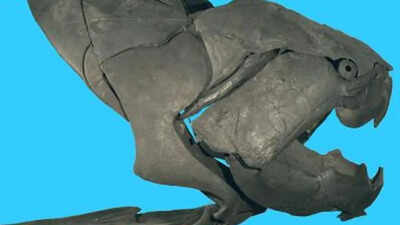
In the long stretch of geological time, Cleveland once sat under a shallow inland sea rather than the grid of roads and industry it carries now. Around 360 million years back, this stretch of water was not quiet or empty.
It held a strange mix of early marine life, much of it unfamiliar even by the standards of the Devonian period. Among them was a large predatory fish that would later become one of the more recognisable fossils pulled from the region’s black shale. Dunkleosteus terrelli, as it is now called, was not a delicate swimmer. It moved through those waters with a heavy front section, armoured and angular, built in a way that feels almost improvised by modern comparisons.
Its remains keep turning up in fragments, mostly around the Cleveland area, where ancient seabeds were slowly locked into stone.
How an ancient shallow sea preserved Devonian creatures beneath modern Ohio
The Cleveland of that era bore little resemblance to the land. What is now urban Ohio was submerged beneath a warm, shallow sea that slowly shifted across muddy basins and low-lying reefs. Sediment drifted down in fine layers, occasionally burying creatures before decay could fully take hold.
The research reveals published in the American Association for Anatomy, titled, 'Functional anatomy, jaw mechanisms, and feeding behavior of Dunkleosteus terrelli (Placodermi, Arthrodira)', Dunkleosteus fossils survived in a condition detailed enough to study at all. The black shale that formed there works almost like a time capsule, preserving bone plates, jaw fragments, and occasional near-complete skull sections. Construction digs in the region still bring pieces of it to the surface, as if the past keeps brushing against the present without much warning.Life in that water column was not gentle. Early sharks, armoured fish, and shelled invertebrates all shared the space, though not evenly.
How armour and strong jaws made Dunkleosteus a powerful fish
Dunkleosteus was not built like a typical fish. Its head and front body were wrapped in thick bony plates, more armour than skin in places, giving it a rigid profile that would have limited flexibility but added protection. The rear half, by contrast, was comparatively softer, less preserved in fossils and still partly uncertain in reconstruction.Its jaws are often the feature that draws attention. Instead of teeth in the modern sense, it had sharpened edges of bone that acted like cutting blades. They were capable of shearing through prey in a single motion, leaving little room for struggle once the bite was set.The size estimates vary, but some individuals stretched beyond four metres. Not the longest fish of its time, perhaps, but heavy through the front end in a way that suggests short bursts of force rather than prolonged pursuit.
Re-reading old fossils with new eyes
Much of what is known about Dunkleosteus comes from specimens collected more than a century ago, when early palaeontologists were still trying to work out how the fragmented plates fitted together. Those early reconstructions were shaped as much by guesswork as by anatomy, simply because the comparative material was limited.Later finds from other parts of the world, including better-preserved arthrodire fossils, have slowly changed that picture.
They revealed internal structures that earlier work had missed, especially around muscle attachment points and jaw mechanics. When researchers returned to the Cleveland material with that newer framework in mind, some of the assumptions around Dunkleosteus began to shift.One of the more unexpected details concerns cartilage. It had long been assumed that most of the skull was solid bone, but closer analysis suggests a substantial portion was actually cartilage, more than previously thought.
That places it closer to modern sharks in certain structural ways, even if its armour sets it apart entirely.
The hidden mechanics behind Dunkleosteus’ rapid strike
The jaw system in Dunkleosteus is still a subject of careful reconstruction. What stands out is not just the cutting edges but the way force may have been delivered. The arrangement of muscle attachments suggests a mechanism designed for rapid closure, where speed and pressure mattered more than repeated biting.There is also evidence of a channelled structure linked to jaw muscles, something that appears rarely in early fish groups. It hints at a more complex internal layout than the external armour might suggest at first glance.How exactly it fed remains partly interpretive, but the general picture points towards an animal that relied on sudden impact. Prey would have been intercepted rather than chased over distance, the environment doing some of the work by limiting escape routes in that shallow sea.
What makes Dunkleosteus an evolutionary exception
Dunkleosteus is often placed within a broader group of armoured fish known from the Devonian period, yet it does not sit neatly within expectations for that group. Its combination of heavy plating, partial cartilage structure and blade-like jaw elements sets it apart from many of its relatives.That variation matters because it suggests a wider range of body plans than once assumed. These fish were not all following the same design rules. Some were heavily armoured, others lighter, and a few, like Dunkleosteus, developed features that seem unusually specialised for their time. The fossil record from Cleveland has helped make that clearer, not by offering a complete skeleton, but by repeatedly showing the same unusual mix of traits across multiple specimens.









 English (US) ·