

 1 hour ago
3
1 hour ago
3
ARTICLE AD BOX
Last Updated:April 25, 2026, 18:00 IST
A historic turnout in Phase 1 of Bengal polls raises key questions: fear of voter roll deletion, push for change, or TMC consolidation ahead of Phase 2?


Murshidabad, the district which saw the highest deletions in SIR, also saw four of its assembly constituencies report the highest voting percentage in the state. (ANI)

The figure, which comes ahead of the all-crucial Phase 2 of the West Bengal elections next week, has stumped pollsters and surprised political parties.
Is it the Special Intensive Revision (SIR) effect? Remember, nearly 12 per cent of the electoral roll of the state saw deletion in these polls. Or is it people stepping out to vote in larger numbers because they want their vote to count?
ALSO READ | Bengal Records Historic Turnout In 2026 Elections. Last Time This Happened, Politics Shifted Forever
The voter turnout is over 10 per cent from the last time in 2021. The last time Bengal saw its highest turnout was 84.72 per cent in 2011, when it was a verdict for change as Mamata Banerjee threw out the over three-decade rule of the Left.
So, this time, is it an anti-incumbency vote against Banerjee? Or one to keep her in power as her voters consolidated? Or is it simply a case of voters taking no chances and coming out to vote, fearing their name would otherwise not remain on the voting list due to SIR?
Let us see some figures first.
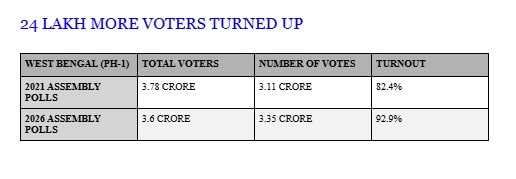
The total number of electors in Phase 1 was 3.6 crore. At 92.88 per cent voting, nearly 3.35 crore have voted. This is nearly 25 lakh more than the number of voters who cast their ballot in the last elections when polling was done on the seats in Phase 1. The number stood at 3.11 crore then.
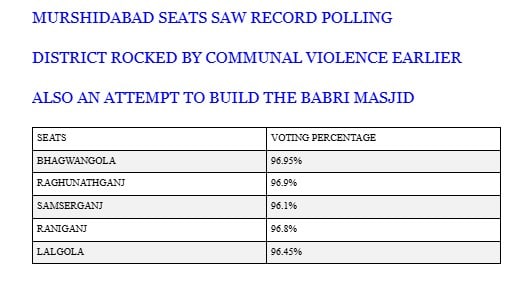
Murshidabad, the district which saw the highest deletions in SIR, also saw four of its assembly constituencies report the highest voting percentage in the state—Samserganj, Raghunathganj, Bhagawangola and Lalgola—all of which witnessed over 96 per cent voting. A heavily Muslim-dominated area, it also saw communal violence in recent years as well as the campaign to build a Babri Masjid here.
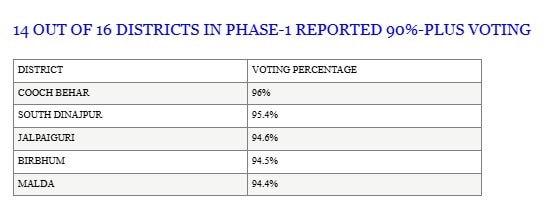
This time in West Bengal, there were almost no incidents of poll violence—people voted fearlessly and the presence of 2.5-lakh strong central forces acted as a confidence-booster. Not a single booth has seen a repoll in West Bengal this time, the keywords being ‘no fear’.
BJP sees this as a positive sign that voters were not intimidated and voted for change. The party believes the incremental number of voters are its Hindu voters who were earlier wary to vote for the party out of fear and reprisals.
Union Home Minister Amit Shah has already proclaimed victory and claimed BJP is winning 110 seats in Phase-1 itself. Prime Minister Narendra Modi has said BJP is headed to a massive and decisive win and predicted that there will be districts where TMC will not get a single seat.
That brings me to another important aspect of this election—the messaging right from the top of the BJP to the electorate.
ALSO READ | West Bengal’s Poll Paradox: 20 Lakh More Votes Polled In Phase 1 Despite 37 Lakh Deletions
At the heart of the party’s approach is a psychological barrier it believes has long worked against it in the state—fear among sections of voters that openly supporting it could invite intimidation or reprisals.
This concern, often raised quietly in internal surveys and booth-level feedback, is now being addressed head-on. Senior BJP leaders, including Shah, have sharpened their rhetoric against what they describe as “goons" and entrenched local syndicates.
First, PM Modi warned “TMC goons" to surrender at their nearest police station before April 29 or face the new government’s wrath after May 4. Shah doubled down on that message when he said a new BJP government will “hang the TMC goons upside down" after the results.
The warnings are not just political attacks; they are calibrated signals aimed at reassuring voters that the BJP is both aware of these fears and prepared to confront them. Shah’s extended stay, coupled with the prime minister’s repeated visits to the state, is meant to convey that the party is fully invested in Bengal and willing to back its supporters.
There is also a clear communication push underway. Party leaders are stressing themes of political freedom and democratic rights, framing the act of voting as a matter of courage and change. BJP feels this has worked for it in Phase-1.
Here is why BJP thinks high voting helps it:
Fear-free voting: Heavy central forces ensured peaceful polls, no re-polls.
BJP’s gain: Party sees higher turnout as fearless voters backing change.
Big claims: Amit Shah and PM Narendra Modi predict strong BJP victory.
Breaking fear factor: Campaign targets intimidation narrative around BJP supporters.
Hard messaging: Strong rhetoric and outreach frames voting as courage and change.
But there may be another ‘fear’ that could have prevailed on people’s minds. The fear that if they do not vote this time, their name may get deleted in the next SIR. Unfounded it may be, but anecdotal accounts show that fear existed. It is also possible that Banerjee’s voters consolidated, anticipating the SIR to be a plot to throw her out of power, and ensured each vote mattered.
ALSO READ | West Bengal’s Poll Paradox: 20 Lakh More Votes Polled In Phase 1 Despite 37 Lakh Deletions
Banerjee surely feels so, claiming that the high turnout is a mandate against SIR and the BJP.
Also, West Bengal’s unusually high voter turnout cannot be explained solely by traditional factors like strong party machinery or booth management. Instead, it reflects a deeper, emotionally driven mobilisation shaped by anxiety, identity, and political intent. While procedural on paper, SIR has sparked widespread uncertainty among voters about whether their names remain on the rolls, especially in regions with migration histories. This has turned voting into a defensive act—an assertion of presence and inclusion.
The psychological impact of debates around the Citizenship Amendment Act (CAA) and National Register of Citizens (NRC) has further intensified this sentiment. Even without full implementation, these issues have heightened fears around citizenship, particularly in border and minority-dominated areas.
High turnout, in this context, signals not just participation but a collective response to perceived vulnerability.
Adding to this is the visible return of migrant voters, who travelled long distances not just to vote, but to be seen doing so—making the ballot both participation and protest.
While such turnout does not guarantee a particular electoral outcome, it reshapes the contest by tightening margins, increasing polarisation, and reducing complacency. Ultimately, this election reflects “emotional polling", where voting becomes a powerful expression of identity, survival, and political agency rather than mere routine participation.
Here is why TMC thinks high voting helps it:
Alternate fear factor: Concern over possible deletion from voter rolls (SIR) may have pushed people to vote.
Perception vs reality: Even if unfounded, anecdotal evidence suggests this fear influenced turnout.
TMC consolidation: Possibility that Banerjee’s voters rallied in response to SIR concerns.
Political framing: TMC views SIR as a strategy to unseat the government, driving urgency among its base.
Mamata’s claim: High turnout reflects a mandate against SIR and the BJP.
Nevertheless, SIR has a major part to play in increased voting percentages. The electoral rolls have been purified and now one has the true picture of voting percentages, ECI functionaries say.
Traditionally, high turnout always means an anti-establishment vote. The BJP believes so. However, the TMC believes that this is not just high turnout but a pushback to the SIR’s draconian deletion of voters. Which way it goes may well determine the election result on May 4.
Handpicked stories, in your inbox
A newsletter with the best of our journalism
First Published:
April 25, 2026, 18:00 IST
News india Bengal’s 92.9% Poll Shocker: Signs Of No Fear Or New Fear?
Disclaimer: Comments reflect users’ views, not News18’s. Please keep discussions respectful and constructive. Abusive, defamatory, or illegal comments will be removed. News18 may disable any comment at its discretion. By posting, you agree to our Terms of Use and Privacy Policy.
Read More





 English (US) ·