

 1 hour ago
3
1 hour ago
3
ARTICLE AD BOX
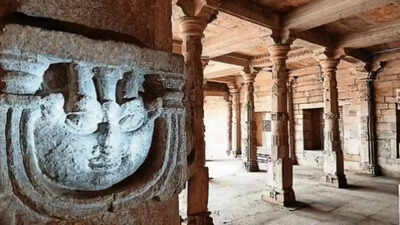
In its ruling, the high court held that the disputed Bhojshala complex is a temple dedicated to Goddess Saraswati.
NEW DELHI: A Hindu party on Friday has filed a caveat in the Supreme Court seeking to ensure that no order is passed without hearing it in any appeal filed against the Madhya Pradesh high court’s ruling in the long-standing Bhojshala complex dispute, as per a report by PTI news agency.The caveat was filed by Jitendra Singh “Vishen” through advocate Barun Kumar Sinha. The plea urged the Supreme Court to issue notice to the caveator before passing any direction in matters arising from the high court judgment delivered earlier in the day.Vishen was among the petitioners in the case before the Madhya Pradesh high court, whose Indore bench delivered a significant verdict in favour of the Hindu side.In its ruling, the high court held that the disputed Bhojshala complex is a temple dedicated to Goddess Saraswati. The court further observed that the Centre and the Archaeological Survey of India (ASI) would be empowered to take decisions regarding the administration and management of the site.The court also set aside the ASI’s April 7, 2003 order, which had permitted Muslims to offer namaz at the Bhojshala complex every Friday.
The bench further added that the Muslim community, which refers to the 11th-century ASI-protected structure as the Kamal Maula Mosque, could approach the Madhya Pradesh government for allotment of separate land in Dhar district for the construction of a mosque.What was the dispute?The Bhojshala complex in Dhar district of Madhya Pradesh has been at the centre of a long religious dispute between Hindu and Muslim communities.
The site was regarded as a temple of Goddess Saraswati by the Hindu community and as a mosque by the Muslim community.After the controversy erupted, the ASI issued an order on April 7, 2003, permitting Hindus to worship at the complex every Tuesday and Muslims to offer namaz there every Friday.The Hindu side challenged this arrangement in the high court, seeking exclusive rights to worship at the site. A Jain community also entered the fray, claiming the structure was originally a Jain temple and learning centre.The Indore bench of the high court began regular hearings on five petitions and one writ appeal related to the case on April 6, hearing arguments from Hindu, Muslim, and the Jain communities against the backdrop of differing religious beliefs, historical claims, complex legal provisions, and thousands of documents related to the disputed monument, before reserving its decision on May 12, according to a LivLaw report.On what grounds was the judgment made?The court's ruling was based on historical literature, archaeological evidence, and constitutional provisions.The bench recorded that historical literature establishes the Bhojshala complex as a centre of Sanskrit learning associated with Raja Bhoj, and that archaeological references indicate the existence of a temple which was dedicated to Goddess Saraswati at Dhar.
The court noted the continuity of Hindu worship at the site, even if regulated over time, as a factor in determining its religious character.On the archaeological front, the high court had earlier ordered a scientific survey of the site by the ASI. The Supreme Court had temporarily stayed the survey in the Muslim community's appeal, but later laid down a time-bound process to unseal the ASI survey report, supply copies to all parties, and consider their objections at the final hearing.
The survey findings and the historical record together formed the evidentiary basis for the verdict, as per a LiveLaw report."We have noted the continuity of the Hindu worship at the site, though regulated overtime...We record finding that historical literature of the place establishes as a centre of Sanskrit learning associated with Raja Bhoj...it indicates the existence of Temple dedicated to Goddess Sarawsati at Dhar...
Therefore, the religious character of the area is held to be Bhojshala with temple of Goddess Vagdevi Saraswati," the court said, as quoted by LivLaw.The court also invoked the constitutional obligation of every government, observing that it is the duty of the state to ensure preservation and protection of not only ancient monuments and structures of historical and archaeological importance, but also of the sanctum sanctorum and deities of spiritual importance.The Muslim side had argued that historical records from the Khilji period do not mention the destruction of any Saraswati temple at Dhar, and had relied on a 1935 notification by the erstwhile Dhar ruler permitting the Muslim community to offer namaz at the site. However, the government counsel argued that the 1935 notification was invalid since the site had already been declared a protected monument under the Ancient Monument Preservation Act of 1904.
The court accepted this position and quashed the 2003 ASI order accordingly.







 English (US) ·