

 7 hours ago
2
7 hours ago
2
ARTICLE AD BOX
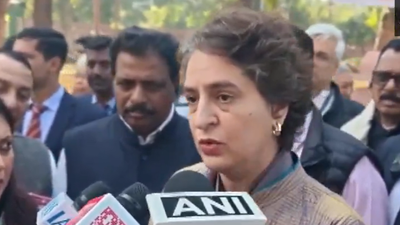
NEW DELHI: Congress leader Priyanka Gandhi Vadra on Tuesday accused the Centre of attempting to dismantle the Mahatma Gandhi National Rural Employment Guarantee Act under the pretext of renaming and restructuring it, warning that the proposed changes could eventually lead to the scheme being scrapped.Speaking during a protest against the proposed renaming of MGNREGA to G RAM G, Priyanka Gandhi said the government was “obsessed” with changing names and argued that such exercises lead to unnecessary expenditure. She said the rural employment scheme carries the name of Mahatma Gandhi, the Father of the Nation, and altering it amounts to disrespect.
“This scheme is named after Mahatma Gandhi. He is the Father of the Nation and his name should not be insulted,” she said.
Priyanka Gandhi also pointed out that MGNREGA was enacted with unanimous political consensus. “When this law was passed, there was not a single national party that opposed it. It was made with everyone's consent,” she said, adding that the law was meant to guarantee 100 days of employment to the poorest sections of society.Questioning the government’s claim that it was expanding employment from 100 to 125 days, she said the proposal was misleading.
“On the surface, it appears they are increasing workdays, but if you read it carefully, the scheme itself could come to an end,” she said, alleging that there were multiple provisions that could weaken or dismantle the programme.She criticised the proposed change in the funding pattern, noting that earlier the Centre bore 90 percent of the financial responsibility. “Now the Centre wants the work to continue but is shifting the burden onto states. Poor states will not be able to afford this, and eventually the scheme will collapse,” Gandhi said.“The truth is that in the garb of changing the name of the scheme, they want to scrap this scheme. Why do they want to change the name of this scheme? Mahatma Gandhi is the father of the nation,” she added.
- Renaming used as a cover to weaken or scrap MGNREGA
“On the surface, it appears that only the name is being changed and the number of workdays is being increased from 100 to 125. But if one reads this carefully, there are 23 provisions through which this scheme can be weakened or even finished.”“The truth is that in the garb of changing the name of the scheme, they want to scrap this scheme.”
- Financial responsibility shifted from Centre to states
“Earlier, 90 percent of the responsibility lay with the Centre to provide the funds.”“Once the Centre’s share is reduced, the burden will fall on the states. Poor states will not be able to afford this, and eventually the scheme will collapse.”
- Centralisation of decision-making, weakening Panchayati Raj
“That decision is taken at the panchayat level by the gram pradhan.”“Now what will happen? These decisions will be made at the Centre. People sitting in Delhi will decide.”
“The powers given to panchayats under the 73rd Constitutional Amendment, under the Panchayati Raj system, will be taken away.”
Several opposition MPs staged a demonstration outside Parliament’s Makar Dwar and later gathered near the Mahatma Gandhi statue within the Parliament compound. Holding photographs of Mahatma Gandhi and accused the Centre of attempting to dismantle the rural employment scheme under the guise of renaming it. Samajwadi Party chief Akhilesh Yadav and other senior opposition leaders were present during the protest.
Earlier in the day, Union agriculture minister Shivraj Singh Chouhan sought permission in the Lok Sabha to introduce the Viksit Bharat Rozgar and Ajeevika Mission (Gramin) Bill, 2025, also known as the G RAM G Bill, which seeks to replace MGNREGA.
The proposed Bill guarantees 125 days of wage employment per rural household, up from the existing 100 days, for adult members willing to undertake unskilled manual work. The government has said the new framework aims to provide income security while creating durable and productivity-enhancing rural assets through a nationally coordinated development strategy.







 English (US) ·