

 1 hour ago
4
1 hour ago
4
ARTICLE AD BOX
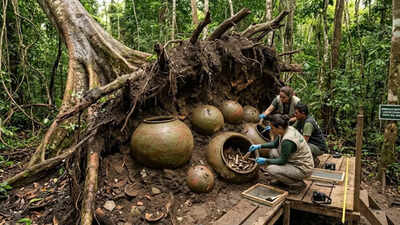
A significant archaeological recovery occurred in Amazonas, the Brazilian state, when the uprooting of a paricarana tree at Lago do Cochila uncovered seven prehistoric funeral urns in its roots.
The round ceramic vessels were discovered near Fonte Boa, Brazil and provide a unique look into the engineered landscapes of ancient indigenous culture in the Middle Solimões region. They contained an unusual combination of human and animal remains, and this finding has impacted the understanding of the burial practices of ancient Amazonian societies. The excavated urns were part of an effort by the Mamirauá Institute to reveal how these communities used artificial islands as an environment for living and practising their traditions during seasonal floods.
This evidence represents an important aspect of the history of these resilient cultures that were hidden under the rainforest for a very long time.
Funeral spheres recovered from Brazil’s Amazonas state
The recovered ceramic assemblages are referred to as ‘units of the urn’ and exhibit a globular morphology. The majority of the urns' diameters range between 70 and 90 centimetres and do not have any known lids (as in many other boxes found throughout the Amazon). Archaeologists assume they would have originally been covered with an organic material, such as a lid or cloth, which has long since decayed.
The urns were located at a depth of 40 centimetres, underneath an artificial mound, indicating they were deposited directly beneath the floors of homes used by the people from this time period.
How ancient Amazonians conquered rising waters
The site of these urns, Lago do Cochila, would have been surrounded by several what have been described as ‘promotions,’ as in anthropogenic mounds formed by refuse used household items. These types of structures are known as man's solution to build on land in the ‘várzea’ (floodplain) of the Amazon, allowing them to settle in their homes even though there are drastic seasonal fluctuations of water levels.
This shows us that humans of the previously mentioned pre-history did not behave like nomads and built extremely organised, non-nomadic societies in which they lived, as well as made considerable alterations to the surrounding geography.
Why were humans buried with Fish and Turtles
According to the Journal of Anthropological Archaeology, the archaeologists who excavated these urns were able to recover the bones of an individual; however, they were mixed with fish bones and chelonian (turtle) bones.
Archaeologists interpret these as components of a complex funeral offering ritual, which was performed in connection with the idea of ‘alimentation’ or feeding. The animal bones found in this urn also lead to the assumption that the entire process of burying the deceased took place in stages and was likely done in a symbolic manner, correlating the factors of the deceased and living with the resources provided by the aquatic surroundings.
Advanced material engineering in prehistoric Amazonia
The newest findings in the National Museum of the American Indian show that the ceramics exhibit a distinct typology, with a type of clay that is a rare greenish-brown colour and is decorated with red bands. This is not consistent with what we generally call the Amazon Polychrome Tradition and raises questions about what unique cultural groups might have lived in the area of the Fonte Boa region that we also do not know about yet, or whether or not there was an archaeological horizon unrelated to the Amazon Polychrome period.
The use of specific minerals to temper the clay suggests that those who made the ceramic products had advanced technical knowledge.
How collaboration saved the Amazon’s ancient spheres
The recovery of the urns was done jointly by researchers formally trained in archaeology and the members of the Amandarubinha community. Community members have provided access to much-needed resources for the careful removal of the very dense root mass at a height of over three metres above ground. This type of collaboration will continue to be crucial in working together to protect Amazonian sites from environmental degradation and to assist local people in protecting their cultural heritage against unlawful attempts to remove cultural artefacts and to keep them in proper contextual locations after they are recovered.





 English (US) ·