

 6 days ago
10
6 days ago
10
ARTICLE AD BOX
Paper leak scandals recur with alarming regularity and convictions remain elusive. A deeper question now confronts the system itself is: can India still guarantee the integrity of its examinations?
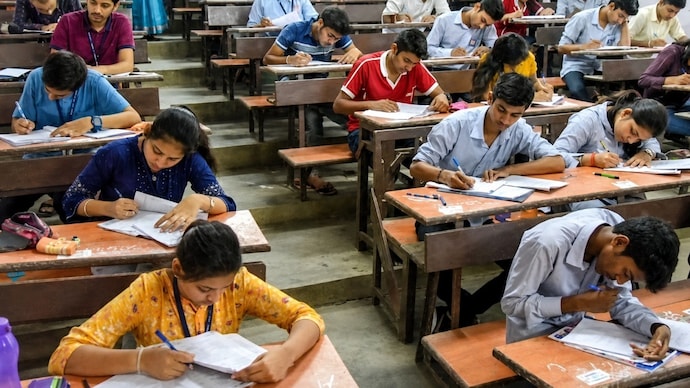
Not a single individual has been convicted so far in the NEET-UG 2024 case. (Photo: PTI)
The recent NEET paper leak has reignited a nationwide debate: will students get justice, and can the system reassure them that such breaches will not recur? The concern stems from India’s dismal track record in prosecuting paper leak cases. In the past 23 years, across more than 50 reported cases, convictions have reportedly been secured in only two.
Let’s start with the case that rocked the nation two years ago. On the morning of May 5, 2024, inside a school control room in Jharkhand's Hazaribagh, sealed trunks were allegedly prised open using specialised tools, question papers for the National Eligibility-cum-Entrance Test (NEET) were photographed, and solved answers began circulating among waiting candidates. By the time NEET-UG 2024 concluded across the country, more than 23 lakh students had appeared for the examination, and an untold number were allegedly being cheated in real time.
What followed was a sweeping CBI probe. Multiple charge sheets, around 45 accused persons named, nearly 144 alleged beneficiaries identified and successive waves of arrests, including a man described as a "kingpin", Rockey alias Rakesh Ranjan. The agency eventually captured the alleged mastermind, Sanjeev Kumar Singh alias Sanjeev Mukhiya, who reportedly carried a bounty of Rs 3 lakh and remained absconding for nearly a year after the examination.
Yet, as of mid-2026, not a single individual has been convicted in the NEET-UG 2024 case. The trial drags on. Most of the accused continue to await proceedings either from custody or while out on bail. The ecosystem that allegedly enabled the leak, such as financiers, institutional insiders and a multi-state logistics network, remains officially unmapped at its highest levels.
This is not an exception. It is a pattern.
A NATIONWIDE PATTERN OF EXAM FRAUD
India’s paper leak epidemic is documented, quantified and widely understood in its mechanics, yet almost entirely unpunished in its consequences. According to data compiled from parliamentary proceedings and media investigations, there were more than 50 instances of paper leaks in government recruitment examinations across eight states between 2015 and 2023 alone, jeopardising the futures of over 1.4 crore aspirants. When national competitive examinations such as NEET, UGC-NET and BPSC teacher recruitment tests are added, the figure rises further.
Rajasthan alone recorded 26 paper leak incidents between 2011 and 2022, with 14 occurring in the final four years of that period, averaging more than three leaks a year. Gujarat recorded 14 cases since 2015; Uttar Pradesh logged six between 2017 and 2022; Uttarakhand recorded four since 2019.
In response, Rajasthan’s Assembly was informed in January 2024 that 615 people had been arrested across 33 cases registered since 2014, and charge sheets had been filed in 32 of them. However, the number of actual convictions was not disclosed separately.
The Bihar Police’s Economic Offences Unit (EOU), which first cracked open the NEET 2024 case, identified the accused network as spanning Bihar, Uttar Pradesh, Haryana, Punjab and Rajasthan. This was not a local operation run by a handful of opportunists. Investigators described it as a multi-state organised crime enterprise whose operators had allegedly been engaged in examination fraud for more than two decades.
REPEAT OFFENDERS AND FAILURE OF DETERRENCE
Perhaps the most damning indictment of India’s paper leak enforcement machinery is the phenomenon of the repeat offender. Individuals arrested, charged, granted bail are being arrested again, accumulating criminal cases across multiple states over several years.
Consider Sanjeev Kumar Singh alias Sanjeev Mukhiya. By the time he was arrested in April 2025, 12 criminal cases had reportedly been registered against him, five of them linked to paper leaks. According to Bihar Police, his alleged involvement spans the NEET-UG 2024 leak, the BPSC Teacher Recruitment Examination conducted in March 2024, the Bihar Police Constable Recruitment Examination, and at least three other major leaks within a single year.
His son, Dr Shiv Kumar, an MBBS graduate from Patna Medical College, was also allegedly part of the NEET conspiracy. By investigators’ account, examination fraud had become a family enterprise.
Then there is Vikas Mishra, once described by investigators as a "kingpin". He was implicated in the 2021 Uttar Pradesh Teachers Eligibility Test (UPTET) leak, arrested in the 2023 National Health Mission nursing examination leak in Madhya Pradesh, and surfaced again in the Uttar Pradesh Review Officer examination leak of 2024.
And then there is Ranjit Attri, a name linking cases separated by nearly a decade. His alleged involvement stretches back to the 2012 AIPMT and 2015 AIIMS-PG paper leaks. He resurfaced in connection with the NEET-UG 2024 case after Bihar’s EOU uncovered alleged links between him and Sanjeev Mukhiya.
Two generations of examination fraud. The same names recurring across cases. Yet no final conviction to show for any of it.
LAWS EXIST, ENFORCEMENT DOES NOT
India has not been passive legislatively. Rajasthan enacted its own anti-paper leak law in April 2022, prescribing punishments of up to 10 years' imprisonment and fines of up to Rs 10 crore. Yet the REET second-grade teachers' examination paper was allegedly leaked within eight months of the law coming into force.
At the national level, Parliament passed the Public Examinations (Prevention of Unfair Means) Act in February 2024 amid mounting public anger. The Centre notified the law in June 2024, only weeks after the NEET controversy erupted.
On paper, the legislation is formidable. It prescribes imprisonment ranging from three to five years for individuals resorting to unfair means, and up to 10 years for organised examination fraud. It also provides for fines ranging from Rs 10 lakh to Rs 1 crore. Offences under the law are cognisable, non-bailable and non-compoundable. Service providers found complicit can face penalties of up to Rs 1 crore. The law also provides for the establishment of special courts to expedite trials.
Yet, as of mid-2026, the Act has yielded no known convictions, a situation one legal observer described as "laws written in ink that hasn't dried".
JUSTICE DELAYED IN OVERBURDENED COURTS
Part of the problem is structural. India's criminal courts are burdened with a backlog running into tens of millions of cases. Paper leak prosecutions, even when diligently investigated, enter a judicial queue that often moves at a glacial pace.
The Railway Recruitment Board examination leak case of 2002, which was a relatively straightforward matter involving officials accused of accepting money in exchange for a question paper, took 23 years to reach a verdict. If that timeline were applied to NEET 2024, the accused in the current case could face judgment only around 2050.
In the NEET case, the CBI has repeatedly maintained that the investigation remains open and that supplementary charge sheets may still follow.
But critics, including several education policy analysts who declined to be named due to the sensitivity of the ongoing proceedings, argue that, in case after case, investigators identify the visible operators while the financial architecture behind the racket remains largely untouched.
The masterminds at the end of the money trail are not necessarily the middlemen in Patna or the school officials in Hazaribagh. They are whoever made it worth everyone’s while.
- Ends
Published On:
Jun 5, 2026 18:15 IST




 English (US) ·