

 2 days ago
30
2 days ago
30
ARTICLE AD BOX
In China, authorities have built highways around "nail houses" after landowners refused to sell them. A similar case is now unfolding in India, where a house in Ghaziabad is blocking a key exit ramp on the Delhi–Dehradun Expressway.
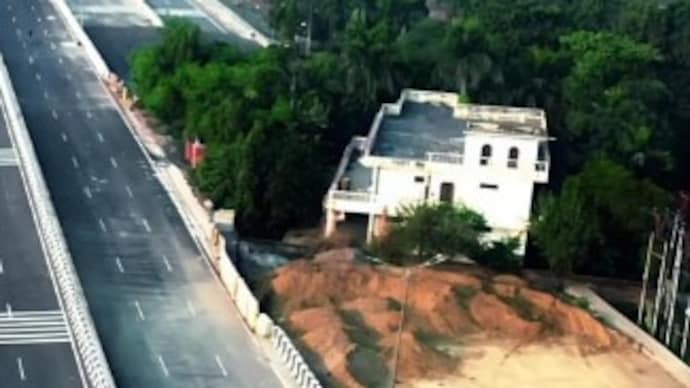
A house named Swabhiman, which translates to self-respect, stands right in the middle a service road on the Delhi–Dehradun Expressway. (Image: File)
In 2025, a Chinese landowner, tofu vendor Ye Yushou, did not let the government acquire his property for the construction of the G206 highway in Jinxi County, in eastern China's Jiangxi province. The highway was completed, but his house remained exactly where it was. Authorities had to reroute the project and build the highway around it by diverting the route. The structure later came to be known as a "nail house". This was the most recent episode of Nail House reported from China. There are multiple cases of landowners resisting giving up their land to the Chinese government.
Now, a similar resilience of the nail house has emerged in India too. A house in Mandola village in Ghaziabad, Uttar Pradesh, drew attention for obstructing the Delhi–Dehradun Expressway's crucial part. On April 14, Prime Minister Narendra Modi inaugurated the project, but along the 213-km stretch, a house named "Swabhiman", which translates to self-respect, stands squarely in the path of the service road.
The 213-km-long Delhi–Dehradun Expressway cuts travel time between the two cities from around 6 hours to just 2 to 2.5 hours. The estimated cost of the project was around Rs 12,000 to 13,000 crore. Featuring a six-lane access-controlled design with a speed limit of 100 kmph, the corridor included 14 wayside amenities, multiple bridges, interchanges, and rail overbridges.
But like the Chinese nail house, Swabhiman has not budged, literally and figuratively.
Shivang Shukla of India Today Group's NewsMo visited the house for a reality check. When he reached the spot, he saw a two-storey house spread over almost 1,600 square metres. The security guard of the property arrived after Shivang shouted, "Koi hai?!" (Is anyone there?!) from outside. When asked about the owner, the guard replied, "Owner stays in Noida."
A land dispute over the house has been going on since 1998. The owner of the house, the late Dr Veersen Sorah, challenged the Uttar Pradesh Housing Board's acquisition of his land for the Mandola Housing Scheme in the Allahabad High Court. The authorities had issued a notification to acquire 2,614 acres of land from six villages in the region for its Mandola housing scheme, offering Rs 1,100 per square metre. Saroha did not agree to this notification and moved to court seeking higher compensation.
According to a report in The Indian Express, presently the land is owned by the late Saroha's grandson, Lakshyaveer Saroha. The housing scheme was not completed. In 2020, the National Highways Authority of India (NHAI) decided to launch an expressway from Delhi's Akshardham to Dehradun in Uttarakhand. The authorities needed that very land parcel owned by the Saroha family to construct a service road for vehicles coming from Dehradun to exit at Mandola and head towards Panchlok near Loni.
While the dispute was still pending in the Allahabad High Court, Lakshyaveer, citing the threat of demolition of his house, filed a litigation in the Supreme Court in 2024. The Supreme Court directed that the status quo be maintained, prohibiting any demolition or further construction. It also urged the High Court to expedite the hearing of the case.
CHINA'S NAIL HOUSE OWNER REGRETS DECISION
Among the several cases of nail houses in China, one instance stands out as the owner of the nail house, Ye Yushou, became a symbol of resistance when he first refused to sell his home for the construction of the highway. But once the project was completed, with the road built around his house, his defiance turned into regret. According to the Hong Kong–based South China Morning Post, Yushou had initially rejected a compensation offer of 1.6 million yuan (about $220,000) and alternative housing. He expected a better deal and wanted 2 million yuan and three homesteads instead.
According to the South China Morning Post report, he admitted that this decision felt like "losing a gamble", as authorities chose to bypass his property rather than meet his demands.
Yushou's house now sits isolated in the middle of a busy highway, cutting him off from normal surroundings and exposing him to constant traffic, noise, and disruption. While the government constructed a special access route for the family, daily life has become inconvenient and uncomfortable. But what's important to note is that Yushou has now lost all chances of compensation. With the highway completed, authorities are unlikely to revisit negotiations or offer payment, leaving him with neither financial gain nor practical living conditions.
SWABHIMAN'S IN THE MIDDLE OF THE HIGHWAY, LITERALLY
Cut to Mandola village, NewsMo's Shivang spoke to the landowner's mother to find out their demands. "Our demand is clear, we need the authorities to pay the compensation according to the current land prices, else let them forget about our land," the landowner's mother said.
"The house is blocked from all four sides," the security guard told NewsMo.
The security guard, speaking to The Indian Express said, "The house always remains empty, and I clean it every day." He also said, "The noise of the traffic after the expressway's operations began is very difficult to control."
One NHAI official supervising the expressway works told The Times of India that the authorities were aware of the problem since the corridor opened for trial. "The ramp needs to be constructed at the earliest, but since it is caught in litigation, there is nothing we can do. We have erected crash barriers," the official was quoted as saying by The Times of India. The last hearing of the case was in March at the Allahabad High Court, which gave a date for further hearing.
The nail house in China became a symbol of a high-stakes standoff between individual resistance and state-led infrastructure. But it also shows how such defiance can end in isolation and regret once development moves on without compromise. What becomes of Swabhiman now remains to be seen.
- Ends
Published By:
Avinash Kateel
Published On:
Apr 25, 2026 09:33 IST



 English (US) ·