

 1 day ago
8
1 day ago
8
ARTICLE AD BOX
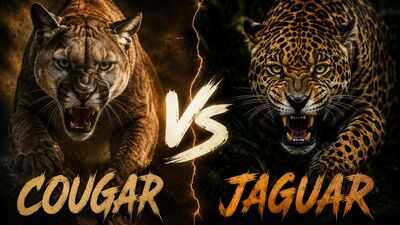
At first glance, a cougar and a jaguar might appear to belong to the same mould. Both are solitary hunters, both sit near the top of the food chain, and both have earned a reputation for remarkable strength.
Yet they are built for rather different lives. One relies on stealth, speed and extraordinary leaps across mountains and forests. The other carries a heavier frame, an exceptionally powerful bite and is equally comfortable moving through rivers and wetlands. Their paths overlap only in parts of Central and South America, but each has adapted to its surroundings in distinct ways. Looking beyond appearances reveals two predators with separate hunting styles, physical traits and survival strategies that have evolved over thousands of years.
Cougar and Jaguar: Comparing size, strength, habitat and hunting style
| Parameter | Cougar | Jaguar |
| Scientific name | Puma concolor | Panthera onca |
| Average size | Slender, usually 64–82 kg for males, occasionally heavier | Stockier males commonly reach 120 kg or more |
| Body build | Lean with long legs and tail | Muscular, broad chest and powerful shoulders |
| Coat | Plain tawny or greyish coat | Golden coat covered in rosettes with central spots |
| Habitat | Mountains, forests, deserts and shrublands | Tropical forests, wetlands and river systems |
| Geographic range | Widest distribution of any wild cat in the Americas | Mainly Central and South America, with the largest populations in Brazil |
| Main prey | Deer, elk and other medium to large mammals | Deer, capybaras, caiman, tapirs, turtles and many other animals |
| Hunting method | Ambush followed by a throat or neck bite | Ambush finished with a crushing bite to the skull |
| Swimming ability | Can swim when necessary, but prefers land | Strong swimmer who regularly crosses rivers |
| Conservation | Stable in parts of North America but affected by habitat loss elsewhere | Near Threatened, facing pressure from habitat loss and poaching |
Understanding the differences between a Cougar and a Jaguar
SizeThe most obvious difference appears the moment the two cats stand side by side. A jaguar carries much more weight on a compact frame, giving it a dense, muscular appearance. Cougars look longer and leaner, with relatively long legs and an equally long tail that helps maintain balance. Even large male cougars are generally lighter than mature male jaguars, making the jaguar the larger and more heavily built animal.
AppearanceAlthough both belong to the cat family, confusing them is unlikely once their coats are examined closely. Jaguars are recognised by dark rosettes scattered across a golden background, with many of those markings containing small black spots. Cougars lack these patterns altogether. Their coats are usually plain tawny, reddish-brown or greyish, allowing them to disappear against rocky hillsides, woodland and dry vegetation.HabitatCougars have adapted to an unusually broad range of landscapes. They occupy mountains, dense forests, deserts, scrubland and rugged canyons, provided enough cover and prey are available. Jaguars are far more closely tied to warm, humid environments. Rainforests, flooded forests, marshes and wetlands suit their lifestyle, particularly places where rivers, lakes and thick vegetation come together.Geographic rangeFew wild cats occupy as much territory as the cougar. Its range stretches from western Canada through the United States and into South America, making it the most widespread cat in the Western Hemisphere. Jaguars once occupied a similarly vast area but have disappeared from much of their historic range. Healthy populations now survive mainly across the Amazon Basin and the Pantanal.Hunting stylePatience defines both predators, though the final attack differs.
Cougars stalk quietly before launching a sudden burst of speed, usually bringing prey down with a bite around the neck or throat. Jaguars depend less on prolonged chases. Their powerful jaws allow them to finish hunts with a crushing bite through the skull, a technique that sets them apart from every other big cat.DietCougars feed largely on hoofed mammals such as deer, though they also take smaller animals, including rabbits, raccoons and occasionally livestock where opportunities arise.
Jaguars are among the least selective hunters in the cat family. Fish, monkeys, armadillos, capybaras, tortoises, birds, tapirs and even large caiman may all become part of their diet depending on local availability.Bite forceRaw strength separates these two predators more than any other feature. Jaguars possess the most powerful bite of any living big cat relative to their size. Their jaws can crack turtle shells and pierce the skulls of large prey that would challenge most other carnivores.
Cougars certainly have a strong bite, but it is designed to suffocate prey rather than crush bone.Speed and agilityCougars are built for movement. Their long hind legs allow spectacular leaps, with individuals capable of covering remarkable horizontal and vertical distances in a single bound. They also move comfortably across steep slopes and rocky ground. Jaguars are agile as well, but their heavier bodies favour explosive power over athletic jumping, making them less nimble than cougars.Swimming abilityWater presents little obstacle to a jaguar. Rivers, flooded forests and wetlands form part of its everyday environment, and these cats frequently swim between riverbanks while searching for prey. Fish, turtles and caiman may even be hunted in the water. Cougars can swim when necessary, though they generally avoid spending long periods in rivers or lakes and remain primarily land-based hunters.BehaviourBoth species usually lead solitary lives, meeting only during the breeding season or when females are raising cubs.
Cougars communicate through growls, chirps, hisses and the haunting screams often heard during mating. Jaguars are known for their deep roars, often described as sounding like repeated sawing. Neither animal seeks conflict unless defending territory, young or a valuable kill.CubsFemale cougars generally give birth to litters of two to four kittens, which are born with spotted coats that gradually fade as they mature.
Young remain with their mother for well over a year before setting off alone. Jaguars usually raise one to four cubs, although two is common. Their young grow rapidly, learning hunting skills before becoming independent.Conservation statusNeither cat is free from pressure, although the challenges differ across their ranges. Cougar populations remain relatively healthy in several parts of North America, yet habitat fragmentation and conflict with people continue to affect local numbers.
Jaguars face greater long-term pressure. Expanding agriculture, deforestation, shrinking prey populations and illegal hunting have reduced both their range and population in many regions.
Cougar vs Jaguar: Which wild cat holds the natural advantage
If two healthy adult males met under equal conditions, the advantage would almost certainly lie with the jaguar. Its heavier build, broader shoulders and exceptional bite force make it the stronger combatant. Jaguars regularly subdue prey capable of inflicting serious injury, including large caiman and tapirs, and their jaws deliver a level of power unmatched by any other big cat.That does not make the cougar a weak opponent. It is quicker, capable of extraordinary leaps and highly efficient at avoiding danger. In the wild, however, survival rarely depends on fighting another large predator. Both animals are more likely to retreat than risk injuries that could leave them unable to hunt. Direct encounters are uncommon, and each species is far better suited to thriving in its own environment than proving dominance over the other.








 English (US) ·