

 1 week ago
16
1 week ago
16
ARTICLE AD BOX
The Supreme Court has entered a six-week summer recess with only the vacation benches hearing urgent cases. The break has kickstarted the annual ritualistic debate over judicial vacations amid high pendency. Here's a look at an SC judge's day to settle the debate.
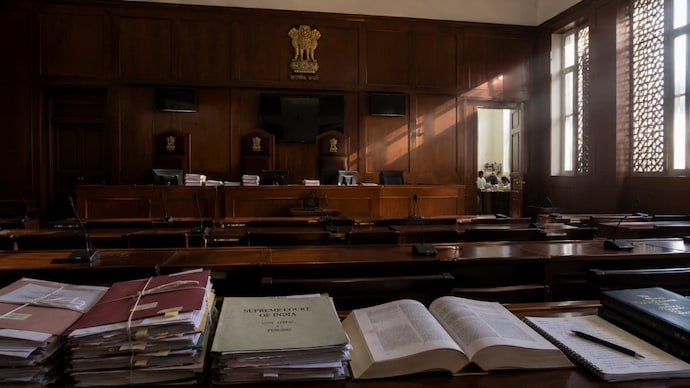
Unlike the Supreme Court, most institutions manage leaves through staggered schedules, ensuring they continue to function at near-full capacity. (Image: AI Generated/India Today)
"Justice delayed is justice denied" is a legal maxim with roots tracing back to at least the 19th century. The saying was popularised by British Prime Minister William E Gladstone in 1868, and has echoed through centuries of jurisprudence. In India, where over 53 million cases pend across courts, with roughly 4.81 crore in lower levels alone, the phrase carries particular significance.
Just two weeks after Chief Justice of India (CJI) Surya Kant emphasised that the judiciary should function "like hospitals, 24x7" and advocated greater use of AI and technology for faster justice delivery, the Supreme Court of India began its six-week summer recess on Monday. The court is operating on "partial court working days" until July 12, with only the vacation benches functioning, reportedly at around 19% of normal capacity, handling urgent matters like bail pleas while the registry remains operational.
The timing of the remarks has reignited an age-old debate that gets a new life almost every year. Should constitutional courts get long vacations? And how much do judges actually work in a day?
The questions are legit. After all, no other arm of the government goes on a collective vacation. The Supreme Court functions for 190 to 193 days a year, on a five-day workweek basis. It has 80 to 89 holidays a year, including summer vacations, and six-day breaks each for Holi and Dussehra. It also breaks for 10 to 14 days for Christmas and New Year.
One of the pillars of democracy, the judiciary interprets the Constitution and ensures that the rights of citizens aren't violated. Yet it operates with pre-planned breaks that neither the executive nor the legislature enjoy.
Of course, judges, like everyone else, need time off. The real question is not whether individual judges deserve a break, but whether the judiciary as an institution should slow down at a time when millions of cases remain pending. Most organisations with heavy workloads manage leave through staggered schedules, ensuring the institution continues to function at near-full capacity. Should the courts be any different?
Two senior advocates of the Supreme Court walked India Today Digital through a judge's day at work, which is essential for understanding if the vacations are needed for the proper functioning of the judiciary.
THE BACKLOG REALITY, AND WHAT A JUDGE'S DAY LOOKS LIKE IN THE SUPREME COURT
The Supreme Court currently has 93,143 pending cases, going by data from March 2026. It's a record high in recent decades and up by over 1,100 from the previous month. Every month, 7,000 to 8,000 cases are admitted or registered by the Supreme Court, according to the National Judicial Data Grid.
This figure includes a mix of civil and criminal matters, with many awaiting resolution for years. Nationally, the pendency crisis is far worse. It all points towards a systemic strain. Critics argue that long breaks exacerbate delays, while defenders point to the intense demands on judges and the need for time to write detailed judgments that shape the law of the land.
A senior advocate of the Supreme Court, speaking to India Today Digital on condition of anonymity, said, "They have stopped calling it a vacation. It's partial court working days... there are a few benches which are still functioning where urgent cases and cases which are pending for a very long time... are still heard."
According to the senior advocate who has over 10 years' experience, Supreme Court hearings typically run from 10.30 am to 4.30 pm, with a one-hour lunch break.
Post-hearing, judges return to chambers to review files, dictate orders, and prepare for the next day.
"After 4.30, say you give them 30 minutes... They have to read the files for the next day's hearings... After 5 o'clock, every court will have around 40-60 cases... Some supplementary cases... So that will be around 15-20 themselves and they have to read every single file and know about it."
Judges also handle administrative duties, registry oversight (especially for the CJI), speeches, and conferences.
"In a week when the court is functioning at full-fledged time, the judges barely have time to write a judgment or to do any administrative work," the senior advocate said. This workload extends beyond court hours, often into evenings and weekends for preparation.
During vacations, much of the focus shifts to judgment writing.
The senior advocate cited a complex GST and gaming law case heard over 47 days. "Arguments concluded in August last year, but the 417-page judgment was delivered only recently. Judgments take time... you need to go through the written submissions, the arguments... It can take a day, it can take 10 days, it can take 10 months," he said.
One needs to remember that judgments by constitutional courts — the Supreme Court and high courts — are cited as precedence. So, they have a bearing not just in that particular case, but several others that might not have been filed yet.
UNOFFICIALLY, SUPREME COURT JUDGES WORK BEYOND 5 DAYS A WEEK?
The Supreme Court has 19 courtrooms. On a regular working day, anywhere between 10 and 15 courtrooms are likely to be functioning simultaneously, though the exact number varies depending on the roster and the nature of cases listed, another senior advocate of the Supreme Court, with over two decades of experience, told India Today Digital.
Courts generally function five days a week during regular terms, though urgency can extend this. The Supreme Court sits for approximately 190-193 full judicial working days annually, higher than many global peers like the US or Australian supreme courts, though critics note this still leaves significant non-sitting periods.
The Supreme Court has a sanctioned strength of 38 judges (including the CJI), recently increased via ordinance in May 2026 from 34. This marks the first expansion since 2019 (when it rose from 31 to 34, excluding the CJI).
The second senior advocate told India Today Digital that actual working strength, however, fluctuates with vacancies and retirements.
"Not all judges sit every day or all day. Benches are constituted variably (a division bench of two, or larger constitutional benches). Judges work with support staff, including law clerks and personal staff, but the core burden of reading briefs, hearing arguments, and authoring judgments falls on them," the senior advocate noted.
"A single judge can only handle so much," he said.
Judges have relatively lean personal teams compared to most corporate executives, suggested both the senior advocates. Typically, a few law clerks for research, administrative support from the registry, and chamber staff is all they have. The heavy-lifting on file preparation is individual.
Speaking at the India Today Conclave in 2023, then CJI, DY Chandrachud, shared how judges ended up working seven days a week.
"So on Saturdays, typically, every judge of the Supreme Court will sit down and dictate judgments. On Sunday, all of us sit down and read for Monday. Without exception, every judge of the Supreme Court works for seven days a week," said Chandrachud.
IS SUMMER VACATION A NECESSARY RESET OR A PRIVILEGE FOR SC JUDGES?
The first senior advocate said vacations are used by SC judges to recalibrate.
"Imagine a court is handling insane number of cases... old cases get piled down under... then there are new cases... This is the time where you can recalibrate and... reset the entire thing," he said.
But the counterarguments are strong. No other major Indian government service or department enjoys a dedicated multi-week summer vacation. Corporate, bureaucratic, and even many essential services operate with staggered leaves or shorter breaks.
With massive pendency, critics argue the judiciary as an institution cannot afford to function like schools or colleges. "Judges can have vacation, judiciary can't," as one public commentator put it. The import is that the top judicial machinery can't shift to a lower gear.
While the vacations might draw criticism, advocates India Today Digital spoke to said judges write crucial judgments during these breaks.
Average reserved judgment delivery times vary, and recent analyses suggest a median of around 27 days for some cohorts, though complex matters can stretch months. The Supreme Court has urged High Courts to pronounce judgments within three months of reserving them.
The core issue with the Indian judiciary is structural. Inadequate judge strength relative to caseload, delays in appointments by the executive, and infrastructure gaps.
The latest Department of Justice data, as of May 2026, shows India's 25 High Courts have a sanctioned strength of 1,114 judges. But only 769 judges are currently serving, leaving 345, or 30% of the posts vacant.
The senior advocate with over two decades of experience stressed, "The focus should be on increasing the number of judges everywhere... The moment that gets sorted... pendency [will] go away... and vacations, too, won't matter."
- Ends
Published By:
Anand Singh
Published On:
Jun 2, 2026 08:45 IST







 English (US) ·