

 1 week ago
8
1 week ago
8
ARTICLE AD BOX

In a surprising twist, grip strength has emerged as a critical metric for assessing one’s health, with doctors linking it to both lifespan and physical robustness. A confident handshake is not just a social nicety; it can reflect a person's muscle vitality and bone health, particularly important as we grow older.
A firm handshake has long been seen as a sign of confidence. But doctors now say it may also reflect something deeper: overall health. Grip strength, a simple measure of how firmly a person can squeeze an object, has quietly become an important marker in medical research.Across the world, scientists have begun to link grip strength with longevity, heart health, and physical resilience. The idea is surprisingly straightforward. Muscles weaken when the body loses strength, nutrition, or physical activity. Because the hands depend on many muscles and nerves working together, the strength of that squeeze can reveal how well the body is ageing.For doctors, it is a quick screening tool. For individuals, it may be an early signal that the body needs attention.
Why doctors look at grip strength today
Grip strength was once used mainly in sports medicine and orthopaedics. Today, it has become a broader health indicator.Dr (Prof.) Raju Vaishya, senior consultant orthopaedic and joint replacement surgeon at Indraprastha Apollo Hospitals, explains why doctors are paying attention to it, “Grip strength is increasingly being recognized as a simple but important measure of overall health and well-being, especially as we get older.
While grip strength is obviously linked to hand function, it can also be linked to factors such as muscle mass, bone density, and even our overall physical robustness.”In simple terms, grip strength works like a window into the body's overall muscle health. Weak muscles rarely occur in isolation. They often reflect changes across the body, including reduced mobility, slower metabolism, and poorer physical endurance.
Experts say grip strength reflects muscle mass, nutrition, and overall physical robustness.
The science linking grip strength to longevity
Several large international studies have strengthened the connection between grip strength and long-term health.One of the most widely cited studies is the Prospective Urban Rural Epidemiology (PURE) study, which followed more than 140,000 adults in 17 countries. Researchers found that lower grip strength was linked to a higher risk of heart disease and early death.Another long-term study funded by the UK Biobank, supported by the UK government, also found that stronger grip strength was associated with better cardiovascular health and lower mortality risk.These findings do not mean that grip strength alone determines lifespan. Instead, it acts as an early signal. When muscle strength drops, it may point toward broader issues such as frailty, inactivity, or chronic illness.
What a weak grip may actually signal
A weak grip does not automatically mean illness. However, doctors say it can sometimes reflect deeper health changes.Dr Vaishya explains, “A weaker grip than expected can sometimes be a sign of weaker muscles, poor nutrition, a sedentary lifestyle, or underlying health issues that need attention.”Muscle mass tends to decline gradually after the age of 30. This process, known as sarcopenia, accelerates with age if physical activity drops. Reduced protein intake, chronic disease, and prolonged inactivity can speed up this loss.In many cases, grip strength declines before people notice larger problems such as reduced mobility or balance issues. That is why doctors often use it as an early screening tool.
How to test your grip strength at home
In hospitals and research centres, grip strength is measured with a device called a hand dynamometer.
But people can get a rough idea at home with simple objects.Dr Vaishya suggests a practical approach, “One way to get a rough idea of your grip strength at home is to squeeze a tennis ball or an object at home such as a rolled towel and compare how comfortably and firmly you can hold the object in both hands.”
A simple home check may include:
- Squeezing a tennis ball for about 10 seconds
- Comparing strength in both hands
- Noticing if holding grocery bags feels harder than before
- Checking whether opening jars has suddenly become difficult
“You can also pay attention to whether activities such as opening jars, carrying grocery bags, or holding objects for long periods feel harder than usual,” he adds.These observations cannot replace medical tests. But they can help people notice early changes.
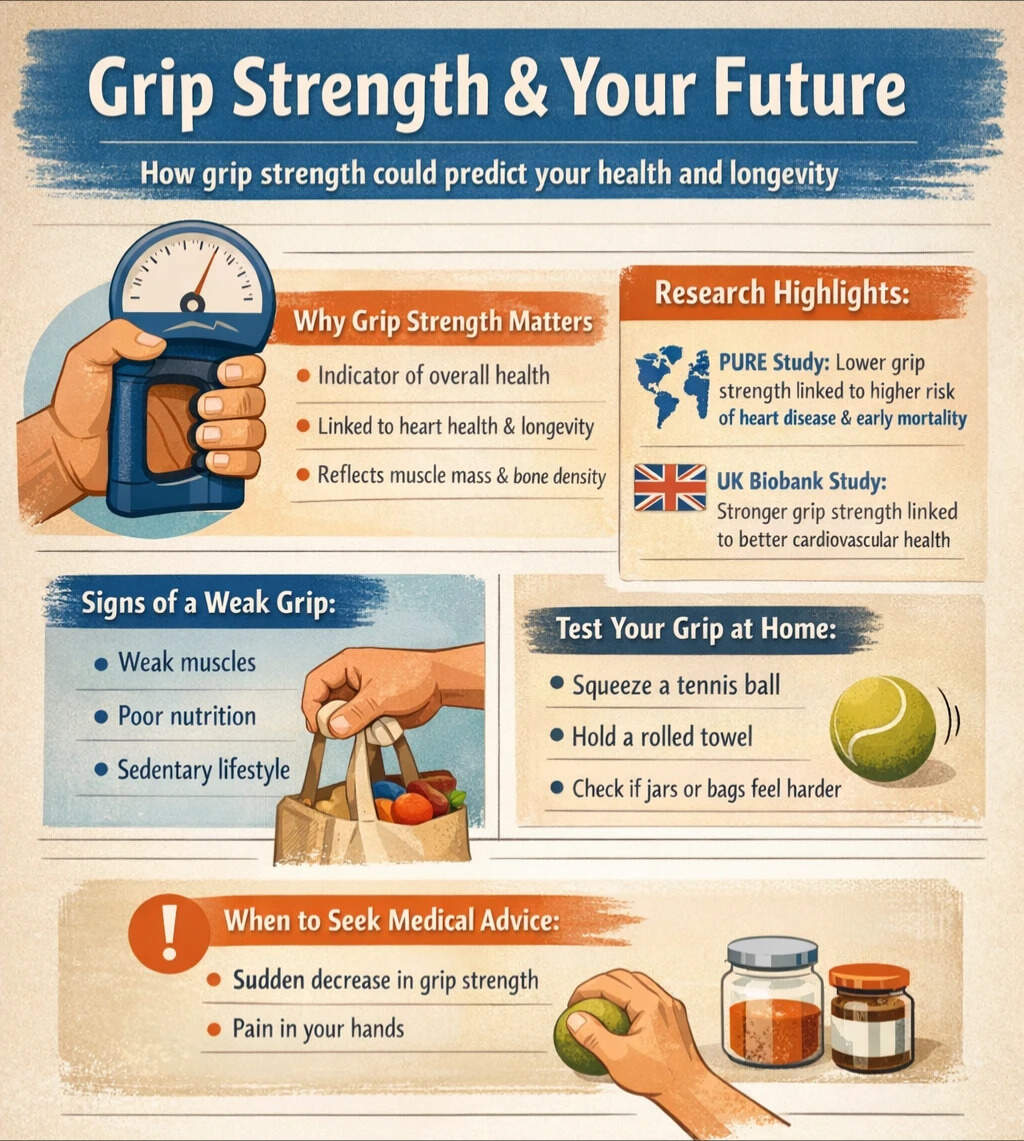
A simple home check using a tennis ball or daily tasks like opening jars can offer clues, though it should not replace medical evaluation. Sudden decline in grip strength or hand pain should prompt medical consultation.
Why muscle strength reflects whole-body health
Muscle strength is closely linked with many systems in the body. Strong muscles help regulate metabolism, improve insulin sensitivity, and support bone density.When muscles weaken, the body often becomes less active. That inactivity can increase the risk of conditions such as heart disease, diabetes, and osteoporosis.Grip strength also depends on nerve health, circulation, and joint function. In other words, the hand acts as a small but powerful summary of how well the body’s systems are working together.
When a drop in grip strength needs medical attention
Experts emphasise that grip strength should not be viewed as a standalone predictor of longevity.Dr Vaishya stresses an important point: “It is, however, imperative to note that grip strength does not solely determine longevity, although it could be a warning sign for a person experiencing a decrease in their physical strength.”A sudden decline in grip strength should not be ignored. It may signal nerve issues, arthritis, injuries, or systemic health problems.“In case a person experiences a sudden decrease in their grip, as well as pain in their hands, it is recommended that they seek medical attention from a doctor,” he advises.Early evaluation can help detect underlying causes before they progress.
The quiet message behind a strong grip
Grip strength may seem like a small detail, but it tells a bigger story about physical resilience.The ability to carry groceries easily, open jars, or hold objects steadily reflects healthy muscles, good nutrition, and regular movement. When that strength fades unexpectedly, it may be the body’s way of asking for attention.Doctors are increasingly recognising that sometimes the simplest tests reveal the most important clues.Medical experts consultedThis article includes expert inputs shared with TOI Health by:Dr (Prof.) Raju Vaishya, senior consultant orthopaedic and joint replacement surgeon at Indraprastha Apollo Hospitals.Inputs were used to explain how grip strength can serve as a simple indicator of overall health and longevity, and why doctors recommend monitoring it regularly and trying easy at-home tests to assess muscle strength and detect potential health risks early.









 English (US) ·