

 1 week ago
7
1 week ago
7
ARTICLE AD BOX
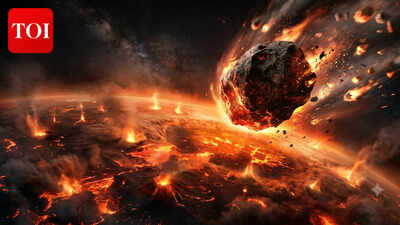
A massive, jagged asteroid glowing with intense friction and heat hurtles into the foreground. Image Credit: Gemini
Earth four billion years ago was very different from the world today. Rather than having firm continents surrounded by oceans, the planet appears to have endured millions of years of repeated asteroid strikes.
A recent study in Science suggests the bombardment did more than create craters: it may have kept Earth’s crust too warm and unstable for continents to form.The study provides an intriguing insight into one of the most enduring questions in geology.Earth’s violent youth was harsher than scientists previously thoughtWhen the planets formed about 4.5 billion years ago, the Solar System was filled with rocky debris orbiting the Sun. Due to the movement of giant planets into their current orbits, these leftovers were knocked off their places, making asteroids fall down into the inner part of the Solar System.This bombardment occurred especially actively on Earth and the Moon during the Hadean Eon that happened about 4.5 billion to 4 billion years ago. Scientists from Curtin University and Queensland University of Technology (QUT) studied this process by using computer simulations. Unlike previous studies, these researchers examined not a single impact but the amount of energy transferred by multiple impacts into the core of Earth.
According to the study, published in Science, the impacts heated up the mantle of our planet so much that the crust couldn't be cooled down sufficiently.
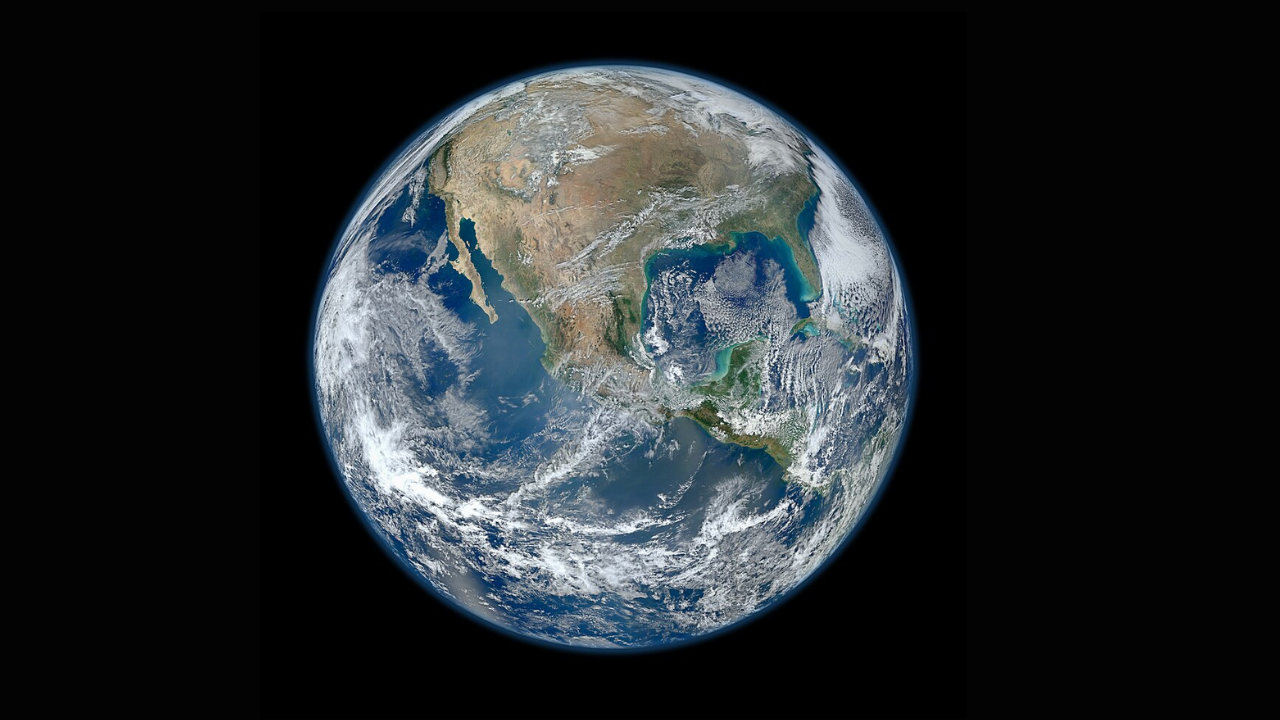
The Earth. Image Credit: Wikimedia Commons
Reasons why it was difficult for continents to formThe current continents are placed on strong crustal blocks called continental lithosphere. Forming such structures needs time and cooling of the outer layer of the Earth. According to the new study, the early Earth did not have many chances for that. Each significant asteroid impact used to reheat the mantle, leading to its melting and the formation of great volumes of magma.
The consequences of the impact lasted for tens or even hundreds of millions of years after it occurred.As Professor Craig O'Neill of Queensland University of Technology explained in a statement provided by Curtin University, available through Phys. org, most of the energy released during these impacts went into heating of the mantle of the Earth, which led to the melting and recycling of the crust.The Moon might be key to the puzzleRemarkably, the authors claim that data obtained on the Moon back up their findings.
The thing is that the Moon lacks any plate tectonic activity and large-scale erosion, which means that most of the traces of asteroid collisions on its surface have survived. These traces prove that there were numerous collisions with asteroids over 4 billion years ago.As Professor Tim Johnson from Curtin University said, the timing is hard to overlook. According to the research, the impact-heating effect weakened about 3.9 billion years ago.
That is precisely the time when Earth started creating stable continental crusts.Although it does not prove a cause-and-effect relationship, it is still significant.It could help explain the rarity of rocks dating back to Earth’s earliest daysOne of the greatest mysteries of Earth sciences is the absence of any rocks from the Hadean Eon, during which the planet was formed 4.54 billion years ago.This model might provide an explanation for this mystery.These rocks would have been destroyed due to being remelted and recycled due to the combined effect of the impacts of asteroids and Earth's own heat.
As the scientists note, the Earth's primitive crust must have been relatively thin, fragile, and unstable, unlike the modern tectonic plates. This hypothesis fits well with the previous modeling studies showing the effect of large impacts of asteroids on the early Earth.An evolving theory of Earth's early yearsFor many years, scientists have been discussing whether the early continents of Earth appeared rapidly after the cooling of the planet or if they evolved gradually through tectonic processes.
According to the new research, there might be another scenario for consideration. Unlike geology, it seems that asteroids might have played an influential role in determining when Earth would become ready to have its first continents.Although the theory is based only on modeling, it does align with other scientific evidence of heavy bombardment during Earth’s early formation in the inner Solar System.With more geological evidence and improved models, scientists may learn more about Earth’s turbulent early history.









 English (US) ·