

 2 days ago
7
2 days ago
7
ARTICLE AD BOX
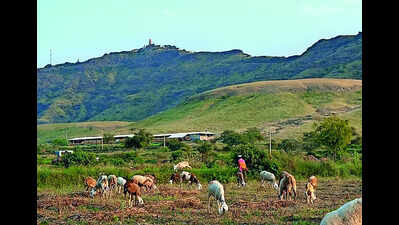
Ecologists tap into 750 yrs of Marathi lit to explain Maha landscape history | page 1Pune: Before the urbanscape, was the landscape of western Maharashtra dense forests or an open savanna? Science has answers, but people need convincing.In the quest for explanations, ecologists Ashish Nerlekar and Digvijay Patil tapped into the unlikely archives of Marathi literature, an approach that could resonate with policymakers and people alike. "People misunderstand the history of our landscape. They romanticise the past and assume everything was forest at some point. When they see grasslands, they think something went wrong," Nerlekar said.Ecologists have maintained that India's tropical savannas are ancient ecosystems, not degraded forests.
Fossil pollen, animal remains, and evolutionary studies support this view. Nerlekar realised that science needed support from evidence that felt familiar and culturally resonant to get people to accept facts. The duo turned to traditional Marathi literature to make complex ecological ideas accessible.
"Many see it as an offbeat source of data," Nerlekar added.Their research article "Utilizing traditional literature to triangulate the ecological history of a tropical savanna," published in the Oct 2025 edition of People and Nature by the British Ecological Society, analyses nearly 750 years of Marathi texts dating from the 13th to the 20th century.
These include sant biographies, devotional poetry, oral folklore, women's grindmill songs, and myths associated with local deities.
Started with stories of saints: Ecologists tap into literature for landscape history | page 5Their research led them to a folk tale describing the founding of Kolvihire village near Jejuri in Pune district. The story recounts the transformation of Valhya Koli, a robber who turns into the sage poet Valmiki after years of penance.
As a sign of this transformation, leaves sprout from the stick he once used as a weapon, and the stick grows into a padala tree, which the tale says still stands in Kolvihire.For the researchers, beyond the story's moral arc, its precise grounding in place and vegetation was important. The naming of a specific tree species tied to a known location strengthens the argument that such texts retain reliable ecological detail.The same story reflects a sequence of human settlement common to savanna landscapes, describing the arrival of hunting communities such as the kolis, followed by pastoral groups like the gavlis and later the dhangars. This order mirrors ecological transitions from hunting to grazing-based livelihoods, aligning with open landscapes capable of supporting pastoralism rather than dense forests."Our starting point was Stories of Indian Saints: Translation of Mahipati's Marathi Bhaktavijaya by JE Abbott, which we were reading a few years ago when we stumbled onto the idea of using this kind of literature as ecological records.
Repeated references to specialist plant species and descriptions of open landscapes stood out. At the time, we saw them as interesting observations, but only later did we realise the value of taking this approach systematically beyond a single, rich source," Nerlekar said.The researchers had to filter through the text that would be relevant to their work. "We restricted ourselves to Marathi literature, excluding Sanskrit and Urdu.
We then focused on seven districts of western Maharashtra- Nashik, Ahmednagar, Pune, Satara, Sangli, Solapur and Kolhapur. We omitted material from regions like Nagpur because eastern Maharashtra already has multiple independent lines of evidence in its fossils both historical and botanical," Nerlekar added.The final filter was georeferencing. If a poem or song praised trees, landscapes, or religious imagery but could not be tied to a specific location, they excluded it.
They needed to know exactly where a tree stood, which shrine was being described, or which place the narrative referred to. Texts without that spatial clarity were omitted.Nerlekar said, "We retained only sources that were firmly embedded in place, such as founding myths of specific locations in western Maharashtra, where religious narratives are intertwined with detailed descriptions of the surrounding landscape.
These savanna indicators are not incidental, they are woven into the religious context because they are part of the environment people lived in. We deliberately avoided sources that could reflect memory, imagination, or artistic abstraction, and focused instead on texts that were explicitly grounded in a particular region.
"Such stringent filters eliminated a large amount of material but also greatly increased the researchers' confidence in the data.
Another example comes from a 'dhangari ovi' (poetry/song of and about the dhangar community) narrated by a shepherd from Chitalenagar in Solapur district, where Lord Khandoba is told to care for and feed an impossibly large flock of sheep and lambs at Kolvihire. While the numbers are mythic, the setting is not.
Large-scale sheep grazing requires open grasslands with plenty of fodder. By placing such scenes in devotional songs linked to real locations, the research shows that grazing and open landscapes were long-standing features of these regions, not signs of environmental damage.The most striking fact that the researchers came across was how things did not change. "What surprised us most was the continuity. We expected to find open canopies, given the other scientific evidence, but we did not expect the landscape to remain so consistent over at least 750 years. The dominant tree species described in these texts are still around, and in similar proportions," Nerlekar said.Kundlik Paradhi, assistant professor in Marathi department at Savitribai Phule Pune University (SPPU), said, "Folk literature, in Marathi as well as other regional languages, has always been read symbolically or devotionally, but this research reminds us that these texts are also grounded in lived landscapes."









 English (US) ·