

 3 days ago
6
3 days ago
6
ARTICLE AD BOX
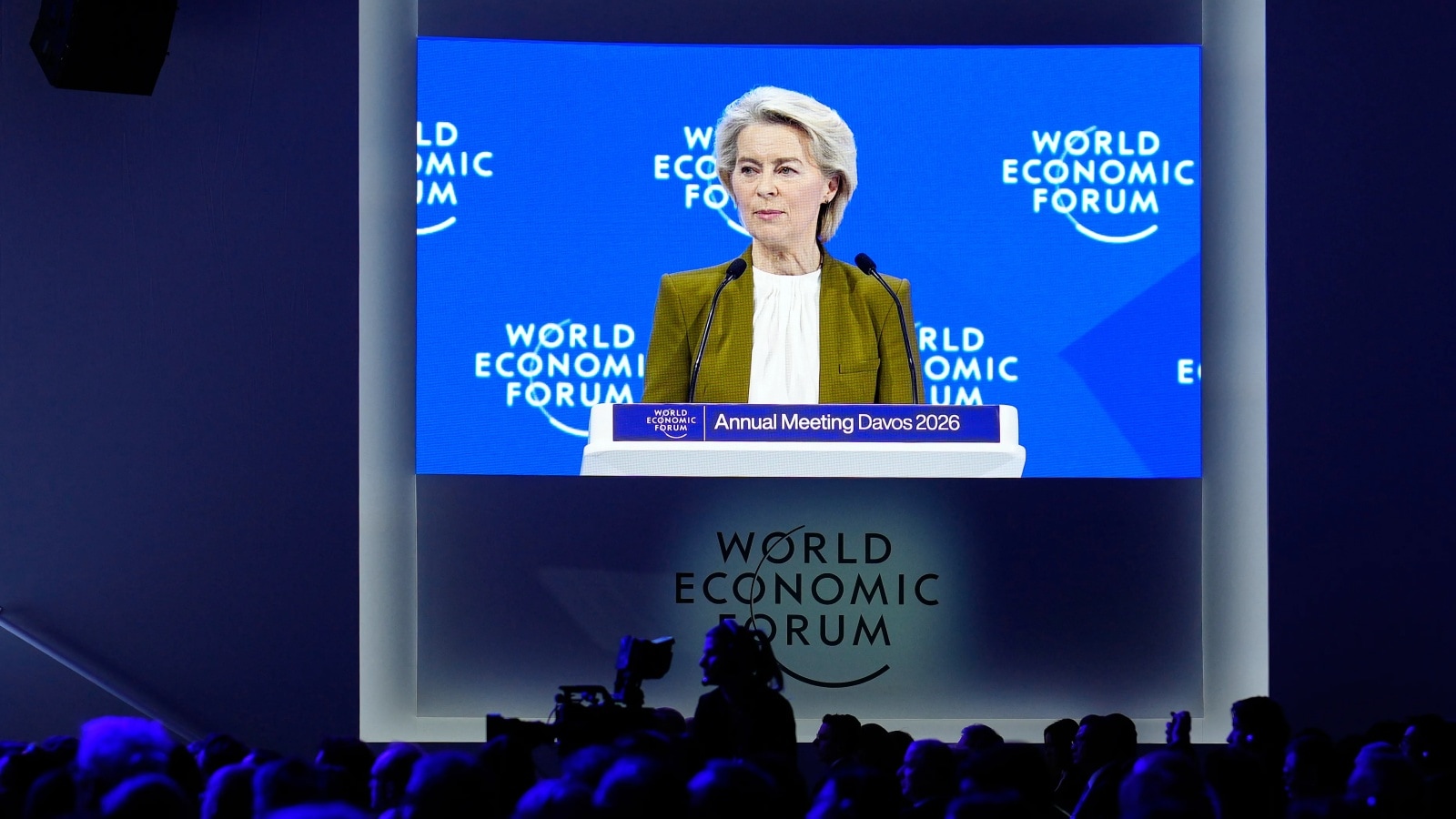 President of the European Commission Ursula von der Leyen talks during the Annual Meeting of the World Economic Forum in Davos, Switzerland, Tuesday, Jan. 20, 2026. (AP Photo/Markus Schreiber)
AMID trade negotiations between India and the European Union, with four chapters yet to be closed, an EU official said Friday said that the EU leaders’ visit to India next week is aimed at concluding the negotiations. The formal signing of the trade deal could follow after internal procedures are completed.
President of the European Commission, Ursula von der Leyen, and President of the European Council Antonio Luís Santos da Costa will be the chief guests at the Republic Day celebrations next week and will also co-chair the 16th India-EU Summit the next day.
Signalling the urgency of narrowing differences, the EU official said: “It is our objective to complete the negotiations. That’s the first step. We’re not talking about signatures in Delhi, but we’re talking about the conclusion of the negotiations, and then both sides will go through their internal procedure to get us to the signature.”
The EU official said that the trade agreement will help India and the EU diversify supply chains and reduce unwanted dependencies. The official added that both countries are “looking at how to develop and joint industrial capacity in specific supply chains such as active pharmaceutical ingredients (API) and solar equipment”.
Dependence on APIs and other high-tech products from China is a key source of strategic worry for India as well as the West. India is the largest exporter of generic drugs, but the majority of the ingredients come from China. India’s imports from China have crossed $112 billion during the last financial year.
“Goods trade between India and the EU has already grown by almost 90 per cent over the past decade, and that is despite higher tariffs on the Indian side over that period. India still accounts for around 2-2.5 per cent of the EU’s total goods trade compared with close to 15 per cent in the case of China,” the official said.
The EU official said that, alongside the free trade agreement, the EU is also looking at traditional measures to boost investment and business cooperation in specific supply chains that both sides aim to reinforce, including hydrogen, machinery and advanced manufacturing.
Story continues below this ad
The EU official said there is political will on both sides to expand the trajectory of the relations beyond the FTA. “We don’t see eye to eye on everything, but we do share a core set of interests which include having a stable international order,” the official said, adding the summit will also be an opportunity to discuss Russia’s war of aggression against Ukraine.
EU officials said Costa will convey to India that the Russia-Ukraine war, besides representing an existential threat to Europe, poses a direct challenge to the rules-based international order which also has consequences in the Indo-Pacific.
“We are aware of India’s relationship with Russia, and in this context, it is important to encourage India to use its leverage in this regard towards the peace efforts,” the official said.
India and the EU are also expected to launch a new corporation framework on mobility that would cover students, researchers, seasoned workers, and highly skilled professionals in line with the labour market needs in the European Union, EU officials said, adding that the decision on movement rests with the EU members.
Story continues below this ad
The official said that the India-EU summit is also expected to “inject some momentum” into the preparatory work for India-Middle East-Europe Economic Corridor (IMEC).
“The progress on IMEC has been impacted by developments in the Middle East, but work has been advancing. Working groups have been formed, and feasibility studies are ongoing. Political considerations are still bearing on the speed of the work on the initiative. But both India and the EU are very much committed to taking this forward,” the official said.
The IMEC was announced during the G20 Summit held in New Delhi in 2023, “to stimulate economic development through enhanced connectivity and economic integration between Asia, the Arabian Gulf, and Europe.”
Its eastern leg will carry container traffic from India’s western ports to the UAE, from where high-speed freight railway will carry goods across the Arabian peninsula (UAE, Saudi Arabia, Jordan) up to the port of Haifa in Israel. The second leg will see cargo being shipped from Haifa to ports in Greece and Italy, from where Europe’s well-established train networks will take goods to their final destinations across the continent.
– with inputs by Shubhajit Roy

Ravi Dutta Mishra is a Principal Correspondent with The Indian Express, specializing in economic policy and financial regulations. With over five years of experience in business journalism, he provides critical coverage of the frameworks that govern India's commercial landscape. Expertise & Focus Areas: Mishra’s reporting concentrates on the intersection of government policy and market operations. His core beats include: Trade & Commerce: Analysis of India's import-export trends, trade agreements, and commercial policies. Banking & Finance: Covering regulatory changes and policy decisions affecting the banking sector. Professional Experience: Prior to joining The Indian Express, Mishra built a robust portfolio working with some of India's leading financial news organizations. His background includes tenures at: Mint CNBC-TV18 This diverse experience across both print and broadcast media has equipped him with a holistic understanding of financial storytelling and news cycles. Find all stories by Ravi Dutta Mishra here ... Read More
Stay updated with the latest - Click here to follow us on Instagram
© The Indian Express Pvt Ltd


 English (US) ·