

 1 hour ago
4
1 hour ago
4
ARTICLE AD BOX
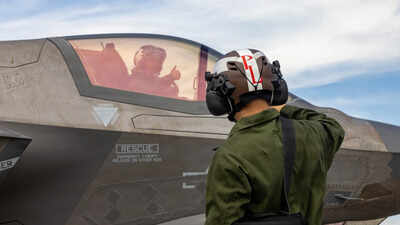
"Speak softly and carry a big stick; you will go far" is a phrase popularised by the 26th US President Theodore Roosevelt. The phrase has been a mantra for the US State Department for China, the 'Dragon' in the room.
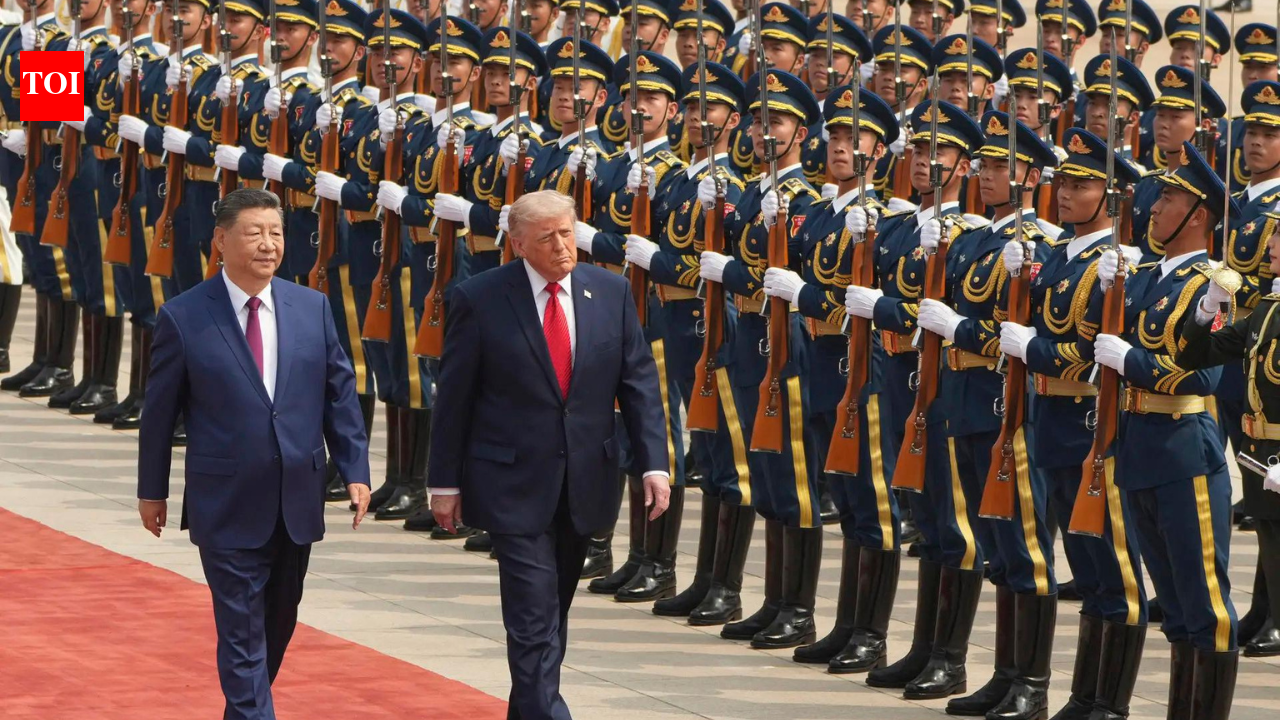
US President Donald Trump, while on his China trip, said, "When we cooperate, both sides benefit; when we confront each other, both sides suffer."Trump went on to praise China's President Xi Jinping saying, "You're a great leader, sometimes people don’t like me saying it, but I say it anyway". Although the US President's affinity for China is well known and well documented. Donald Trump has been a very vocal critic of Beijing and made it a plank for all three of his presidential bids.
Last year, he engaged in a very public back-and-forth tariff war with China.While Trump was welcomed by Xi in Beijing for a key meeting, the US is working on its 'big stick' plan. All branches of the US military are expanding their presence in the Indo-Pacific region. The Pentagon is reshaping deployments investing in advanced weapons platform tailored for a fight against China in the broader Indo-Pacific theatre, propping up partners as well as reviving old bases to strengthen posture against an increasingly assertive China.
This reposturing and reorientation against China by adopting a more dispersed stance, as well as building a multi-domain deterrence architecture designed to complicate Beijing’s calculations.
China is heightening gray-zone and multi-domain aggression across the Indo-Pacific to erode US alliances, normalize coercive presence, and challenge American regional leadership, explicitly framed in U.S. assessments as Beijing’s effort to dominate the region and undermine the post-WWII rules-based order. This is not episodic but a calibrated strategy of persistent pressure that raises escalation risks while testing U.S. credibility as security guarantor.Dr Sriparna Pathak, Professor of China Studies and International Relations, OP Jindal Global University
Dispersed firepower to take on China
The United States first adopted a hub and spoke strategy, also known as the San Francisco System, in 1951. As per this system, US was the hub and it projected powers through its allies, namely, Japan, South Korea, Australia, Philippines and Thailand which were the spokes.
This philosophy has now expanded to include various US bases across the Pacific from where the Americans can project power.At the same time, the United States is also working on alliances to strengthen its presence in the region. The US is already working to provide the Royal Australian Navy nuclear powered submarines under the AUKUS program, giving significant capabilities to Australia. At the same time, the Americans are increasing their military engagements with Japan and the Philippines.
The US concluded a major wargames called Exercise Balikatan in Philippines just last week.
Australia, Japan, France, Canada and New Zealand took part in this exercise that focused on maritime security, amphibious operations and defensive battles. This network of allies forms a strategic lattice designed to prevent Chinese dominance in the Taiwan Strait and South China Sea.The United States is now reactivating old bases that largely fell into disuse after the Second World War.
The operational capabilities of these bases are being improved so they could become frontline airfields in the event of hostilities breaking out. Some of the bases being reactivated are in the Northern Mariana Islands, North Field on Tinian (which was the largest bomber base during WWII), and the Northwest Airfield in Guam is also being made operational to support missions in the Pacific.
These bases are being made to withstand long-range strikes from China.
Tinian is also the same air base from which the nuclear strike missions to Hiroshima and Nagasaki were flown. These bases are being upgraded under the Agile Combat Employment (ACE) program.American is now upgrading airbases in Alaska such as the Eilson and Elmendorf-Richardson are also being upgraded. Joint Base Elmendorf-Richardson’s runway has been extended to 10,000 feet, while Eielson Air Force Base has undergone a $600 million expansion for F-35 squadrons.
King Salmon Airport, a World War II divert field, is being upgraded for long-term ACE operations.Across other Pacific islands, smaller World War II-era airstrips are also being restored, enabling dispersed operations for fighters, refueling tankers, and support units. Civilian airports are also being adapted for dual-use military operations, according to the Australian Strategic Policy Institute.This dispersal strategy reduces reliance on large hubs such as Okinawa, Guam, and Hawaii, which are vulnerable to Chinese missile barrages.
By spreading forces across multiple smaller bases, the US complicates Beijing’s targeting calculus and ensures airpower remains viable even if the main bases are damaged by Chinese strikes.
Forward deployments and strike power
At the heart of the US strategy for the Pacific is the deployment of advanced missile systems along the First Island Chain, which stretches from Japan in the north to the Philippines in the south. US Army and Marine Corps units are dispersing HIMARS rocket systems, Typhon land-based launchers (officially known as the Strategic Mid-Range Fires System), and Navy-Marine Expeditionary Ship Interdiction Systems across these islands, with an aim of denying the Chinese Navy access to the Pacific.
These mobile batteries are designed to hold Chinese naval forces at risk from multiple directions, creating a structured and layered access denial.Earlier this month, US Indo-Pacific theatre commander Admiral Samuel Paparo stated that the United Stares should double the number of B-21 bombers to be procured. Currently, the US seeks to acquire 100 of these advanced next generation stealth bombers, Admiral Paparo wants this number to be increased to 200 airframes, as a deterrence against China, as per the same report.Complementing these weapons will be the Long-Range Anti-Ship Missiles (LRASM), stealthy munitions with 1,000-pound warheads integrated into platforms such as the F/A-18 Super Hornet, B-1B Lancer, and F-35C fighters. The Americans are also using transport aircraft such as the C-17 and C-130 to deploy these missiles in bulk under the Rapid Dragon program. This would increase the number of platforms which can deploy these next generation weapons in mass, thereby negating China's advantage of mass.
Together, these two systems are designed to neutralise China’s anti-access/area denial strategy and to ensure that America's strike power remains credible in contested waters.US is now contemplating increase of increasing their weapons stockpiles much before the ongoing conflict with Iran, according to the US based Center for Strategic and International Studies.
Force structures redesigned to take on China
The US Marine Corps is undergoing a structural transformation under Force Design 2030.
Heavier formations are being replaced by smaller, mobile, low-signature units that will operate in dispersed maritime zones. These units are tailored for sea denial operations in contested environments.The US Navy too is positioning warships to counter the People’s Liberation Army Navy’s surface-to-air and anti-ship weapons. The Yokosuka based US 7th Fleet is the largest forward deployed American fleet.
Keeping an eye on China
The Pentagon is also investing heavily in expanding space based surveillance and intelligence assets.
This includes the Silent Barker constellation of spy satellites and offensive cyber capabilities. These assets provide persistent monitoring of Chinese maneuvers, submarines and satellite activity, ensuring US commanders retain situational awareness across multiple domains.The United States is reinforcing its Indo-Pacific posture with a strategy designed to make any Chinese military move infeasible.
Washington is dispersing forces across the wider region. Surveillance expansion through satellites and cyber assets ensures persistent monitoring of Chinese maneuvers, while naval and air forces are positioned to attrit Chinese fleets before they threaten allied territory.For Beijing, this creates a complex web of denial defenses and strike assets that raises the cost of aggression in the Taiwan Strait or South China Sea.The buildup is backed by a massive defense budget of over $900 billion, with allocations for readiness, cyber warfare, space surveillance, and base hardening. Together, these measures reflect a comprehensive, multi-domain strategy of resilience, denial, and alliance solidarity, even as the US President is speaking softly in Beijing, a big stick is being readied for any contingency in an effort to have a free, open, connected, prosperous, secure, and resilient.








 English (US) ·