

 1 hour ago
5
1 hour ago
5
ARTICLE AD BOX
A citizen survey has revived questions over how E20 petrol affects older vehicles. The Centre says the fuel is safe and the blending policy supports energy security and farmers.
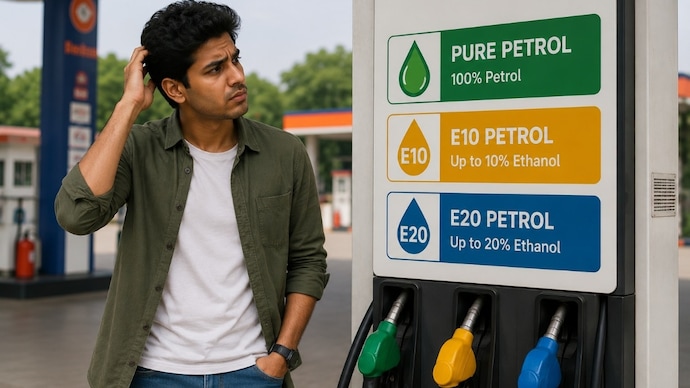
The government maintains that E20 is a scientifically validated and safe fuel. (Representative image)

New Delhi,UPDATED: Jul 10, 2026 16:13 IST
More than a year after India completed the nationwide rollout of E20 petrol, fresh concerns over its impact on older vehicles have resurfaced following a citizen survey that reported declining fuel efficiency and higher maintenance costs among many motorists.
According to a recent LocalCircles survey, 66 per cent of owners of petrol vehicles manufactured before 2023 claimed their vehicles' fuel efficiency had dropped by more than 10 per cent since early 2025.
This marks a significant increase from a similar survey conducted in May 2026, when 45 per cent of respondents reported a comparable decline.
India achieved its target of supplying 20 per cent ethanol-blended petrol (E20) across the country in April 2025, several years ahead of the original 2030 deadline.
The Centre has said the programme is aimed at reducing crude oil imports, improving energy security, lowering emissions and increasing farmers' incomes by boosting ethanol production.
However, the survey findings and renewed discussions on social media have once again triggered questions about the compatibility of E20 with older vehicles.
Earlier this month, the Ministry of Petroleum and Natural Gas also dismissed several viral claims linking ethanol-blended fuel to engine failures and other alleged issues, calling them misleading and scientifically inaccurate.
In response to the growing debate, the government has issued a detailed clarification addressing some of the most frequently asked questions about E20 petrol.
DID INDIA RUSH INTO ETHANOL BLENDING?
Government's response: No.
The government says India's ethanol blending programme has evolved over more than two decades. Pilot projects began in 2001, the programme was formally announced in 2004, E5 fuel was introduced in several states by 2006, and the policy framework was notified in 2013.
According to the government, major progress came after the National Policy on Biofuels, 2018, which expanded ethanol feedstocks and encouraged investments. It says the transition to E20 followed years of consultations with automobile manufacturers, oil companies and technical experts.
WHY CAN'T CONSUMERS CHOOSE BETWEEN PURE PETROL, E10 AND E20?
Government's response: Maintaining separate nationwide fuel supply chains would be impractical.
The government says operating parallel distribution systems for pure petrol, E10 and E20 across more than one lakh fuel stations, depots, terminals and pipelines would create significant logistical challenges. It also points to nearly INR 1 lakh crore invested in ethanol production infrastructure, saying the policy balances consumer convenience with energy security and national investments.
WHY ISN'T E20 CHEAPER THAN REGULAR PETROL?
Government's response: Ethanol blending is intended to improve energy security rather than reduce pump prices.
The government says ethanol is procured at remunerative prices to ensure fair returns to farmers. At current crude oil prices, E20 may even cost more to produce than pure petrol. However, it argues the programme has already reduced crude oil imports, saved foreign exchange, lowered carbon emissions and transferred substantial income to farmers.
CAN E20 DAMAGE ENGINES OR OLDER VEHICLES?
Government's response: No widespread evidence supports these claims.
The government says E20 was introduced only after extensive testing involving automobile manufacturers, the Automotive Research Association of India (ARAI), SIAM and oil companies. It maintains that manufacturers would not have approved E20-compatible vehicles or continued warranty support if safety concerns existed.
The clarification also cites industry data claiming that millions of older vehicles have been serviced without reports of E20-related corrosion or abnormal engine damage.
DOES E20 REDUCE MILEAGE?
Government's response: A slight reduction is possible.
The government acknowledges that some vehicles may experience a 3-5 per cent drop in fuel economy. However, it says E20 offers higher octane ratings, improved combustion, smoother acceleration, cleaner engines and lower emissions, benefits that it argues outweigh the modest reduction in mileage.
WHAT IS THE GOVERNMENT'S MESSAGE TO CONSUMERS?
The government maintains that E20 is a scientifically validated and safe fuel whose quality is monitored under Bureau of Indian Standards (BIS) norms. It has advised consumers not to rely on unverified claims circulating on social media and says the ethanol blending programme is designed to reduce India's dependence on imported crude oil, improve air quality, strengthen energy security and support farmers through increased ethanol production.
- Ends
Published By:
Ritaban Misra
Published On:
Jul 10, 2026 16:13 IST







 English (US) ·