

 1 hour ago
5
1 hour ago
5
ARTICLE AD BOX
Last Updated:March 03, 2026, 18:25 IST
The IAF is examining options to induct 5th-gen fighters, and two global contenders dominate the conversation - Russia's Sukhoi Su-57 and America's F-35 Lightning II


F-35 vs Su-57: A comparison of stealth, strategy and the geopolitical hurdles shaping India's fifth-generation fighter choice.
The character of warfare in the 21st century has undergone a dramatic transformation. As nations race to deploy ultra-modern air defence systems capable of detecting and destroying hostile aircraft at long ranges, parallel efforts are underway to outsmart those very shields. At the heart of this contest lies fifth-generation stealth fighter technology, a capability currently possessed by only a handful of countries.
The United States, Russia and China have operational 5th-gen fighter jets designed to penetrate advanced air defence networks. India, however, does not yet field such an aircraft. The Indian Air Force (IAF) currently operates 4th and 4.5-gen fighters but has no 5th-gen platform in its inventory.
In the aftermath of Operation Sindoor and amid a rapidly shifting regional security landscape, the absence of stealth aircraft is increasingly being viewed as a strategic gap. Reports suggesting that Pakistan is exploring the acquisition of a 5th-gen fighter jet from China have further sharpened concerns in India.
India shares contested and sensitive borders with both Pakistan and China, where periodic standoffs and military escalations are not uncommon.
Simultaneously, Chinese military deployments near Leh-Ladakh and Tibet to sectors facing Arunachal Pradesh have kept Indian forces on high alert, reinforcing the urgency of air superiority in any future conflict scenario.
Against this backdrop, the IAF is examining options to induct 5th-gen fighters. Two global contenders dominate the conversation, Russia’s Sukhoi Su-57 and America’s F-35 Lightning II.
India has already launched its indigenous Advanced Medium Combat Aircraft (AMCA) programme aimed at developing a home-grown 5th-gen jet. However, production timelines indicate that the aircraft will take years before induction becomes feasible. As a result, the government is reportedly considering the procurement of a limited number of foreign fifth-generation jets as an interim solution.
Russia’s Sukhoi Su-57
Russia has been a longstanding defence partner of India, backing New Delhi during critical junctures in its security history. Moscow has reportedly offered the Su-57 to India, along with provisions for technology transfer, a key demand under India’s push for indigenous manufacturing.
However, Defence Secretary Rajesh Kumar Singh recently clarified that no final decision has been taken regarding the Su-57. While he did not elaborate on specific technical shortcomings, he acknowledged that multiple factors are under consideration.
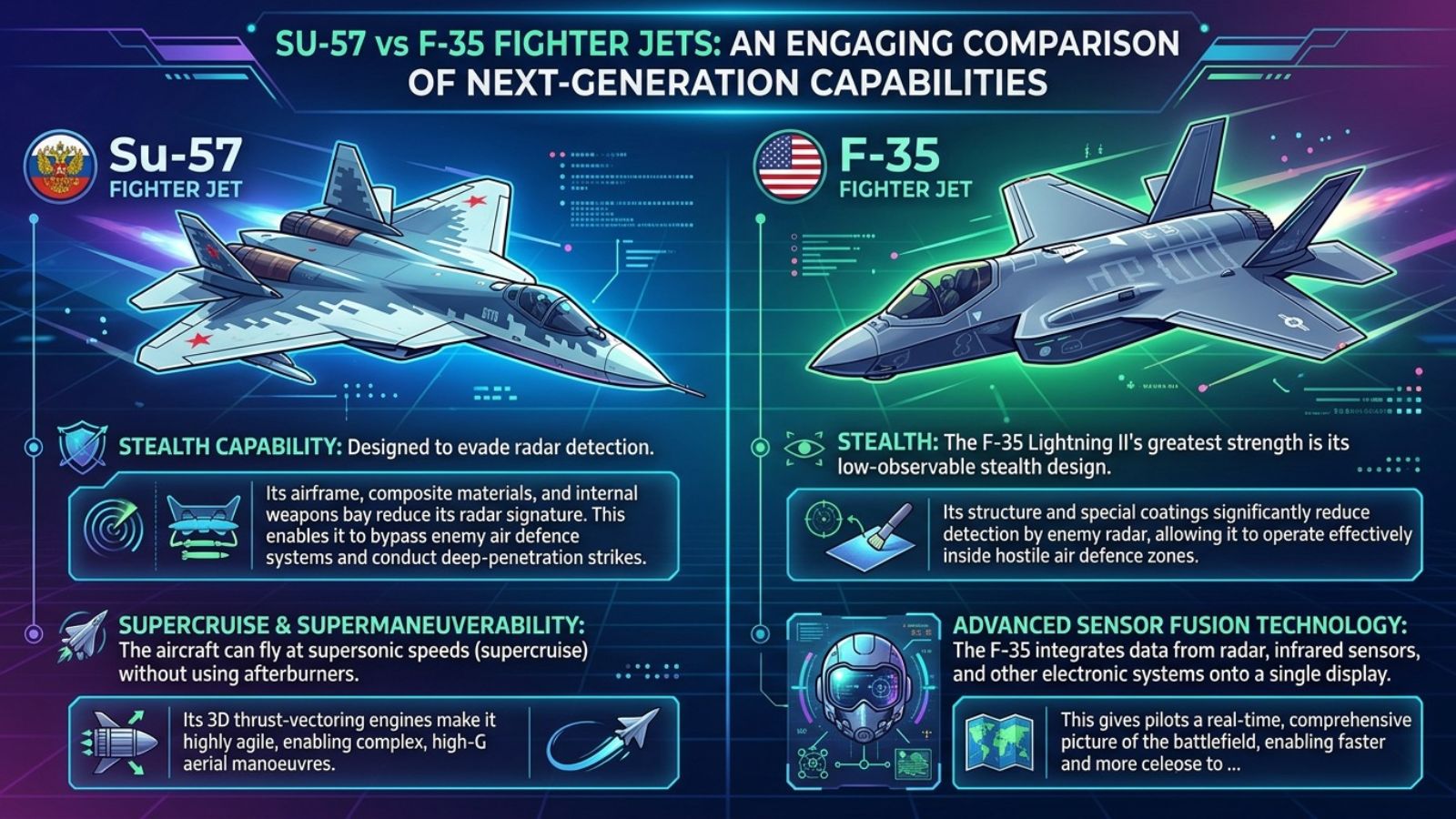
The Su-57 is designed with stealth in mind. Its composite-heavy airframe and internal weapons bays reduce radar visibility, allowing it to operate deep inside hostile territory. The aircraft is capable of supercruise, sustained supersonic flight without afterburners, and features 3D thrust vectoring engines that enhance manoeuvrability.
Equipped with an Active Electronically Scanned Array (AESA) radar and multi-sensor fusion systems, the jet can track and engage multiple targets simultaneously while providing 360-degree situational awareness. It is a multi-role platform capable of conducting air-to-air, air-to-ground and potentially hypersonic strike missions, supported by a long operational range and heavy payload capacity.
Yet questions reportedly persist around lifecycle costs, engine reliability, stealth performance benchmarks and long-term logistics support. India’s emphasis on maximum technology transfer, local assembly, and assured spare parts availability is believed to be central to ongoing deliberations. Geopolitical considerations also weigh heavily, given India’s balancing act between Russia and Western partners.
America’s F-35 Lightning II
On the other side stands the F-35 Lightning II, widely regarded as one of the most advanced stealth fighters currently operational. Its low-observable design, special radar-absorbent coating, and integrated sensor architecture allow it to penetrate sophisticated air defence systems.
The aircraft’s hallmark is its sensor fusion capability, which integrates radar, infrared and electronic warfare inputs into a single real-time battlefield picture for the pilot. Its helmet-mounted display system enables pilots to “see through" the aircraft, providing unprecedented situational awareness.
Beyond its stealth profile, the F-35 is designed for network-centric warfare. It can act as a flying data node, sharing information with other aircraft, drones and ground systems, significantly multiplying combat effectiveness across a fleet.
However, the F-35 option faces its own complications. According to defence observers, Washington has expressed concerns over India’s deployment of the Russian S-400 air defence system. There are apprehensions that operating the F-35 alongside the S-400 could risk exposure of sensitive stealth signatures or electronic data, potentially compromising the jet’s technological edge.
Analysts note that India is unlikely to proceed without sovereign operational flexibility. If a formal offer materialises, India may seek customisation rights similar to those granted to Israel for its F-35I variant. The central issue is not merely procurement, but the strategic conditions under which such an acquisition would be acceptable.
As Pakistan explores closer defence ties with China and Beijing expands its military footprint along contested borders, India’s air power calculus is evolving. The decision before policymakers is complex, shaped by technology, cost, geopolitics, interoperability, and long-term strategic autonomy.
While the indigenous AMCA remains the cornerstone of India’s future air combat doctrine, the immediate requirement for a stealth-capable force multiplier is pressing.
First Published:
March 03, 2026, 18:25 IST
News india F-35 vs Su-57: How The S-400 Deal Complicates India’s 5th-Gen Fighter Choice
Disclaimer: Comments reflect users’ views, not News18’s. Please keep discussions respectful and constructive. Abusive, defamatory, or illegal comments will be removed. News18 may disable any comment at its discretion. By posting, you agree to our Terms of Use and Privacy Policy.
Read More






 English (US) ·