

 53 minutes ago
4
53 minutes ago
4
ARTICLE AD BOX
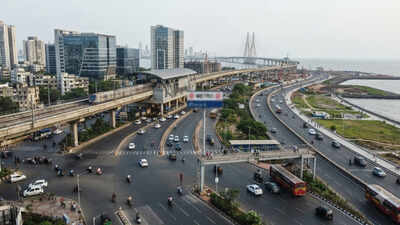
Mumbai's property market now values connectivity over traditional prestige. Infrastructure like MTHL and Metro lines significantly reduces travel times (AI-generated image used for representational purposes)
MUMBAI: Mumbai's property market is witnessing a structural shift in the way homes and offices are being valued, with connectivity increasingly overtaking traditional location prestige as the biggest driver of real estate prices.Instead of paying a premium simply for an address in South Mumbai or the Island City, buyers are increasingly placing higher value on neighbourhoods that significantly reduce travel time through the Mumbai Trans Harbour Link (MTHL), Coastal Road and the expanding Metro network.Real estate consultants say this marks one of the biggest changes in Mumbai's property market in decades, where "connectivity-adjusted value" is emerging as the new benchmark for pricing homes and commercial assets.The 22-km MTHL has substantially cut travel time between Sewri and Nhava Sheva, improving access to Navi Mumbai and the upcoming airport corridor by around an hour during peak traffic.Similarly, the operational and upcoming Metro corridors are creating entirely new residential and commercial micro-markets that were previously considered peripheral.Beyond changing property prices, the infrastructure build-out is also reshaping how buyers and investors evaluate Mumbai's real estate.
Brokers say a new "connectivity-adjusted value" model is gaining ground, with purchasers increasingly comparing homes on measurable factors such as time taken to reach workplaces, BKC, the international airport and key business districts rather than relying solely on the prestige of a postal address.The nearly 60-70-minute reduction in peak-hour travel between South Mumbai and the Navi Mumbai airport corridor through the MTHL, together with Metro corridors such as Line 3 and Line 7, is creating new high-demand micro-markets while improving the prospects of large Grade-A office developments in Central Mumbai.Planners expect these transit-linked business hubs to attract Global Capability Centres (GCCs), financial institutions and other knowledge-sector employers, generating fresh demand for nearby housing.The trend is also prompting investors to look beyond traditional premium neighbourhoods and towards redevelopment and emerging transit-oriented corridors that offer stronger long-term appreciation potential and better everyday liveability.
"Earlier, buyers asked 'Which locality?'. Today, the first question is 'How many minutes to office, airport or BKC?' ," said a Mumbai-based property consultant.
Office market shifts towards Central Mumbai
Improved transport infrastructure is also changing the geography of Mumbai's commercial real estate.Central Mumbai is expected to witness nearly 5 million sq ft of new Grade-A office development, supported by Metro Line 3, future Metro extensions and improved road connectivity to Bandra-Kurla Complex (BKC) and the airport.Government planning envisages BKC evolving further as Mumbai's second central business district, attracting banks, financial institutions and Global Capability Centres (GCCs). Better multimodal connectivity is also unlocking land parcels for mixed-use and office projects that were earlier considered commercially unviable.Industry experts expect these emerging business districts to reduce pressure on traditional office locations while creating fresh demand for housing nearby.
Redevelopment becoming the city's growth engine
Limited availability of vacant land in Island City and South Mumbai means redevelopment is now emerging as the principal source of new housing supply.Planning documents of agencies such as MMRDA and CIDCO indicate that ageing housing societies and revised FSI norms are enabling redevelopment projects that offer larger apartments, improved layouts and modern amenities.Instead of purchasing smaller legacy apartments, affluent buyers are increasingly opting for redeveloped projects located close to Metro stations and key transport corridors.This trend is also strengthening demand in South and Central Mumbai, where redevelopment offers opportunities to modernise ageing housing stock while retaining established social infrastructure.
Luxury now means lower running costs
The definition of luxury housing is also evolving.Developers are increasingly marketing energy-efficient buildings, EV charging infrastructure, rooftop solar, better ventilation and larger green spaces alongside traditional premium amenities.Government policies promoting green buildings and electric mobility have encouraged developers to integrate sustainability into new residential projects.Property consultants say high-end buyers are increasingly evaluating homes on lifetime operating costs, indoor air quality, wellness features and future readiness rather than only imported marble, clubhouses or designer lobbies.
Legacy premium zones face new competition
The infrastructure boom is also creating fresh competition for some of Mumbai's traditional premium addresses.While South Mumbai continues to command prestige and heritage value, several older neighbourhoods suffer from traffic congestion, limited road capacity and relatively weaker metro connectivity compared with newer corridors.As a result, investors are increasingly comparing neighbourhoods on measurable parameters such as commute time, airport access, public transport integration and future infrastructure instead of relying solely on historical brand value.Market observers say this is leading to stronger appreciation in well-connected emerging micro-markets, while price growth in some legacy premium locations is becoming more moderate.For Mumbai's homebuyers, the city's next property cycle may therefore be determined less by postal addresses and more by a simple calculation: how much time infrastructure can save every day.







 English (US) ·