

 1 hour ago
6
1 hour ago
6
ARTICLE AD BOX
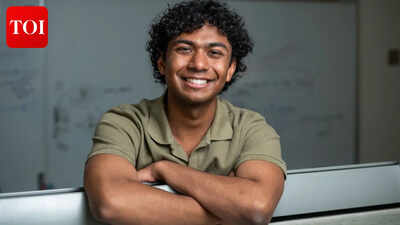
Krithik Vishwanath, a computational engineering, chemistry and mathematics senior at the University of Texas at Austin recently won the elite Churchill Scholarship. The programme that provides students in STEM a fully-funded year of master's study in the UK has been won by a UT student for the first time in 36 years.
Vishwanath, has been honoured for his research in computational medicine models. Interested in math and problem solving since high school, he said he knew he wanted to apply his experience more practically. “I saw a research lab at UT called the Center for Computational Oncology, where math was applied to develop models for (breast and pancreatic) cancer and decide how treatment should be adapted based on how we can model these systems,” Vishwanath said to The Daily Texan.
“That was my first point where I was like ‘Okay, I should try and see what I can do here, if I could leverage some of the things that I’m interested in in a more impactful way.
’”It was his summer at NYU Langone Health, an academic medical centre, that led Vishwanath to begin working with large language models and implementing them in decision-making support. “We spent a lot of time developing a small model that can live on your phone, so that everything is done locally, but at the same time has some kind of medical acumen,” he said.
In Cambridge in 2027, he hopes to further use AI in the medical field to enhance hospital logistics and efficiency. “Our goal, in broad strokes, is to see if we can predict discharge readiness and how long a patient is going to stay there just based on some qualifying factors,” he explained.Vishwanath credits Ernesto Lima and Thomas Yankeelov for being his first research mentors and introducing him to translational modelling at the Center for Computational Oncology at Oden Institute.
As per Lima, it was the student's curiosity that contributed significantly to his research accomplishments. “He tries to find new tools, new methods, to solve the problems that we have,” he said. “I think he’s eager to find the solution.
I think (that) is one quality that helps a lot.”As for Vishwanath, he wasn't expecting it "at all." But his first instinct was to imagine how he could broaden his scope of work and use the "awesome" EHR (Electronic Health Record) system at Cambridge to build on things he was already working on. Numerous fellowships and scholarships across the world provide students with exciting learning opportunities abroad. The Churchill Scholarship selects only 18 students in the United States in the fields of science, technology, engineering and mathematics every year to study at the University of Cambridge. This year, one of them was Vishwanath, who has worked on numerous projects in the STEM field. He has delved into clinical AI evaluation with NYU OLAB and Prof.
Eric K. Oermann. He has worked on photoacoustic imaging, with Prof. Richard Bouchard at MD Anderson Cancer Center and in the SIBMI program with Prof. Chirag Patel at Harvard Medical School. Soon, he will be graduating from the College of Natural Sciences and Cockrell School of Engineering, with triple degrees in computational engineering, chemistry and mathematics.
In the future, he aspires to work as a physician-scientist, focused on making medicine more "powerful, personalised and equitable" through computational technologies. For seniors looking to follow his lead, he advises trying a lot of things early and not being afraid to be a beginner.






 English (US) ·