

 1 hour ago
6
1 hour ago
6
ARTICLE AD BOX
For protesters like Tehseen Poonawalla, the government's reported rethink on E25 is just the "first victory" after the online and offline protests. However, Poonawalla says that the battle is far from over amid concerns over E20 compatibility for millions of vehicles.
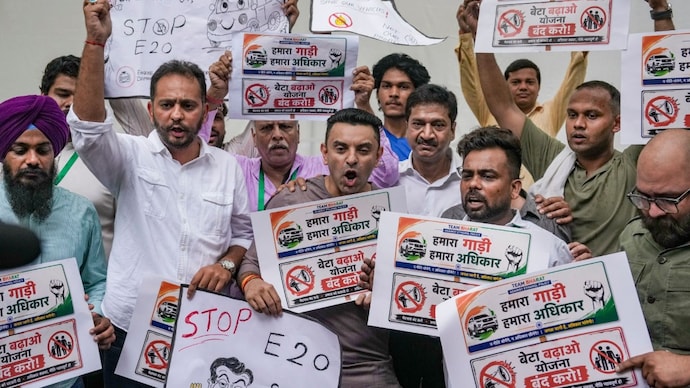
Entrepreneur Tehseen Poonawalla and members of Team Bharat during the protest over the E20 policy, at Jantar Mantar, New Delhi, on Sunday. (Image: PTI)

New Delhi,UPDATED: Jul 7, 2026 15:59 IST
Entrepreneur and TV personality Tehseen Poonawalla on Tuesday termed the Centre's reported rethink on E25 as the "first victory" for citizens protesting against the implementation of the ethanol-blending programme. However, Poonawalla asserted that the battle was far from over, arguing that the government has not rolled back the nationwide E20 policy and continues to dodge questions over vehicle compatibility, consumer losses and the scientific basis for rapidly advancing the ethanol-blending programme.
People have been alleging a drop in mileage and vehicle wear and tear because of E20 petrol. Poonawalla, under the banner of Team Bharat, organised the first offline protest at New Delhi's Jantar Mantar on Sunday (July 5). The Centre has junked the claims and a group of experts defended the government's ethanol-blending programme on the eve of the Delhi protests.
Multiple reports on Tuesday suggested a probable rethink of the E25 policy. The Centre was examining a phased transition, rather than moving directly, to higher ethanol blends, sources told the India Today Group. Sources said the government was evaluating a phased roadmap under which E21 petrol could be introduced by 2027 and E25 by 2029.
The Indian Express reported that the proposed shift to E25 was likely to be deferred. "The government is likely to push back the proposed shift to a higher blend of ethanol fuel E25 comprising 75% petrol and 25% ethanol," the newspaper reported on Tuesday. Earlier in June, The Times of India had reported that the government was "likely to hold off" on higher ethanol blending until vehicle technology and supporting infrastructure were ready. Criticism of the E20 policy had already gained momentum by June.
Calling Tuesday's development a result of public pressure, Poonawalla told India Today Digital, "This is the first victory for the people of India and Team Bharat. After our collective protest at New Delhi's Jantar Mantar, the government has agreed not to roll out further or higher ethanol-blended petrol until the infrastructure is ready."
"But the government has still not rolled back the E20 policy. Some questions remain as to why the government advanced the E20 policy when the infrastructure was not ready? Why are the government and automobile companies claiming E20 fuel is safe for E10-compatible vehicles if dedicated E20-compliant vehicles had to be manufactured? We still demand that the E20 document be made public and that the government announce a solution for pre-2023 vehicles, which account for more than 80% of India's vehicle fleet," Poonawalla added.
GOVERNMENT GOING SLOW ON E25 ROADMAP?
The Centre rolled out the Ethanol Blended Petrol Programme to reduce India's dependence on imported crude oil, support sugarcane farmers, lower greenhouse gas emissions and improve energy security.
Tuesday's developments suggest that the government, while remaining committed to the ethanol-blending programme, might be taking into account the concerns being voiced by the people.
"The transition towards higher ethanol blending will happen in a calibrated and phased manner so that the automobile industry gets adequate time to prepare engines, supply chains and infrastructure accordingly," a source told Business Today of the India Today Group.
The Indian Express report from Tuesday noted that although no official launch date had been announced for E25, two government decisions in recent weeks had fuelled speculation that higher ethanol blends were imminent. These included the exemption of central excise duty on petrol blended with 22% to 30% ethanol and the Bureau of Indian Standards (BIS) notifying fuel specifications for these higher blends.
The gradual approach towards higher ethanol blends is aimed at giving vehicle manufacturers, component makers and fuel suppliers enough time to adapt to higher ethanol blends before they are introduced nationwide.
Those protesting over E20 petrol say they aren't against ethanol-blended fuel, but the way the programme was being implemented. Cars before April 2023 in India were only E10 compliant, meaning they were suitable for using 10% ethanol in 90% petrol. Over 80% of cars in India as of 2024 weren't E20 compliant, according to a report by Context Journalism of Thomson Reuters.
The phased implementation will help take care of those concerns.
REPORTS RAISE QUESTIONS OVER E20 VEHICLE COMPATIBILITY
Questions surrounding the E20 policy have also been fuelled by reports on studies commissioned by the government.
On May 19, The Times of India reported that during an inter-ministerial meeting, the Bureau of Indian Standards informed officials that increasing ethanol blending by one percentage point beyond E20 would not pose a significant challenge.
However, given the larger jump to E25, the Automotive Research Association of India (ARAI) was asked to conduct fresh studies on both E10- and E20-compatible vehicles before any decision.
An ARAI study found that using E20 fuel in E10-compatible vehicles resulted in deterioration of rubber fuel-system components, including hoses, gaskets, seals and O-rings. The report, however, favoured the rollout of the E20 programme.
People, yet unaware of these studies, had already started alleging that they were facing issues with their vehicles due to E20 petrol. In the Poonawalla-led protest, India Today Digital met some BJP supporters who questioned the ethanol policy.
POONAWALLA DEMANDS ANSWERS FROM THE GOVERNMENT
With a major proportion of vehicles compatible with E10 petrol, people said they were experiencing a reduction in mileage, rough engine performance and were concerned about the long-term wear-and-tear from the use of E20 petrol.
Poonawalla said the reported pause in moving to higher ethanol blends did not address the core concerns raised by protesters.
"We still want the E20 document to be made public. The government must explain why E20 was implemented before the infrastructure was ready. It must also provide a solution for pre-2023 vehicles, which make up over 80% of India's vehicle population," he said.
He also questioned the government's repeated assertion that E20 petrol is compatible with E10 vehicles, asking why automobile manufacturers had begun producing dedicated E20-compliant vehicles if existing E10-compatible models could safely use the fuel without long-term consequences.
For the protesters, the latest reports represent the first victory but only a partial one. They see the move to go slow on higher blends of ethanol as a positive sign but are firm on their demand on the E20-petrol issue. They want studies to be shared and a choice of fuel that is compatible with their vehicles.
- Ends
Published By:
Avinash Kateel
Published On:
Jul 7, 2026 15:59 IST




 English (US) ·