

 2 days ago
7
2 days ago
7
ARTICLE AD BOX
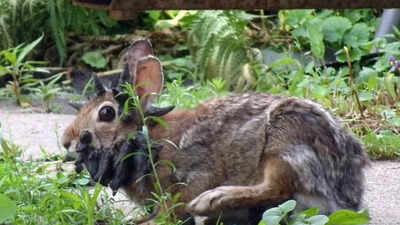
Are you one of those who have been catching a glimpse of those ‘apocalyptic’ rabbits in the yard at dusk? Wild rabbits with black, twisted, tentacle-like growths jutting from their faces and heads — looking at those bunnies… it sure does feel like a scene straight out of a horror film.But strangely, these dark, somewhat ill-formed rabbits have been turning up across the US, and quite understandably, their appearance keeps freaking out neighbors. People are calling them “Frankenstein rabbits,” “zombie bunnies,” even “demon rabbits.”Lately, sightings have already been reported in Wisconsin, Minnesota, and New York. They're really popping up in more places than ever, pushing this strange piece of wildlife folklore back into the spotlight.People first started talking about these rabbits back in August 2025, over in Colorado. Now they're back this summer, and it lines up with the way the disease behind all this actually spreads.
‘Frankenstein’ rabbits: What are they?
Scroll past the alarming photos on social media, and you’ll see rabbits with what look like black antlers or twisted spikes sprouting from their heads, ears, mouths, and eyes. In some cases, the growths look like weird little antlers; in others, they’re more like tentacles.
It’s no wonder people can’t tell if they’re seeing a brand new, scary rabbit disease or some kind of genetic experiment gone sideways.Turns out, there’s a simple (still pretty creepy, though) explanation.And it’s nothing like the plot of a sci-fi movie. These rabbits aren’t mutants or the result of a government project gone wrong.Scientists reveal that they're just eastern cottontail rabbits who’ve picked up a very real, very old disease called Shope papilloma virus (sometimes just called cottontail rabbit papillomavirus).
This virus triggers warty growths on rabbits’ skin, mostly around their faces, ears, and heads.As these tumors get bigger, they harden and can look just like horns, antlers, spikes, or tentacles, hence the creepy creature look.A run-in with a rabbit like this and you’d swear you’d just spotted a mythological monster, not a shy backyard bunny!That’s really where the social media nicknames come from. Seeing those dramatic and dark growths, people named them “Frankenstein rabbit” sticks — not because of any real scientific meaning, but because the bunnies do look stitched together and a little monstrous.
Why are the ‘Frankenstein’ rabbits showing up in so many places?
Recently, people have been spotting these rabbits in Wisconsin, Minnesota, and New York. Back in 2025, Colorado got lots of attention (and headlines) for them. The reports haven’t stopped in Nebraska and other states, either.Scientists aren’t seeing a brand new disease in regard to these appearances, or even an actual rise in infections. What’s happening is mostly about timing. The Shope papilloma virus spreads through biting insects like mosquitoes, fleas, and ticks.
Once summer hits and bug populations explode, it’s way easier for the virus to hop from one rabbit to the next.Most of these cases are spotted in summer and early fall, right when insects are everywhere, and the tumors grow big enough to notice.
The Shope papilloma virus: A disease with a long backstory
Even though seeing one of these bunnies might unsettle you, the virus isn’t some new threat. Per AP News, the Shope papilloma virus dates all the way back to the 1930s, when Dr. Richard Shope, an American virologist, first figured out what was going on.
That discovery ended up being pretty important in cancer research, as it helped scientists see how some viruses cause tumors.Some people think this disease is where the old story of the jackalope comes from: the legendary rabbit with antlers. Before anyone knew about the virus, folks who came across these infected rabbits probably thought they were looking at a totally new, horned species.
Do ‘Frankenstein rabbits’ pose any real danger?
The crazy appearance is the worst of it for the rabbits, not for people.
In the wild, many rabbits get over the infection, and the growths disappear on their own. Most of the time, these tumors don’t actually hurt the animal unless they get so big they block its mouth, eyes, or ears, or make it easy prey.Every once in a while, the growths get out of control. Some rabbits can’t eat or move well, and sometimes, the tumors turn cancerous, which can eventually kill them.Wildlife experts always emphasize the same: don’t pick up or try to “help” rabbits like this.
They can’t give the virus to people, dogs, or cats. However, officials do want people to report any weird rabbit sightings, especially if there’s a local outbreak.
Should people be worried?
Not really. Even though these rabbits are showing up in more places, it’s not a human health crisis. It’s mostly just an unsettling example of what can happen in the wild. The bunnies themselves are dealing with an old virus that comes and goes with the seasons. If anything, these rabbits are one more reminder that real life is sometimes a lot stranger than fiction!









 English (US) ·